
An urban sustainability, green building, and alternative transportation community. Paver Power. A number of bold new works of contemporary landscape architecture in Europe show the power of pavers, those small, sometimes interlocking sets of paving materials.

Creating a sense of depth and quality with simple geometric forms, these projects are subtly elegant. Here are a few offering unique textures that may draw you in: In the new city center of Nieuwegein, Netherlands (see image above and below), Dutch firm, B+B Urbanism and Landscape Architecture, turned an outmoded shopping mall into a new “vibrant heart” for this relatively new city. The theme, a “blooming city”, is represented in the bold paver patterns, says the firm in Landezine. Natural stones are used in a mixture. Another form of city center, a new town hall square in Solingen, Germany, by German firm scape Landschaftsarchitekten, is an “urban living room” for the municipal workers in the surrounding building. Detroit: An American Autopsy. Go ahead and laugh at Detroit because you are laughing at yourself.

-Charlie LeDuff, Author of Detroit: An American Autopsy As Andrew Burleson was putting the finishing touches on his post here last week about Detroit's pending bankruptcy, I was on vacation pondering a powerful book by Charlie LeDuff (twitter) that I had just finished called Detroit: An American Autopsy. For me, Detroit is both a fascinating and scary place. Fascinating because it is a glimpse into America's future and scary because the future is grim. I've long held that Detroit is not some one off place that we can discount but that it actually represents the logical outcome of the Suburban Experiment.
Architecture and Urbanism Documentary. A documentary has been making the rounds recently in urban circles featuring perhaps the most influential architect you’ve (probably) never heard of: Jan Gehl.

Aptly called The Human Scale, the documentary features numerous of Gehl Architects’ projects around the world, many of which are included in Gehl’s recent book, Cities for People. I recently had the opportunity to view said documentary and it did not disappoint (see trailer below). The Human Scale. Ecodistrict. An ecodistrict or eco-district is a neologism associating the terms "district" and "eco" as an abbreviation of ecological.

It designates an urban planning aiming to integrate objectives of "sustainable development" and reduce the ecological footprint of the project. This notion insists on the consideration of the whole environmental issues by attributing them ambitious levels of requirements. Examples[edit] EcoDistricts. LivingCityBlock. Principles of Intelligent Urbanism. Principles of Intelligent Urbanism (PIU) is a theory of urban planning composed of a set of ten axioms intended to guide the formulation of city plans and urban designs.

They are intended to reconcile and integrate diverse urban planning and management concerns. These axioms include environmental sustainability, heritage conservation, appropriate technology, infrastructure-efficiency, placemaking, "Social Access," transit oriented development, regional integration, human scale, and institutional-integrity. The term was coined by Prof. Christopher Charles Benninger. The PIU evolved from the city planning guidelines formulated by the International Congress of Modern Architecture (CIAM), the urban design approaches developed at Harvard's pioneering Urban Design Department under the leadership of Josep Lluis Sert, and the concerns enunciated by Team Ten.
Axioms[edit] Principle one: a balance with nature[edit] Principle two: a balance with tradition[edit] Principle four: conviviality[edit] Bicycling Surges Across the US, Outpacing Noisy Critics. Bike-Share Programs Across the World - Green Transportation. This article was reposted with permission from Earth Policy Institute.

Politicians, lobbyists, and tourists alike can ride bicycles along a specially marked lane between the White House and the U.S. Urban economy: what makes a city a financial hub? - McKinsey Quarterly - Economic Studies - Productivity & Performance. City Repair's VBC10: Intro to Placemaking. Project for Public Spaces - Placemaking for Communities.
City Repair. Betterblock.org. LA School of Urbanism. Next American City. Give a Minute. Project Jonathan Schultz Give a Minute homepage features a user interface modeled on Post-it notes.

Courtesy Local Projects. Newcityreader.net. Burning Man and the Metropolis. Essay: Nate Berg "Intersection," installation by James Reagant and Charles Fields, 2010.

[photo by MadeIn1953 via Flickr] It's not exactly the ideal place to build a city. No water, little vegetation, limited animal life. August temperatures climb to over 100 degrees Fahrenheit and drop close to freezing at night. But year after year in late summer, a small city rises on this ancient lakebed in the Black Rock Desert, in Pershing County in northwestern Nevada.
Summer 2010On the first night of the most recent Burning Man, Monday August 30, it is 11 p.m. before I get through the lines at the entrance gates. Center for an Urban Future. Space Makers Agency. WikiCity – How Citizens can Improve their Cities. This post is also available in: Chinese (Traditional) When governments don’t build infrastructure, citizens usually complain, but can’t do much about it.
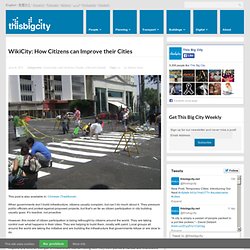
They pressure public officials and protest against proposed projects, but that’s as far as citizen participation in city building usually goes.