
How to Use Twitter for Marketing & PR. Editor's Note: Check out our latest ebook on How to Use Twitter for Business, complete with updates for 2011!
Click here to download it. Twitter is a tool for "micro-blogging" or posting very short updates, comments or thoughts. In fact, since Twitter was designed to be very compatible with mobile phones through text messages, each update is limited to 140 characters. 50 Ideas on Using Twitter for Business. We really can’t deny the fact that businesses are testing out Twitter as part of their steps into the social media landscape.

You can say it’s a stupid application, that no business gets done there, but there are too many of us (including me) that can disagree and point out business value. I’m not going to address the naysayers much with this. Instead, I’m going to offer 50 thoughts for people looking to use Twitter for business. And by “business,” I mean anything from a solo act to a huge enterprise customer. Your mileage may vary, and that’s okay. Oh, and please feel free to reblog this wherever. A Critical Path for Customer Relevance, Part 2. With all of the momentum social media has earned over the years, the reality is that still today, it is very much siloed in marketing.

The aspiration of using social technology to build a social business is not yet within grasp. In many ways, social media is much more about media than it is about opening two-way channels for interaction where information, empathy, and resolution travel inward and outward with all parties walking away with a sense of value and affinity. For what is a relationship without benefit or bond? The convergence of disruptive technology, brand, business functions, and customer experiences will force today’s social media strategies to think beyond the click. The end-game moving forward will be on completing the customer journey and fortifying experience pre, mid, and post transaction. Today, businesses are experimenting with engagement as it relates to real-time interaction. This sets a dangerous precedent, one that is already well in play. #AdaptorDie. Facebook Brand Timelines: 6 Big Changes Every Marketer Needs to Understand. Victoria Ransom is founder and CEO of Wildfire Interactive, the global leader in social media marketing software.
Victoria and Wildfire will host a free webinar on March 2 at 10 a.m. PT, entitled “Timeline for Brands: How to Make the Switch,” further outlining best practices for brands in transitioning to Facebook’s new Timeline format. Today Facebook announced to brand marketers the world over that, within the month, everything they knew about fan Pages on Facebook would be overturned. While you get your brand ready for the new Timeline format, here are six important changes to keep top-of-mind. 1.
What’s new: The format of Timeline for brands is quite similar to Timeline for personal profiles. Recommendation: Milestones present an important and dramatic opportunity to educate the public, humanize the brand and remove a perception of corporate anonymity. 2. What’s new: The new Timeline format does not have the left-side panel of links, which could include hundreds of different tabs. How to Use Twitter: 22 steps (with pictures)
Featured Article.
How to write a corporate Twitter strategy (…and here’s one I made earlier) (Cross-posted from the Cabinet Office digital engagement blog, with thanks for the guest spot.)
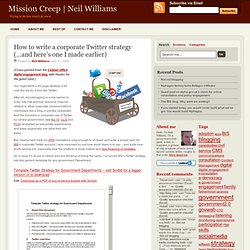
You might think a 20-page strategy a bit over the top for a tool like Twitter. After all, microblogging is a low-barrier to entry, low-risk and low-resource channel relative to other corporate communications overheads like a blog or printed newsletter. And the pioneers in corporate use of Twitter by central government (see No 10, CLG and FCO) all started as low-profile experiments and grew organically into what they are today. But, having held back my JFDI inclinations long enough to sit down and write a proper plan for BIS‘s corporate Twitter account, I was surprised by just how much there is to say – and quite how worth saying it is, especially now the platform is more mature and less forgiving of mistakes. HOW TO: Build A Twitter Strategy for Your Business. Megan Berry is Marketing Manager for Klout, the standard for online influence.
She also blogs at The Huffington Post and Brazen Careerist. You can follow her on Twitter at @meganberry. You know your business can't just wing it on Twitter, you need a strategy. But how do you get there? 9 Facebook Marketing Strategies to Build Super Fans. Facebook Strategy For Your Small Business. Do you have it backwards when it comes to Facebook?
Here’s what no one in the social media space seems to want to say: Facebook is a difficult place to reach new eyeballs organically if you do not already have good brand awareness. There I said it. If you are trying to use Facebook to reach a new audience, organically (i.e. without paying for Ads), from scratch – you are facing an uphill battle. Yes, the stats on how many Facebook users exist are mind-boggling. In reality most of those people will never actually encounter your brand on Facebook, unless you pay good money for them to. The fact is that Facebook is in the business of earning revenue – mostly through the ads they get page owners to buy. So Where Does Facebook Fit Into Your Strategy? Surveys show that people generally fan pages they are already customers of, and usually for discounts. 1.
Facebook Marketing Strategy for Business, 5 Useful Applications.