
Mitosis: Prophase and Prometaphase. As we discussed in cell cycle, before cells are allowed to enter M phase they must meet certain cellular requirements.
Among these requirements are appropriate cell size and cellular environment. Following DNA replication in S phase, cells contain twice their normal number of chromosomes. Because cells that undergo mitosis are diploid, their number of chromosomes can be represented as 2N, where N equals the number of distinct chromosomes in the cell. Cells about to enter M phase, which have passed through S phase and replicated their DNA, have 4N chromosomes. Entry into M phase is allowed by the formation of the mitotic cyclin-Cdk complex known as M phase-promoting factor that occurs as a cell cycle regulatory mechanism in the G2 phase. The first phase of mitosis within M phase is called prophase. Prophase Figure %: Prophase As we discussed, prophase is marked by very thick and dense chromosomes.
Figure %: Prometaphase. CELL DIVISION: BINARY FISSION AND MITOSIS. Meiosis = double cell division. CELL DIVISION: Meiosis... DNA Interactive: Discovering the DNA Structure and beyond. DNA Replication Song. Gene Interactions. Structure of DNA. Legend:Illustration of the double helical structure of the DNA molecule.
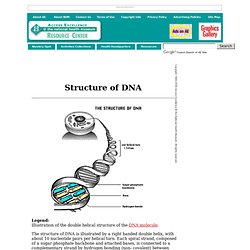
The structure of DNA is illustrated by a right handed double helix, with about 10 nucleotide pairs per helical turn. Each spiral strand, composed of a sugar phosphate backbone and attached bases, is connected to a complementary strand by hydrogen bonding (non- covalent) between paired bases, adenine (A) with thymine (T) and guanine (G) with cytosine (C). Adenine and thymine are connected by two hydrogen bonds (non-covalent) while guanine and cytosine are connected by three. This structure was first described by James Watson and Francis Crick in 1953. Graphics Gallery Index About Biotech Index. DNA Replication. The Central Dogma of Molecular Biology. Legend: Transcription of DNA to RNA to protein: This dogma forms the backbone of molecular biology and is represented by four major stages. 1.
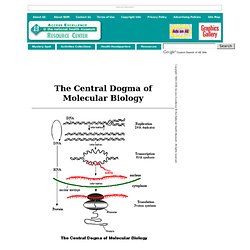
The DNA replicates its information in a process that involves many enzymes: replication. 2. The DNA codes for the production of messenger RNA (mRNA) during transcription. 3. 4. Proteins do not code for the production of protein, RNA or DNA. Graphics Gallery Index About Biotech Index. DNA makes RNA. RNA - Ribonucleic Acid. Animation and slideshow : RNAi. Article body Our knowledge of RNA interference — popularly known as RNAi — has expanded dramatically in the short time since its discovery.
Several types of small silencing RNAs have now been discovered, including small interfering RNAs (siRNAs), microRNAs (miRNAs) and PIWI-interacting RNAs (piRNAs). Small RNAs are involved in regulating gene expression in many ways, and RNAi is being harnessed by scientists for laboratory research and for the development of new therapies for disease.
This animation introduces the principles of RNAi involving siRNAs and miRNAs. We take you on an audio-visual journey through the steps of gene expression and give an up-to-date view of how RNAi can silence specific mRNAs in the cytoplasm. Extra information about RNAi is provided in an accompanying slideshow. View the FREE animation and slideshow Scientific adviser: Craig C. The animation and slideshow are freely available thanks to support from Dharmacon, part of GE Healthcare. Transcription of DNA to Messenger RNA. Legend: Process by which non-coding sequences of base pairs (introns) are subtracted from the coding sequences (exons) of a gene in order to transcribe DNA into messenger RNA (mRNA.)
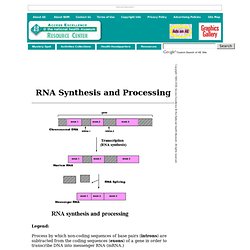
In chromosomes, DNA acts as a template for the synthesis of RNA in a process called transcription. In most mammalian cells, only 1% of the DNA sequence is copied into a functional RNA (mRNA). Only one part of the DNA is transcribed to produce nuclear RNA, and only a minor portion of the nuclear RNA survives the RNA processing steps. One of the most important stages in RNA processing isRNA splicing.
In many genes, the DNA sequence coding for proteins, or "exons", may be interrupted by stretches of non-coding DNA, called "introns". The mRNA leaves the nucleus and travels to the cytoplasm, where it encounters cellular bodies called ribosomes. Graphics Gallery Index. Protein Synthesis. Gene Control. Blazing a Genetic Trail. Cystic Fibrosis Disease Profile. Botany online: Classic Genetics - Chromosomal Numbers - Aneuploidy.
Botany online 1996-2004.
No further update, only historical document of botanical science! All organisms, tissues or cells that contain n chromosomes or a multiple of it are termed euploid in contrast to sets that have either an additional chromosome or lack one. These are called aneuploid. The most common case are trisomies (sing. trisomy) where a single additional chromosome is present. Chromosomal sets that contain either n or a multiple of it (2n, 3n,....Xn) are called euploid while those that have an additional chromosome or lack one are called aneuploid (e. g. 2n+1, 2n-1, 3n+1, 3n+2, 3n-1 etc.). In aneuploid sets, the balance of the chromosomes is disturbed so that aneuploidy can nearly always be detected by growth anomalies if it is not lethal from the outset.