
JREAMdesign's Channel - YouTube - Iceweasel. Download Python - Iceweasel. OpenPGP Public Keys Source and binary executables are signed by the release manager or binary builder using their OpenPGP key. Release files for currently supported releases are signed by the following: Release files for older releases which have now reached end-of-life may have been signed by one of the following: Anthony Baxter (key id: 0EDD C5F2 6A45 C816)Georg Brandl (key id: 0A5B 1018 3658 0288)Martin v.
Löwis (key id: 6AF0 53F0 7D9D C8D2)Ronald Oussoren (key id: C9BE 28DE E6DF 025C)Barry Warsaw (key ids: 126E B563 A74B 06BF, D986 6941 EA5B BD71, and ED9D77D5) My little python based game - YouTube - Iceweasel. Python Tutorial (1) Installing - YouTube - Iceweasel. Python Tutorial (2) Variables - YouTube - Iceweasel. Python Tutorial (3) Functions and Help - YouTube - Iceweasel. Creating Functions - YouTube - Iceweasel. Standard Template Library Programmer's Guide. Learn C++ C++ Language Tutorial. This website uses cookies.
By continuing, you give permission to deploy cookies, as detailed in our privacy policy. ok. Instructions for use. The essential tools needed to follow these tutorials are a computer and a compiler toolchain able to compile C++ code and build the programs to run on it.
C++ is a language that has evolved much over the years, and these tutorials explain many features added recently to the language. Therefore, in order to properly follow the tutorials, a recent compiler is needed. It shall support (even if only partially) the features introduced by the 2011 standard. Many compiler vendors support the new features at different degrees. See the bottom of this page for some compilers that are known to support the features needed. If for some reason, you need to use some older compiler, you can access an older version of these tutorials here (no longer updated). What is a compiler? Computers understand only one language and that language consists of sets of instructions made of ones and zeros.
C++ Language Tutorial. Vector. Vectors are sequence containers representing arrays that can change in size.
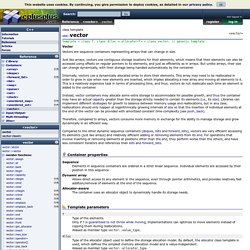
Just like arrays, vectors use contiguous storage locations for their elements, which means that their elements can also be accessed using offsets on regular pointers to its elements, and just as efficiently as in arrays. But unlike arrays, their size can change dynamically, with their storage being handled automatically by the container. Internally, vectors use a dynamically allocated array to store their elements. This array may need to be reallocated in order to grow in size when new elements are inserted, which implies allocating a new array and moving all elements to it. This is a relatively expensive task in terms of processing time, and thus, vectors do not reallocate each time an element is added to the container. Therefore, compared to arrays, vectors consume more memory in exchange for the ability to manage storage and grow dynamically in an efficient way.
Free Developer Tools - Visual Studio 2010 Express. Microsoft Visual Studio. Visual Studio 2010 Express All-in-One ISO. An Introduction to C++ The C++ programming language consists of a vocabulary of commands that humans can understand and that can be converted into machine language fairly easily and a language structure (or grammar) that allows humans to combine these C++ commands into a program that actually does something (well, maybe does something) The vocabulary is often known as the semantics, while the grammar is the syntax.

What's a program? A C++ program is a text file containing a sequence of C++ commands put together according to the laws of C++ grammar. This text file is known as the source file . A C++ source file carries the extension .CPP just as a Microsoft Word file ends in .DOC or an MS-DOS batch file ends in .BAT. Expressions and Declarations in C++ Programming. To perform a calculation in the C=++ program you need and expression.
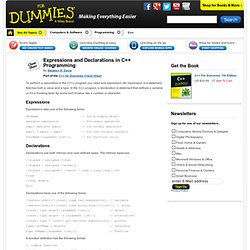
An expression is a statement that has both a value and a type. In the C++ program, a declaration is statement that defines a variable or it’s a “holding tank” for some sort of value like a number or character. Expressions Expressions take one of the following forms: objName // for a simple object operator expression // for unary operators expr1 operator expr2 // for binary operators expr1 ?
Declarations Declarations use both intrinsic and user-defined types. Working with Functions in C++ Developers often need the ability to break programs up into smaller chunks that are easier to develop.

"Real world" programs can be many of thousands (or millions!) Of lines long. Without this ability to divide the program into parts, developing such large programs would quickly become impossible. Beginning Programming with C++ For Dummies Cheat Sheet. Cheat Sheet C++ is not an easy language to master.
Only through experience will the myriad combinations of symbols start to seem natural to you. However, this Cheat Sheet can give you a few hints to help ease that transition from C++ beginner to C++ guru. How to Read a Complex C++ Expression C++ is full of little symbols, each of which adds to the meaning of expressions. C++ Tutorial 1: Intro to the C++ Language.
C++ Tutorial 2: Variables in a program. C++ Tutorial 3: Operators Pt. 1. C++ Tutorial 3: Operators pt. 2. C++ Tutorial 4 pt. 1: Decision Making with if statements. C++ Tutorial 4 pt. 2: Decision Making with if statements. C++ Tutorial 4 pt. 3: While statements and looping. C++ Tutorial 5: Intro to For Looping. Dining philosophers problem. It was originally formulated in 1965 by Edsger Dijkstra as a student exam exercise, presented in terms of computers competing for access to tape drive peripherals.
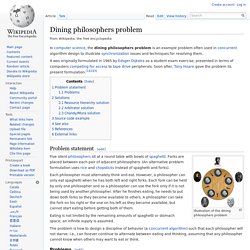
Soon after, Tony Hoare gave the problem its present formulation.[1][2][3] Problem statement[edit] Illustration of the dining philosophers problem Five silent philosophers sit at a round table with bowls of spaghetti. Forks are placed between each pair of adjacent philosophers. Each philosopher must alternately think and eat. Eating is not limited by the remaining amounts of spaghetti or stomach space; an infinite supply is assumed.
Problems[edit] The problem was designed to illustrate the challenges of avoiding deadlock, a system state in which no progress is possible. This attempted solution fails because it allows the system to reach a deadlock state, in which no progress is possible. Solutions[edit] Resource hierarchy solution[edit] This solution to the problem is the one originally proposed by Dijkstra. In 1984, K. The ABCs of Writing C++ Classes. Tips and Tricks for Using C++ I/O (input/output) Getting Started with Visual Studio. Tier One: Visual C++ 2008 Express Edition. Tier Two: Windows Development. Tier Three: Windows Development. Developer Learning Resources - MSDN.
Walkthrough: Working with Projects and Solutions (C++) Here's how to create a C++ project in Visual Studio, add code, and then build and run the project.

The project in this walkthrough is a program that tracks how many players are playing different card games. In Visual Studio, work is organized in projects and solutions. A solution can contain more than one project—for example, a DLL and an executable that references that DLL. For more information, see Solution and Project Basics. To complete this walkthrough, you must understand the fundamentals of the C++ language. To create a project, first choose a project-type template.
To create a project On the menu bar, choose File, New, Project. You can use Solution Explorer to organize and manage the projects, files, and other resources in your solution. This part of the walkthrough shows how add a class to the project. Visual C++ Guided Tour. In this guided tour you will learn about the Visual Studio development environment and about the various types of applications that you can create with Visual C++.

This includes command-line application, Windows applications, and even a simple game. This guided tour will also teach you how to create reusable libraries of code, and how to ship your code to customers after you have written and tested it. Because each topic builds on information in the topics before it, we recommend that you complete the guided tour in order. At the bottom of each topic, you will find navigation links to the next topic in the guided tour, and a link to the previous topic if you want to go back and review something. The guided tour assumes that you understand the fundamentals of the C++ language. Describes how to use the Visual Studio IDE to create solutions and projects, to write code efficiently, and to build, debug, test, and deploy applications.
Visual C++ Walkthroughs. Ruby on Rails 3 Essential Training – Free Video Training Tutorials, Free Lynda.com Inc. Online Tutorial - Iceweasel. In Ruby on Rails 3 Essential Training, instructor Kevin Skoglund shows how to create full-featured, object-oriented web applications with the latest version of the popular, open-source Ruby on Rails framework. This course explains the complete process—from the fundamental concepts and best practices behind the Rails framework, to how to build a complete application with dynamic, database-driven content. Using a content management system as an example project, this tutorial explains how to structure databases, build database-driven, object-oriented models, route incoming requests, render pages with dynamic content, and to process and validate form data.
Previous experience with Ruby is recommended, but not required. Topics include:Using the exercise filesWhat is Ruby on Rails? Why use Ruby on Rails? After taking advantage of the free video training, you can access all of Lynda.com's video tutorials by becoming a member of the Online Training Library®. Offered Free by: Lynda.com Inc.