
30 Famous Mythical Humanoid Creatures. Some mythical creatures, have their origin in tradition and some might be living in distant past.
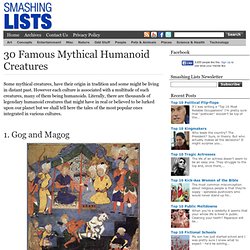
However each culture is associated with a multitude of such creatures, many of them being humanoids. Literally, there are thousands of legendary humanoid creatures that might have in real or believed to be lurked upon our planet but we shall tell here the tales of the most popular ones integrated in various cultures. 1. Gog and Magog Source Gog Magog appear in the Qur’an, Book of Genesis, the Book of Ezekiel and the Book of Revelation. 2. Source Satyrs were originally seen as companions of the goat god Pan in ancient Greek civilisation . 3. Source Abarimon is the name of a legendary race with backwards feet, but in spite of this handicap were able to run at great speed. 4. Source Nephilim are beings, who appear in the Hebrew Bible; specifically mentioned in the Book of Genesis and the Book of Numbers; they are also mentioned in other Biblical texts and in some non-canonical Jewish writings.
Cynocephaly. The characteristic of cynocephaly, having the head of a dog—or of a jackal—is a widely attested mythical phenomenon existing in many different forms and contexts.
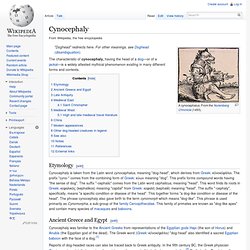
Etymology[edit] Ancient Greece and Egypt[edit] As George Alexandrou has pointed out, "in this northeast region of Pakistan, and we know that there were peoples in this area who slashed their cheeks from mouth to ear, so that all the teeth showed. Marco Polo saw this tribe, whom he called the Cynocefaloi. He said that they looked like mastiffs; that is, they didn’t have elongated heads like German shepherds with the long nose, but like mastiffs. Late Antiquity[edit] Medieval East[edit] Cynocephali also figure in medieval Christian world-views. Saint Christopher[edit] Cynocephalus St. In the Eastern Orthodox Church, certain icons covertly identify Saint Christopher with the head of a dog. The German bishop and poet Walter of Speyer portrayed St. Tikbalang. Tikbalang (also written as Tigbalang, Tigbalan, or Tikbalan) is a creature of Philippine folklore said to lurk in the mountains and forests of the Philippines.

It is generally described as a tall, bony humanoid creature with disproportionately long limbs, to the point that its knees reach above its head when it squats down.[1] It has the head and feet of an animal, most commonly a horse. It is sometimes believed to be a transformation of an aborted fetus which has been sent to earth from limbo.[2] Superstitions[edit] Tikbalangs are said to scare travelers and lead them astray.
Tikbalangs play tricks on travelers such that they keep on returning to an arbitrary path no matter how far he goes or where he turns. A superstition popular with the Tagalog of Rizal Province is that Tikbalangs are benevolent guardians of elemental kingdoms. A common saying has it that rain from a clear sky means "may kinakasal na tikbalang. " Taming a tikbalang[edit] SPARTI : Sown-Men of Thebes. THE SPARTOI (or Sparti) were a race of warlike, earth-born warriors, which sprang fully grown, armed and ready for battle from the sown teeth of a Drakon sacred to the war-god Ares.

Two batches of Spartoi were sown. The first were those of Thebes, sown by the hero Kadmos from the teeth of the sacred Drakon of the spring of Ismene. He cast a stone among them as they were emerging from the earth and they fell to fighting. Only five survived the battle, who joined Kadmos in the founding of the city of Thebes. The second batch was sown by Iason (or Jason) in the fields of Kolkhis on the Black Sea. Pseudo-Apollodorus, Bibliotheca 3. 22 ff (trans. Plato, Laws 663e (trans. Plato, Laws 641c : "The victories which men win in war often have been, and will be, ‘Kadmeian’.” Plato, Sophist 247c : "The aboriginal sons of the dragon's teeth (ge autôn spartoi te kai autochthones auton) among them . . . would maintain that nothing which they cannot squeeze with their hands has any existence at all.
"