
17 Things I've Learned in 17 Years of Lucid Dreaming. I've been lucid dreaming for almost 17 years now.

That sounds like a long time. And yet, I've still got a lot to learn. To the newcomer to lucid dreaming - who has the whole exciting journey ahead of them - I want to share some of the most profound, useful and surprising lessons from my experience. I hope this sees you well on your dream travels. 1. 2. "Whatever I have accepted until now as most true has come to me through my senses. . ~ Rene Descartes 3. 4. 5. 6. 7. How to Have a Wake Induced Lucid Dream (WILD): 6 Steps. Edited by WierdSolution, Flickety, Krystle, J3d1mast3r and 15 others A wake induced lucid dream, aka WILD, is when you are pulled into a dream while being fully conscious and aware you are there. This allows the you to explore limitless possibilities and live out fantasies you have only imagined!
Ad. Scientists Induce Lucid Dreams With Electrical Stimulation. Researchers discover how to induce lucid dreaming by stimulating the lower gamma band during REM sleep.

Are actually effective commercial lucid dream-inducing devices far behind? Lucid dreaming has long been a fascination of mankind: The ability to become lucid during a dream and gain control of the dream itself has been coveted, examined and practiced for centuries, resulting in many methods and exercises that can cultivate lucid dreams. The opportunity to consciously explore the dream-space can provide insights into the mysteries of the unconscious mind; lucid dreaming can also be used therapeutically to address traumatic memories or chronic nightmares. This year, however, researchers made a massive step forward in understanding the physiology of lucid dreams: A team of scientists led by psychologist Ursula Voss of the Goethe University in Frankfort, Germany successfully induced lucid dreams in test subjects by stimulating specific brain regions with an electrical current.
(Image via.) How to Lucid Dream with Robert Waggoner, author of Lucid Dreaming: Gateway to the Inner Self. ▶ Lucid Dreaming - Robert Waggoner 3/5. Lucid Dreaming - Robert Waggoner 1/5. Lucid Dreaming - Robert Waggoner 2/5. Truly mastering lucid dreaming - Blog. The last few days I have been focussing on recalibrating my sleep schedule: prioritizing healthy sleep.
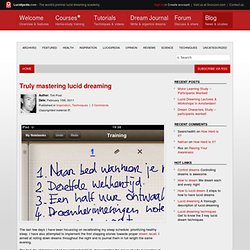
I have also attempted to implement the first stepping stones towards proper dream recall. I aimed at noting down dreams throughout the night and to journal them in full length the same evening. The first day of training, I had an unintended WILD, demonstrating the power of auto-suggestion of even starting (and thinking about) inducing lucid dreams. I should not celebrate too early though. In my terms, true lucid dream skill is reliable and consistent, across multiple weeks or months. A truly skilled lucid dreamer is able to have lucid dreams on command. I have now set my eyes on reclaiming that same skill level, but this time in context of an everyday life, including work, meeting friends and family. Something that I still need to perfect in the upcoming days before progressing to new exercises, is the principle of noting down dreams throughout the night. Okay, now adding a new one:
How to Control Your Dreams Infographic. Twelve Tips for Improving Dream Recall. Bouchard, Rick (1996).Twelve Tips for Improving Dream Recall & A Few Words About Journaling.

Electric Dreams 3(1). www.dreamgate.com/dream/ed-articles/ed3-1bo1.htm (Jan. 1996) Advanced Lucid Dreaming Techniques. This article is useful for the experienced dreamer who wishes to refine and deepen their lucid adventures. If you’ve never practiced being consciously aware within your dreams, check out the beginner lucid dreaming article. To make the following techniques effective I suggest you maximize your dream recall ability. Two weeks worth of daily dream entries in your journal would be advantageous. In-Dream Objectives Gather ‘Chi’ Energy. Lucid Dreaming Techniques. Lucid Dream Guru - Master the Art of Lucid Dreaming.
The lucid dreamers community. Guide on lucid dreams, dream control, conscious dreaming. Tenzin-Wangyal-Rinpoche-The-Tibetan-Yogas-Of-Dream-And-Sleep. Lucid dreaming academy. Wake Initiated Lucid Dreams. Tutorial for Saying a Mantra. Hi i'm LucidAvenger Many people have heard the word 'mantra' floating around DV but not many people actually know what it is and how to do one.

In this tutorial I will explain what a mantra is; the requirements for a mantra; creating your own mantra, examples of mantras, when and how to say a mantra. The tutorial is fairly long for just a mantra and if you do not have time to read the whole thing then I reckon you just need to read: when and how to say a mantra and requirements for a mantra :) What is a Mantra? A mantra is basically an affirmation in which you try to hammer a phrase into your head. The phrase is usually something that convinces your mind of something. Dream RecallDEILD MethodLucid Dreaming Through MILDWaking Up During the NightDream TasksDream Incubation The mantra is used to get a thought or an idea into the subconscious, which later 'remembers' or is 'affirmed' about the task. Top 10 tips on how to lucid dream « How To Lucid Dream.
Digg For those of you who like to get straight to the good stuff, I’ve compiled a list of the top 10 tools that you can use to learn how to lucid dream.

These are so good that you probably won’t need to use any more than two or three before you start having some degree of lucidity. 1. Take naps. Napping during the day not only means you’ll be less tired (increasing likelihood of lucid dreams), but it gives you an extra chance to practice. 2. If you stumble through your waking life in a haze, make it a habit to take more notice of the external world. 3. Music has the ability to trigger just about any emotion you can think of. 4.
Unless you snore heavily, a voice-activated tape recorder put on your bedside table will be able to record any sounds you make during the night. 5. Consuming foods with strong flavors or spices has an interesting effect on the body, just as taking some drugs or medications can do. “The Dream” – Pablo Picasso (1932) 6. 8. Wake yourself up during the night. Subliminal Lucid Dreaming Video. Copyright © Pete Casale Our subliminal lucid dreaming video aims to program your subconscious mind to do a number of things: Remember your dreams Increase the intensity of your dreams Increase your self awareness in dreams Trigger lucid dreams more often The videos are in two parts below.

Yoshi's WILD Technique... WILD Session One: Mental Prep Part A. Adraw's generic WILD - Dreamviews lucid dreaming forums. Lucid Dreaming Tips - How to Lucid Dream - Tips for Lucid Dreaming / Lucid Dreams. The Six Basic Steps There are many techniques and methods that you can use for inducing lucid dreams, but there is an underlying process behind most, if not all of them.
I have broken this underlying process down into six basic steps to serve as a foundation for your lucid dream training. Once you absorb these steps and start following them, it is only a matter of time before you have your first lucid dream. In case you are wondering how long it will take for you to have your first one, just follow through with the steps and have faith that you will have one. Statistically, the time it takes for someone to have their first lucid dream averages from three weeks to two months, but yours may be tonight, but don't be discouraged if you try for a while and don't succeed. 1) Doing the Mental Prep-Work. Hypnagogia Main Page. Sometimes the word hypnagogia is used in a restricted sense to refer to the onset of sleep, and contrasted with hypnopompia, Fredierick Myers’ term for waking up.

However, hypnagogia is also regularly employed in a more general sense that covers both falling asleep and waking up. Other terms for hypnagogia, in one or both senses, that have been proposed include presomnal or anthypnic sensations, visions of half-sleep, oneirogogic images and phantasmata, the borderland of sleep, ‘half-dream state, pre-dream condition, sleep onset dreams, and wakefulness-sleep transition’ state (WST). Transition to and from sleep may be attended by a wide variety of sensory experiences. These can occur in any modality, individually or combined, and range from the vague and barely perceptible to vivid hallucinations.