
Semen Proven to Increase Life Expectancy. Anti-Ageing miracle properties WASHINGTON DC – USA – Women who make regular contact with semen live longer and age less than women who do not, scientists have discovered. The finding that women who ingest semen and do not use condoms during vaginal sex, live longer and have reduced signs of ageing, has led one researcher to conclude that semen is a miracle potion that should be treasured by every woman. Male sperm contains vital chemicals that slow down the ageing process and increases life expectancy by up to 35%. Study author Clifford J. Ponsonby, Ph.D, a psychologist at the State University of Washington in Saint Louis, also found that women who routinely had intercourse without condoms or had facials had better skin quality and wrinkled less plus also had the ability to ingest fatty foods without putting on weight.
“These women have a remarkable ability to achieve serious longevity without showing any signs of ageing, this is the key to life,” says Ponsonby. Pharyngeal raphe. Urinary bladder. The urinary bladder is the organ that collects urine excreted by the kidneys before disposal by urination.

A hollow[1] muscular, and distensible (or elastic) organ, the bladder sits on the pelvic floor. Urine enters the bladder via the ureters and exits via the urethra. It's almost impossible to give an exact measurement for the volume of the human bladder, but different sources mention 500 mL (~17 oz) to 1000 mL (~34 oz).[2] Structure[edit] Detrusor muscle[edit] User:LadyofHats. Cancel Edit Delete Preview revert Text of the note (may include Wiki markup) Could not save your note (edit conflict or other problem).

Please copy the text in the edit box below and insert it manually by editing this page. Upon submitting the note will be published multi-licensed under the terms of the CC-BY-SA-3.0 license and of the GFDL, versions 1.2, 1.3, or any later version. See our terms of use for more details. Add a note Draw a rectangle onto the image above (press the left mouse button, then drag and release). Save To modify annotations, your browser needs to have the XMLHttpRequest object. [[MediaWiki talk:Gadget-ImageAnnotator.js|Adding image note]]$1 [[MediaWiki talk:Gadget-ImageAnnotator.js|Changing image note]]$1 [[MediaWiki talk:Gadget-ImageAnnotator.js|Removing image note]]$1. Anatomical terms of location. Standard anatomical terms of location deal unambiguously with the anatomy of animals, including humans.

Furthermore, the terms are not language-specific, so that with little, or ideally no, translation, they can be understood by all zoologists. While these terms are standardized within specific fields of biology, there are unavoidable, sometimes dramatic, differences between some disciplines. Cunnilingus. A woman performing cunnilingus on another woman.

Cunnilingus is an oral sex act performed by a person on the vulva or vagina of a female.[1][2] The clitoris is the most sexually sensitive part of the human female genitalia, and its stimulation may result in female sexual arousal or orgasm.[3][4][5][6] The analogue of oral sex performed on a female is fellatio, which is performed on a male. Cunnilingus can be sexually arousing for males and females, and may be performed between opposite-sex or same-same sex couples as foreplay to incite sexual arousal before other sexual activities (such as vaginal or anal intercourse),[1][7] or as an erotic and physically intimate act in its own right.[1][2] Like most forms of sexual activity, oral sex can be a risk for contracting sexually transmitted infections (STIs/STDs). However, the transmission risk for oral sex, especially HIV transmission, is significantly lower than for vaginal or anal sex.[8][9][10] Etymology and terminology Practice Positions.
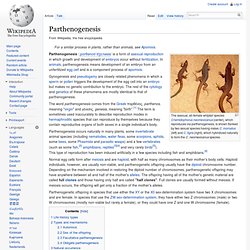
Stem cells diagram.png - Wikipedia, the free encyclopedia. Parthenogenesis. The asexual, all-female whiptail species Cnemidophorus neomexicanus (center), which reproduces via parthenogenesis, is shown flanked by two sexual species having males C. inornatus (left) and C. tigris (right), which hybridized naturally to form the C. neomexicanus species.
Parthenogenesis /ˌpɑrθənoʊˈdʒɛnəsɨs/ is a form of asexual reproduction in which growth and development of embryos occur without fertilization. In animals, parthenogenesis means development of an embryo from an unfertilized egg cell and is a component process of apomixis. Gynogenesis and pseudogamy are closely related phenomena in which a sperm or pollen triggers the development of the egg cell into an embryo but makes no genetic contribution to the embryo. The rest of the cytology and genetics of these phenomena are mostly identical to that of parthenogenesis. Normal egg cells form after meiosis and are haploid, with half as many chromosomes as their mother's body cells. Life history types[edit] Automixis[edit] ZW sex-determination system. The ZW sex-determination system is a system that determines the sex of offspring in birds, some fish and crustaceans such as the giant river prawn, some insects (including butterflies and moths), and some reptiles, including komodo dragons.
