
FROONT – design responsive websites in the browser. Blueprint: Responsive Multi-Column Form. A responsive multi-column form with example media queries for a flexible layout.

View demo Download source. Responsive Layouts for Email. Why use Antwort?

Bulletproof layouts: made with dynamic content in mind. Originally made for transactional Emails with dynamic content so the layouts are thoroughly tested - in live environments with real data and edge cases. Responsive Emails don't have to be boring A single column layout might work well on mobile but often prevents an underwhelming experience for desktop users. Why not satisfy both? Works across all devices, including Outlook Other solutions use floats, which many clients including Outlook don't understand. Supports all major Email clients According to December 2012 statistics on emailclientmarketshare.com, Outlook is still the second most popular email client with 16% market share, more than Gmail and Android combined.
Unless your own email analytics shows different trends, you should consider Outlook support a high priority. Sequence.js and Sequence Themes. ResponsiveSlides.js · Responsive jQuery Slider & Slideshow. Responsive Media, Responsive Images in HTML5. Hey there… This post is 878 days old.

It was written on 19.11.2011. Please make sure to be careful with the information provided and check a more recent source on this topic. There is a big discussion going on at the moment covering the actual point of how to deal with images and media et al. on mobile-phones and other devices as there are some things that don’t work as on a desktop computer: BandwidthScreen sizePerformance / Velocity. Responsive images — Unstoppable Robot Ninja. Since striking out on my own, much of my time’s been dedicated to, well, the book.

But I’ve also been fortunate enough to collaborate a bit with Filament Group on one of their projects: namely, a large-scale engagement that requires a responsive approach. Needless to say, I am having the time of my life. We’re also learning a lot, too. A lot of discussions about approach and execution have come up, largely because processes for a lot of this stuff don’t exist yet. That will, with a bit of hard work and community discussion, change over time.
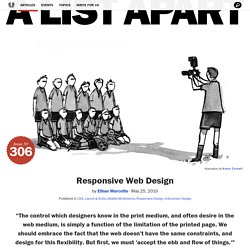
Here’s just one example: The goal of this technique is to deliver optimized, contextual image sizes for responsive layouts that utilize dramatically different image sizes at different resolutions. Check out the script, download it, and kick the tires a bit—feedback and tweaks are most welcome. Foundation: Rapid Prototyping and Building Framework from ZURB. Adaptive Images in HTML. Responsive Web Design Techniques, Tools and Design Strategies - Smashing Magazine. 11 Reasons why responsive web design isn't that cool! Responsive Web Design. The English architect Christopher Wren once quipped that his chosen field “aims for Eternity,” and there’s something appealing about that formula: Unlike the web, which often feels like aiming for next week, architecture is a discipline very much defined by its permanence.
Article Continues Below A building’s foundation defines its footprint, which defines its frame, which shapes the facade. Each phase of the architectural process is more immutable, more unchanging than the last. Creative decisions quite literally shape a physical space, defining the way in which people move through its confines for decades or even centuries. Working on the web, however, is a wholly different matter. But the landscape is shifting, perhaps more quickly than we might like. In recent years, I’ve been meeting with more companies that request “an iPhone website” as part of their project. 960 Grid System. Amazium - The responsive web framework..! Skeleton: Beautiful Boilerplate for Responsive, Mobile-Friendly Development.
960 Gridder - Lay out websites with ease. What is this?
960 Gridder is an excellent tool for any web developer/ designer that wants to easily align, match and/or lay out websites. The idea came when designing a website for a student organization where I worked with several designers that handed their lay outs and designs in Photoshop format with a similar grid built-in to me. After a while I noticed how hard it became to make sure everything looked exactly how they intended it, especially in the different browsers. 960 Gridder is cross-browser compliant and works well in Internet Explorer 6/7/8, Firefox 2/3 and Chrome.
Safari 4 Beta and Opera 9 is also working as expected and it should work in Safari 2.x-3.x also. According to browsershots, all A-grade browsers now display the grid perfectly (version 1.3.1). How does it work? 960 Gridder is built upon the very famous JavaScript framework jQuery. 960 Gridder will automatically identify if jQuery is present at the website and if it is not, it will include it. Where do I use it? Note! Media Queries. Responsive Web Design: What It Is and How To Use It - Smashing Coding. Advertisement Almost every new client these days wants a mobile version of their website.

It’s practically essential after all: one design for the BlackBerry, another for the iPhone, the iPad, netbook, Kindle — and all screen resolutions must be compatible, too. In the next five years, we’ll likely need to design for a number of additional inventions. When will the madness stop? It won’t, of course. In the field of Web design and development, we’re quickly getting to the point of being unable to keep up with the endless new resolutions and devices.