
Documentary - Amazing Marriage Customs - China Anthropology 101 - English narration w Chinese subs. Phaser Examples. A video on naming conventions. (Go to the complete list of videos) To download this 27 MB video, right-click on download and select "save link as" or "save target as".

While long names will never yield self-documenting code, correctly naming things is hugely important. Watch this 9 minute video to learn why using names like read_timer_1 is poor programming practice. Please enable JavaScript to view the <a href=" powered by Disqus. </a> Hi, I'm Jack Ganssle and welcome to the embedded news and video blog, which is a companion to my free online embedded news e-newsletter. Experiment: Human Human Interface. Making the Connection: The Human-Human Interface is now available in a pre-bundled package!

It comes with everything you need, including an arduino board already programmed with the HHI code! For the fastest way to begin imparting your will upon others, check it out in our store! If you're a budding neuro-prosthetic designer, and you're still interested in building and gathering the devices yourself, check out our DIY page for further instructions! XXL Drogerie Concealer Vergleich. Small Business Fundraising. Student Success at Purdue - Future Naval Officers of Purdue. Catch-22 (logic) A catch-22 is a paradoxical situation from which an individual cannot escape because of contradictory rules.[1][2] Catch-22s often result from rules, regulations, or procedures that an individual is subject to but has no control over.
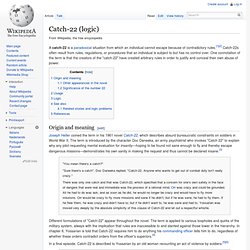
One connotation of the term is that the creators of the "catch-22" have created arbitrary rules in order to justify and conceal their own abuse of power. Joseph Heller coined the term in his 1961 novel Catch-22, which describes absurd bureaucratic constraints on soldiers in World War II. The term is introduced by the character Doc Daneeka, an army psychiatrist who invokes "Catch 22" to explain why any pilot requesting mental evaluation for insanity—hoping to be found not sane enough to fly and thereby escape dangerous missions—demonstrates his own sanity in making the request and thus cannot be declared insane.[3] Cascading. Cascade, Cascades, or Cascading may refer to: Science and technology[edit] Natural sciences[edit]

Travel. Gustav Klimt. Fakultätsbilder (Universität Wien) Die Hygieia (griechisch „Gesundheit“) aus dem Fakultätsbild Medizin von Klimt in einer Reproduktion des Originals (Ausschnitt) Mit ihrer Anfertigung wurden im Jahre 1894 die Künstler Gustav Klimt und Franz Matsch beauftragt.

Klimt sollte dabei die Bilder für die Philosophie, Medizin und Jurisprudenz übernehmen, Matsch sollte das Bild für die Theologie anfertigen. Bereits bei der ersten Ausstellung des Bildes „Philosophie“ bei der siebten Kunstausstellung der Wiener Secession im Jahr 1900 kam es zu massiver öffentlicher Kritik, vor allem seitens der Professoren der Universität. Klimts Darstellungsweise entsprach überhaupt nicht den Vorgaben der Auftraggeber und auch nicht seinen vorab eingereichten Entwurfsskizzen, sondern zeigte eine zutiefst pessimistische und kritische Perspektive der Wissenschaft. Mercedes-benz-left-brain-right-brain-paint1.jpg (JPEG Image, 1600 × 1131 pixels) - Scaled (75%) Edward_Hopper-Nighthawks-1942.jpg (2362×1292) Bosch, Hieronymus: The Temptation of St Anthony. C. 1500; Oil on panel, tryptych describing the ordeals of St Anthony; Museu Nacional de Arte Antiga, Lisbon Bosch's spiritual heroes were the saints who endured both physical and mental torment, yet remained steadfast.

Among the saints, Bosch's favorite was Saint Anthony, the subject of his triptych The Temptation of Saint Anthony (c.1500; Museo National de Arte Antiga, Lisbon), which features physical punishment on the left wing, a Black Mass in the center, and the blandishments of food and sex on the right wing. St. Anthony's triumph over such trials is mirrored by those of other hermit saints and by the Passion of Christ, whose arrest and carrying of the cross adorn the exterior of the Lisbon altarpiece.
Bosch was preoccupied with themes of torment and the sinfulness of man, which replaced earlier, more optimistic visions of Christ and the Virgin with feelings of anxiety, fear, and guilt. Mudflat hiking in Encyclopedia. Facts Of Belgium - Awesome Facts about Belgium. 9 English Words With Funny Translations In Other Languages [VIDEO] Exploits of a Mom. Just For Laughs Festival: Todd Barry - Bluetooth Hearing Aid. The Century Of The Self 1 of 4. CS 229: Machine Learning Final Projects, Autumn 2012.
Surrealism. Wordplay. Profresher’s stream. ODESZA - My Friends Never Die by ODESZA. The Ethics of Globalization. Moral Relativism. First published Thu Feb 19, 2004; substantive revision Tue Dec 9, 2008 Moral relativism has the unusual distinction—both within philosophy and outside it—of being attributed to others, almost always as a criticism, far more often than it is explicitly professed by anyone.

Nonetheless, moral relativism is a standard topic in metaethics, and there are contemporary philosophers who defend forms of it: The most prominent are Gilbert Harman and David B. Wong. The term ‘moral relativism’ is understood in a variety of ways. Most often it is associated with an empirical thesis that there are deep and widespread moral disagreements and a metaethical thesis that the truth or justification of moral judgments is not absolute, but relative to some group of persons. 1. Though moral relativism did not become a prominent topic in philosophy or elsewhere until the twentieth century, it has ancient origins. 2. In general, the term ‘relativism’ refers to many different ideas. 3. Cafes Arkaden, Josephinum and Reichsrat. These two photos are of the building in Vienna in which the Cafe Arkaden was located.

It's across the street from the Votivkirche. Today, this space is occupied by the Votiv Cafe. The Arkaden was patronized by members of the Vienna Circle.