
New ‘Chemical Surgery’ Technique Repairs Mutations in Human Embryos. FAA completes landmark rules for commercial drones. Play Video Play Fullscreen 5 things to know about the new FAA drone rules This is a modal window.
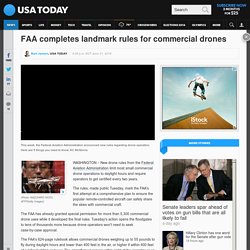
Error Code: PLAYER_ERR_NO_SRC This week, the Federal Aviation Administration announced new rules regarding drone operation. WASHINGTON – New drone rules from the Federal Aviation Administration limit most small commercial drone operations to daylight hours and require operators to get certified every two years. The rules, made public Tuesday, mark the FAA's first attempt at a comprehensive plan to ensure the popular remote-controlled aircraft can safely share the skies with commercial craft.
The FAA has already granted special permission for more than 5,300 commercial drone uses while it developed the final rules. The FAA's 624-page rulebook allows commercial drones weighing up to 55 pounds to fly during daylight hours and lower than 400 feet in the air, or higher if within 400 feet of a taller building or tower. Artificially Intelligent Lawyer “Ross” Has Been Hired By Its First Official Law Firm. In Brief Ross, the world's first artificially intelligent attorney, has its first official law firm.
Baker & Hostetler announced that they will be employing Ross for its bankruptcy practice, currently comprised of almost 50 lawyers. Ross: A Very Smart Artificial Co-worker Law firm Baker & Hostetler has announced that they are employing IBM’s AI Ross to handle their bankruptcy practice, which at the moment consists of nearly 50 lawyers. Microsoft has created Star Wars-style holographic communication. Scientists Build Synthetic Bacteria With Just 473 Genes. What is the minimum requirement for life to exist?
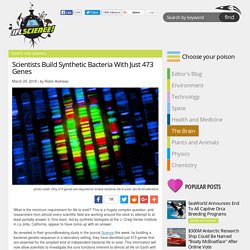
This is a hugely complex question, and researchers from almost every scientific field are working around the clock to attempt to at least partially answer it. One team, led by synthetic biologists at the J. Craig Venter Institute in La Jolla, California, appear to have come up with an answer. As revealed in their groundbreaking study in the journal Science this week, by building a bacterial genetic sequence in a laboratory setting, they have identified just 473 genes that are essential for the simplest kind of independent bacterial life to exist.
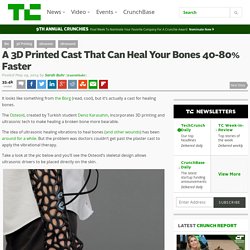
This information will now allow scientists to investigate the core functions inherent to almost all life on Earth with unprecedented insight. NowThis - Goodyear unveils plan for futuristic 'sphere' tires. Everything You Know About Artificial Intelligence is Wrong. 2045 Initiative. Dronebox nest concept carries impact on drone use efficiency. A 3D Printed Cast That Can Heal Your Bones 40-80% Faster. It looks like something from the Borg (read, cool), but it’s actually a cast for healing bones.
Company Plans To Resurrect Humans With Artificial Intelligence By 2045. A company has announced its intention to resurrect the dead by storing their memories and using artificial intelligence to return them to life.
In the future, of course. Yeaaaaaah. New Li-Fi Internet Is 100 Times Faster Than Wi-Fi. The inventor of the electric lightbulb could hardly have imagined that one day his creation would be used not only to illuminate homes around the world, but also to transmit data that would enable people to download information from satellites in space to small hand-held devices.
However, with the introduction of Li-Fi, household lighting could soon double as a form of data transmission that’s up to 100 times faster than Wi-Fi. Li-Fi, which was first invented by Harold Haas of the University of Edinburgh in 2011, uses visible light communication (VLC) to send data at extremely high speeds. Essentially, this works like an incredibly fast signal lamp, flashing on and off in order to relay messages in binary code (1s and 0s). In previous lab-based experiments, the technology was able to transmit up to 224 gigabits per second. To put this in perspective, Wi-Fi is capable of reaching speeds of around 600 megabits per second. The world's most advanced Prosthetic Hand - bebionic. The world’s first robotic kitchen prepares crab bisque for Ars Technica. 3D-printed bionic ants team up to get the job done - tech - 26 March 2015. Video: Big bionic ants team up to move objects They're big, bionic copycats.
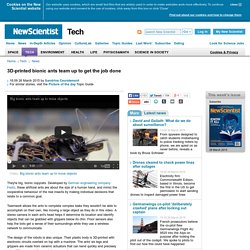
Developed by German engineering company Festo, these artificial ants are about the size of a human hand, and mimic the cooperative behaviour of the real insects by making individual decisions that relate to a common goal. Teamwork allows the ants to complete complex tasks they wouldn't be able to accomplish on their own, like moving a large object as they do in this video.
A stereo camera in each ant's head helps it determine its location and identify objects that can be grabbed with grippers below its chin. Backpack Turns a Beetle Into a Remote-Controlled Cyborg. In the video above, watch closely for the flying insect.
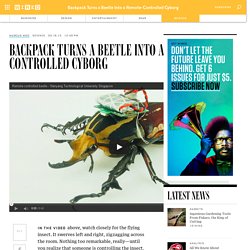
It swerves left and right, zigzagging across the room. Nothing too remarkable, really—until you realize that someone is controlling the insect. With a remote control. Airbus UFO Patent. Airbus/EspacenetPassengers would sit in a 360 degree cabin.
The image at right is not a UFO or a prop design idea from the new Star Wars movie — it's a patent for a new commercial aircraft. The patent application from France-based Airbus SAS, an aircraft manufacturing division of the Airbus Group, was published last month, according to The Financial Times. It shows an elaborate design with a circular passenger cabin, tucked behind the plane's nose and between its wings. Paralyzed Man Walks After Cells for Smelling Placed in Spine. A man paralyzed from the chest down in a knife attack is walking again after undergoing surgery using cells responsible for the sense of smell, marking an advance in the search for treatments for spinal injuries.
Darek Fidyka, 38, received the cells after failing to recover from a stabbing in the back in 2010, according to University College London, whose doctors developed the procedure. The technique involves using olfactory ensheathing cells and placing them in the spinal cord. The study gives hope to the thousands of people each year who suffer a severe spinal cord injury and must live the rest of their lives with permanently damaged body functions.
Harvard RoboBees Closer to Pollinating Crops. This is the amazing design for NASA’s Star Trek-style space ship, the IXS Enterprise. “Warp speed, Mr. Sulu” (courtesy of Mark Rademaker/Flickr) NASA engineer and physicist Harold White announced a few years ago that he was working on a potentially groundbreaking idea that could allow space travel faster than the speed of light. Could Solar Panels Replace Concrete Or Asphalt Roads? INFOGRAPHIC: Why asteroid mining is necessary. To keep hackers away from implanted devices, researchers use the heartbeat as a password. Just like a phone or computer, devices implanted inside the body can be hacked; potentially with life-threatening consequences. The Skin Gun. Scientists grow blood vessels › News in Science (ABC Science) News in Science Thursday, 3 February 2011 AFP.
DNA Stores MLK's Speech, Shakespeare's Sonnets. Next, they sent the genetic instruction to the biological lab Agilent Technologies in California. First Bionic Eye Sees Light of Day in U.S. After years of research, the first bionic eye has seen the light of day in the United States, giving hope to the blind around the world.
Developed by Second Sight Medical Products, the Argus II Retinal Prosthesis System has helped more than 60 people recover partial sight, with some experiencing better results than others. Transcending the Human, DIY Style. Mozilla Seabird Phone Concept. Tooth Regeneration Gel Could Replace Painful Fillings. Scientists Have Created Crystals That Are Almost Alive. Scientists Have Created a Microscopic Tractor Beam. Hydrogen Tech Generates Juice from Heat. Super-fine sound beam could one day be an invisible scalpel. The first flexible, fiber-optic solar cell that can be woven into clothes. An international team of engineers, physicists, and chemists have created the first fiber-optic solar cell.
These fibers are thinner than human hair, flexible, and yet they produce electricity, just like a normal solar cell. How to turn living cells into computers. Nokia Morph Concept Phone - Future Phone Technology. Morph is a Nanotechnology concept for future phones which is stretchable, flexible, and wearable having self cleaning surface and transparent electronics. A brave new world of fossil fuels on demand. Scientists Invent Vanishing Electronics That Dissolve in the Body. Researchers Create First Working Qubit Based on Single Atom in Silicon. LG produces the first flexible cable-type lithium-ion battery. Scientists create photon-based bio transistor - Spooky chip could speak to the living.
World's Smallest Motor Composed of a Single Molecule Why wood pulp is world's new wonder material - tech - 23 August 2012. Cover Charge: New Spray-On Battery Could Convert Any Object into an Electricity Storage Device. Scientists Invent Particles That Will Let You Live Without Breathing. MIT creates glucose fuel cell to power implanted brain-computer interfaces. Israeli firm developing electricity-generating roads. No Pulse: How Doctors Reinvented The Human Heart. Envelope for an artificial cell. New technique puts chemistry breakthroughs on the fast track. Future Feeder » Blog Archive » Extracting Video from the Brain. The GOP is trying to rig the electoral college. Experimental therapy gives paralyzed new hope - The Early Show.
Imaginary Phone Turns Your Hand Into a 'Touchscreen'; Gets Weird Looks From Others. Scientists Cook Up Artificial Leaf, Quantum Dots for Solar Cells. MIT TechTV - Tiny Bubbles.