
We’re More Unequal Than You Think by Andrew Hacker. The Spirit Level: Why Greater Equality Makes Societies Stronger by Richard Wilkinson and Kate Pickett Bloomsbury, 331 pp., $28.00; $18.00 (paper) The Darwin Economy: Liberty, Competition, and the Common Good by Robert H.

Frank Princeton University Press, 240 pp., $26.95 The Age of Austerity: How Scarcity Will Remake American Politics by Thomas Byrne Edsall Doubleday, 272 pp., $24.95 Why Some Politicians Are More Dangerous Than Others by James Gilligan Polity, 229 pp., $19.95 Imagine a giant vacuum cleaner looming over America’s economy, drawing dollars from its bottom to its upper tiers. All four of the books under review reject Hamilton and Madison’s premises. The Spirit Level is a prodigious empirical effort directed to a moral purpose.
As income gaps grow, they write, it’s not only the poor who suffer. The authors don’t go so far as to say that people with above-average incomes would end up better off were they to take home less money, and if greater numbers of their poor compatriots had more. Global Wealth Distribution. As we have discussed, from 1979 to 2007, inflation-adjusted incomes of the top 1 percent of households increased significantly versus the rest of the wage earners (i.e., the remaining 99%).
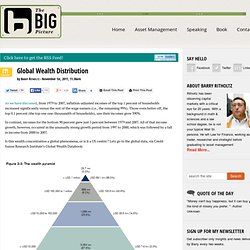
Those even better off, the top 0.1 percent (the top one one-thousandth of households), saw their incomes grow 390%. In contrast, incomes for the bottom 90 percent grew just 5 percent between 1979 and 2007. All of that income growth, however, occurred in the unusually strong growth period from 1997 to 2000, which was followed by a fall in income from 2000 to 2007. Is this wealth concentration a global phenomena, or is it a US centric? Lets go to the global data, via Credit Suisse Research Institute’s Global Wealth Databook: Source: Credit Suisse, Research Institute And as a reminder, here is the recent growth in the US data, via EPI: Source: Economic Policy Institute UPDATE: November 1 2011 12:51pm David Wilson of Bloomberg News points out that a rising Misery Indexes worsens the income-gap effect: The Hidden Prosperity of the Poor.
A concept promulgated by the right — the notion of the hidden prosperity of the poor — underpins the conservative take on the ongoing debate over rising inequality.

The political right uses this concept to undermine the argument made by liberals that the increasingly unequal distribution of income poses a danger to the social fabric as well as to the American economy. President Obama forcefully articulated the case from the left in an address on Dec. 6, 2011 at Osawatomie High School in Kansas: This kind of gaping inequality gives lie to the promise that’s at the very heart of America: that this is a place where you can make it if you try. We tell people — we tell our kids — that in this country, even if you’re born with nothing, work hard and you can get into the middle class.
We tell them that your children will have a chance to do even better than you do. Echo a standard left-wing critique of capitalism: Economic growth does not serve all classes of society. Economic Policy Institute.