Team:Peking/Project/3D/Future. Prospective of Bio-printing Bio-printing is not only a simple demonstration in our project, but it may also play an important part as an interface between physical environmental factors and organisms, as well as a vital inducer in highly organized biomaterial formation.
For the first time, our project demonstrated that bio-printing is feasible even in weak and incoherent light. Biofilms are an aggregation of cells in which they adhere together on a surface. Previous studies mainly focused on chemical-induced biofilm formation. Their limitations are usually inevitable because induction requires the chemical(s) to physically contact the receiver cells. 1472-698X-13-16. New device can extract human DNA with full genetic data in minutes. Take a swab of saliva from your mouth and within minutes your DNA could be ready for analysis and genome sequencing with the help of a new device.

University of Washington engineers and NanoFacture, a Bellevue, Wash., company, have created a device that can extract human DNA from fluid samples in a simpler, more efficient and environmentally friendly way than conventional methods. Generic Drug Approvals. First Time Generics are those drug products that have never been approved before as generic drug products and are new generic products to the marketplace.

See also: New Drug Approvals, New Drug Applications, Recent Additions, Generic Drug Facts Solifenacin Succinate Tablets 5 mg and 10 mg Approved: April 2, 2014 - Teva Pharmaceuticals, Inc. Generic for: VesicareNevirapine Extended Release Tablets 400 mg Approved: April 3, 2014 - Apotex Inc.; Sandoz Inc. New Drug Applications. The New Drug Application (NDA) is the vehicle through which drug sponsors formally propose that the FDA approve a new pharmaceutical for sale and marketing in the United States.

The purpose of a NDA is to provide enough information to permit the FDA to reach the following key decisions Whether the drug is safe and effective in its proposed use(s), and whether the benefits of the drug outweigh the risksWhether the drug's proposed labeling (package insert) is appropriate and what it should containWhether the methods used in manufacturing the drug and the controls used to maintain the drug's quality are adequate to preserve the drug's identity, strength, quality, and purity For more information on New Drug Applications, please visit the FDA's How Drugs are Developed and Approved page. Get news by email or subscribe to our . Catalog - partsregistry.org. Browse parts by collection See all of the Registry collections.

Browse parts by type Browse devices by type We're in the process of developing new support for the specification of devices in the Registry. For the time being, please see the existing device tables below. Browse parts and devices by function This section replaces the previous Featured parts pages. Browse parts and devices by chassis.
Synthetic Biology. Born to die: how self-destructing electronics will transform medicine, war, and more. Right now, electronics are built to last.
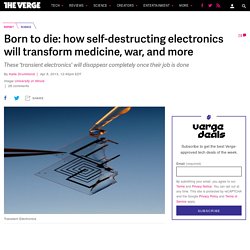
Soon, however, their lifespan might be more fleeting — courtesy of burgeoning research into "transient electronics," or devices meant to serve a specific function before completely dissolving into their environment over a predetermined span of weeks, months, or even years. In fact, your own body might be one of the first places these devices are deployed. This new discovery will finally allow us to build biological computers. Tiny DNA Switches Aim To Revolutionize 'Cellular' Computing. If you think programming a clock radio is hard, try reprogramming life itself.

That's the goal of Drew Endy, a synthetic biologist at Stanford University. Endy has been working with a laboratory strain of E. coli bacteria. He sees the microbes as more than just single-cell organisms. They're little computers. "Any system that's receiving information, processing information and then using that activity to control what happens next, you can think of as a computing system," Endy says.
Normally the E. coli follow their own program. "For us, what's become exciting is the idea that we could get inside the cells in sort of a bottom-up fashion," he says. Endy is talking about more than splicing in a few extra genes, as scientists already do with crops. Gene therapy cures leukaemia in eight days - health - 26 March 2013. WITHIN just eight days of starting a novel gene therapy, David Aponte's "incurable" leukaemia had vanished.
For four other patients, the same happened within eight weeks, although one later died from a blood clot unrelated to the treatment, and another after relapsing. The cured trio, who were all previously diagnosed with usually fatal relapses of acute lymphoblastic leukaemia, have now been in remission for between 5 months and 2 years. Michel Sadelain of the Memorial Sloan-Kettering Cancer Center in New York, co-leader of the group that designed the trial, says that a second trial of 50 patients is being readied, and the team is looking into using the technique to treat other cancers. The key to the new therapy is identifying a molecule unique to the surface of cancer cells, then genetically engineering a patient's immune cells to attack it. In acute lymphoblastic leukaemia, immune cells called B-cells become malignant. More From New Scientist Promoted Stories Recommended by.