
Narcissistic personality disorder - Wikipedia, the free encyclop. Symptoms[edit] Some people diagnosed with a narcissistic personality disorder are characterized by exaggerated feelings of self-importance.
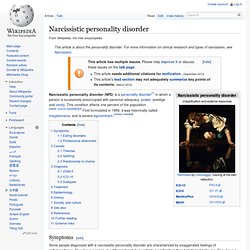
They have a sense of entitlement and demonstrate grandiosity in their beliefs and behavior. Projective identification. While based on Freud's concept of psychological projection,[2] projective identification represents a step beyond.

In R.D. Laing's words, “The one person does not use the other merely as a hook to hang projections on. He strives to find in the other, or to induce the other to become, the very embodiment of projection”.[3] Feelings which can not be consciously accessed are defensively projected into another person in order to evoke the thoughts or feelings projected.[4] Experience[edit] Though a difficult concept for the conscious mind to come to terms with,[5] since its primitive nature makes its operation or interpretation seem more like magic or art than science,[6] projective identification is nonetheless a powerful tool of interpersonal communication.
Scapegoats, Scapegoating Psychology, Undoing Blame. Scapegoat. Scapegoat, 2012, bronze sculpture Scapegoating (from the verb "to scapegoat") is the practice of singling out any party for unmerited negative treatment or blame as a scapegoat.[1] Scapegoating may be conducted by individuals against individuals (e.g.
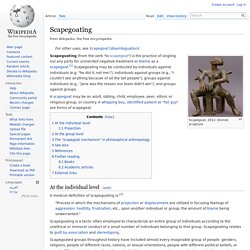
"he did it, not me! "), individuals against groups (e.g., "I couldn't see anything because of all the tall people"), groups against individuals (e.g., "Jane was the reason our team didn't win"), and groups against groups. Psychological trauma. Trauma can be caused by a wide variety of events, but there are a few common aspects.
There is frequently a violation of the person's familiar ideas about the world and of their human rights, putting the person in a state of extreme confusion and insecurity. This is also seen when institutions that are depended upon for survival, violate or betray or disillusion the person in some unforeseen way.[3] However, the definition of trauma differs among individuals by their subjective experiences, not the objective facts. People will react to similar events differently. In other words, not all people who experience a potentially traumatic event will actually become psychologically traumatized.[6] This discrepancy in risk rate can be attributed to protective factors some individuals may have that enable them to cope with trauma. Dissociation. Dissociation (in the wide sense of the word) is an act of disuniting or separating a complex object into parts.
Dissociation may also refer to: Displacement (psychology) In Freudian psychology, displacement (German Verschiebung "shift, move") is an unconscious defense mechanism whereby the mind substitutes either a new aim or a new object for goals felt in their original form to be dangerous or unacceptable.[1] A term originating with Sigmund Freud,[2] displacement operates in the mind unconsciously, its transference of emotions, ideas, or wishes being most often used to allay anxiety in the face of aggressive or sexual impulses.
Freud initially saw displacement as a means of dream-distortion, involving a shift of emphasis from important to unimportant elements,[3] or the replacement of something by a mere allusion.[4] Idealization and devaluation. In child development, idealization and devaluation are quite normal.
During the childhood development stage, individuals become capable of perceiving others as complex structures, containing both good and bad components. If the development stage is interrupted (by early childhood trauma, for example), these defense mechanisms may persist into adulthood. Freud[edit] The term idealization first appeared in connection with Freud’s definition of narcissism. Freud’s vision was that all human infants pass through a phase of primary narcissism in which they assume they are the centre of their universe. Rationalization (fallacy) People rationalize for various reasons. Rationalization may differentiate the original deterministic explanation of the behavior or feeling in question.[3][4] Sometimes rationalization occurs when we think we know ourselves better than we do.
It is also an informal fallacy of reasoning.[5] According to the DSM-IV, rationalization occurs "when the individual deals with emotional conflict or internal or external stressors by concealing the true motivations for his or her own thoughts, actions, or feelings through the elaboration of reassuring or self serving but incorrect explanations. " Rationalization can be used to avoid admitting disappointment: "I didn't get the job that I applied for, but I really didn't want it in the first place. " Rationalizations often take the form of a comparison. Reaction formation. In psychoanalytic theory, reaction formation is a defensive process (defense mechanism) in which emotions and impulses which are anxiety-producing or perceived to be unacceptable are mastered by exaggeration (hypertrophy) of the directly opposing tendency.[1][2] Theory[edit] Reaction formation depends on the hypothesis that "[t]he instincts and their derivatives may be arranged as pairs of opposites: life versus death, construction versus destruction, action versus passivity, dominance versus submission, and so forth.
When one of the instincts produces anxiety by exerting pressure on the ego either directly or by way of the superego, the ego may try to sidetrack the offending impulse by concentrating upon its opposite. For example, if feelings of hate towards another person make one anxious, the ego can facilitate the flow of love to conceal the hostility. Cognitive dissonance.
In psychology, cognitive dissonance is the mental stress or discomfort experienced by an individual who holds two or more contradictory beliefs, ideas, or values at the same time, or is confronted by new information that conflicts with existing beliefs, ideas, or values.[1][2] Leon Festinger's theory of cognitive dissonance focuses on how humans strive for internal consistency.

When inconsistency (dissonance) is experienced, individuals tend to become psychologically uncomfortable and they are motivated to attempt to reduce this dissonance, as well as actively avoiding situations and information which are likely to increase it.[1] Denial. Denial, in ordinary English usage, is asserting that a statement or allegation is not true.[1] The same word, and also abnegation, is used for a psychological defense mechanism postulated by Sigmund Freud, in which a person is faced with a fact that is too uncomfortable to accept and rejects it instead, insisting that it is not true despite what may be overwhelming evidence.[2][3] The subject may use: Many contemporary psychoanalysts treat denial as the first stage of a coping cycle.
When an unwelcome change occurs, a trauma of some sort, the first impulse to disbelieve begins the process of coping. Cognitive distortion. Psychiatrist Aaron T. Beck who laid the groundwork for research on cognitive distortion. An exaggerated or irrational thought pattern involved in the onset and perpetuation of psychopathological states. Splitting (psychology) Splitting (also called all-or-nothing thinking) is the failure in a person's thinking to bring together both positive and negative qualities of the self and others into a cohesive, realistic whole. It is a common defense mechanism used by many people.[1] The individual tends to think in extremes (i.e., an individual's actions and motivations are all good or all bad with no middle ground.) The concept of splitting was developed by Ronald Fairbairn in his formulation of object relations theory;[2] it begins as the inability of the infant to combine the fulfilling aspects of the parents (the good object) and their unresponsive aspects (the unsatisfying object) into the same individuals, but sees the good and bad as separate.
Passive–aggressive behavior. Passive-aggressive behavior is the indirect expression of hostility, such as through procrastination, sarcasm, hostile jokes, stubbornness, resentment, sullenness, or deliberate or repeated failure to accomplish requested tasks for which one is (often explicitly) responsible. For research purposes, the DSM-IV describes passive-aggressive personality disorder as a "pervasive pattern of negativistic attitudes and passive resistance to demands for adequate performance in social and occupational situations".
Concept in different areas[edit] In psychology[edit] In psychology, passive-aggressive behavior is characterized by a habitual pattern of passive resistance to expected work requirements, opposition, stubbornness, and negativistic attitudes in response to requirements for normal performance levels expected of others. Passive-aggressive may also refer to a person who refuses to acknowledge their own aggression (in the sense of "agency"), and who manages that denial by projecting it. Defence mechanism. In psychology, defense mechanisms are unconscious coping mechanisms that reduce anxiety generated by threats from unacceptable impulses.[1] Defence mechanisms, which are unconscious, are not to be confused with conscious coping strategies.[2] Sigmund Freud was one of the first proponents of this construct.[3] Healthy persons normally use different defences throughout life.
An ego defence mechanism becomes pathological only when its persistent use leads to maladaptive behaviour such that the physical or mental health of the individual is adversely affected. The purpose of ego defence mechanisms is to protect the mind/self/ego from anxiety and/or social sanctions and/or to provide a refuge from a situation with which one cannot currently cope.[9] One resource used to evaluate these mechanisms is the Defense Style Questionnaire (DSQ-40).[10][11] Structural model: Id, ego, and superego[edit] The iceberg metaphor is often used to explain the psyche's parts in relation to one another. Otto F.