
Humanizing Technology Prize: The Nominees (Human Relationships) You have shown excellent taste in your selection. Generate Infographics of your Facebook Usage. While the tide might be turning on the use of infographics by journalists or bloggers, we can imagine they’re still pretty popular among social media users.
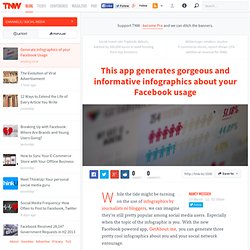
Especially when the topic of the infographic is you. With the new Facebook-powered app, GetAbout.me, you can generate three pretty cool infographics about you and your social network entourage. To get started, the first thing you’ll have to do is grant the app access to your Facebook profile. Cool Infographics and Visuals. Dribble-Show and tell for designers.
Internet of Things Platform Connecting Devices and Apps for Real-Time Control and Data Storage. Participatory culture. Participatory culture is a neologism in reference of, but opposite to a Consumer culture — in other words a culture in which private persons (the public) do not act as consumers only, but also as contributors or producers (prosumers).
The term is most often applied to the production or creation of some type of published media. Recent advances in technologies (mostly personal computers and the Internet) have enabled private persons to create and publish such media, usually through the Internet. This new culture as it relates to the Internet has been described as Web 2.0. In participatory culture "young people creatively respond to a plethora of electronic signals and cultural commodities in ways that surprise their makers, finding meanings and identities never meant to be there and defying simple nostrums that bewail the manipulation or passivity of “consumers.”[1] History[edit] Participatory culture has been around longer than the Internet.
Storify. Organize your resources in an online binder - LiveBinders. Todo list, task manager, online, fast, easy to use: Todoist. Access your bookmarks anywhere. 10EQS-Crowdsourcing service providers. August 20, 2013 10EQS is featured in the Arabian Gazette as a way to work part-time in the Arabian Gulf.
MentorMob - Learn What You Want, Teach What You Love. WordItOut - Generate word clouds (and make custom gifts) Tag Galaxy. Timehop. Memolane. Dashter. Storybird. Vizualize.me Beta: Turning Your LinkedIn Resume in Infographics. There seems to be a commercial market emerging around the idea of automizing the creation of infographics.
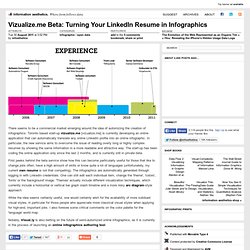
Toronto based start-up vizualize.me [vizualize.me] is currently developing an online application that can automatically translate any online LinkedIn profile into an online infographic. In particular, the new service aims to overcome the issue of reading overly long or highly complex resumes by showing the same information in a more readable and attractive way. The start-up has been coding the online application only since the last 2 months, and is currently still in private beta. Join.me. Voki. Online Team Collaboration. Audacity.
Flickr. Pinterest. How Much Do Your Friends' Facebook Apps Know About You? Even if you never connect your Facebook account to a single app, dozens of them may still have access to your profile information via your Facebook friends.
When your Facebook friends connect new apps, the list of permissions they approve can include access to not just their own information, but also specific information from your profile — including your birthday, status updates, photos, hometown, current city and app activity. Facebook won't share information with your friends' apps that you haven't shared with your friends, and you can control which information friends' apps can access through a privacy settings page. But some Facebook users don't realize they're sharing information with app developers this way, or that they can control it. Intel Creates Infographic Generator That's All About You. Intel, which has catered to Facebook and Twitter users' inherent narcissism before, is giving you a new tool for digital navel-gazing: an infographic that's all about you.
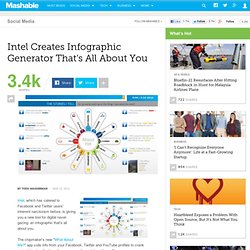
The chipmaker's new "What About Me? " app culls info from your Facebook, Twitter and YouTube profiles to crank out a data visualization of your composite social media profile. Follow the Hash Tag: A Dynamic Bubble Graph of Twitter Trends. Follow the Hash Tag [followthehashtag.com] by Madrid-based communication design office DNOiSE is a viral advertising tool, but also a live visualization of popular Tweet topics.
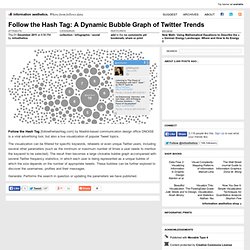
The visualization can be filtered for specific keywords, retweets or even unique Twitter users, including several other parameters (such as the minimum or maximum number of times a user needs to mention the keyword to be selected). The result then becomes a large clickable bubble graph accompanied with several Twitter frequency statistics, in which each user is being represented as a unique bubble of which the size depends on the number of appropriate tweets. These bubbles can be further explored to discover the usernames, profiles and their messages. Mapping The World's Tweet Networks. This is a picture of the world, as connected by Twitter, created by Eric Fischer.
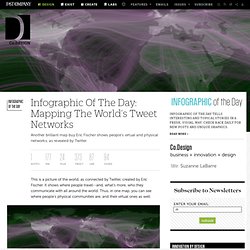
It shows where people travel--and, what’s more, who they communicate with all around the world. Thus, in one map, you can see where people’s physical communities are, and their virtual ones as well. [Click to enlarge.] Here’s how it works: Fischer tracked all of the information of Twitter accounts with geo-locations enabled between May 17 and September 1, 2011. Collusion for Chrome maps how sites are tracking you, courtesy of the Disconnect team. Social Hypertree. When Facebook is combined with Information Visualization.