
Understanding Depersonalization Disorder. I don’t usually google the topic of what I’m writing about, but in this case, I did want to look up the term ‘depersonalization disorder’ just to make sure we’re talking about the same thing.

Yep. I’ve had that. Not as severe as some people, I’m sure, but still, enough to know what it feels like. It’s when you’re not connected to yourself. You’re not grounded, and you’re not even in your body, it seems. It’s like your life is a movie, and you’re just watching it, rather than actually being in it. What would cause it? I separate from the person I am. When you look at it from afar, it’s a wonderful defense mechanism of survival. The bad news – your freedom becomes your prison. So figuring out depersonalization disorder is easy. The problem is, at the moment you can’t change it. You need a certain amount of power to change. It’s like the astronaut who has to go outside the space station and is only connected by some sort of tether.
But it can change. First, get a sense of the situation. Mark. Depersonalization disorder. Depersonalization disorder (DPD) is a mental disorder in which the sufferer is affected by persistent or recurrent feelings of depersonalization and/or derealization.
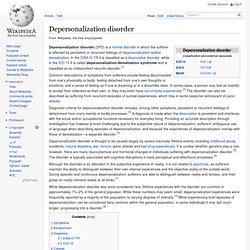
In the DSM-IV-TR it is classified as a dissociative disorder, while in the ICD-10 it is called depersonalization-derealization syndrome and is classified as an independent neurotic disorder.[1] Common descriptions of symptoms from sufferers include feeling disconnected from one's physicality or body, feeling detached from one's own thoughts or emotions, and a sense of feeling as if one is dreaming or in a dreamlike state.
In some cases, a person may feel an inability to accept their reflection as their own, or they may even have out-of-body experiences.[2] The disorder can also be described as suffering from recurrent episodes of surreal experiences, which may in some cases be reminiscent of panic attacks. Symptoms[edit] Assessment[edit] The diagnosis of DPD can be made with the use of the following interviews and scales: The Role of Childhood Interpersonal Trauma in Depersonalization Disorder. Dissociation is the disruption of the normal integrative processes of consciousness, perception, memory, and identity that define self-hood.

All dissociative disorders currently classified in DSM-IV are characterized by pathological dissociation but differ in the dissociative domains in which symptoms are primarily manifested. Research has revealed that pathological dissociation is a categorically distinct entity from the normal dissociative tendencies that characterize the general population (1), and in a well-designed twin study (2), the genetic heritability estimate for pathological dissociation was zero, suggesting that these conditions may be strongly driven by environmental traumas. It appears that traumatic antecedents play a major role in the pathogenesis of various dissociative disorders, although the age, type, and severity of the traumas involved differs.
When examined by individual disorder, the role of trauma can be briefly summarized as follows.