
Jargon File. The Jargon File is a glossary of computer programmer slang.

The original Jargon File was a collection of terms from technical cultures such as the MIT AI Lab, the Stanford AI Lab (SAIL) and others of the old ARPANET AI/LISP/PDP-10 communities, including Bolt, Beranek and Newman, Carnegie Mellon University, and Worcester Polytechnic Institute. 1975 to 1983[edit] In 1976, Mark Crispin, having seen an announcement about the File on the SAIL computer, FTPed a copy of the File to the MIT AI Lab. He noticed that it was hardly restricted to "AI words" and so stored the file on his directory, named as "AI:MRC;SAIL JARGON" ("AI" lab computer, directory "MRC", file "SAIL JARGON").
The File expanded by fits and starts until 1983. 1983 to 1990[edit] The Jargon File. The Original Hacker's Dictionary. [This file, jargon.txt, was maintained on MIT-AI for many years, before being published by Guy Steele and others as the Hacker's Dictionary.
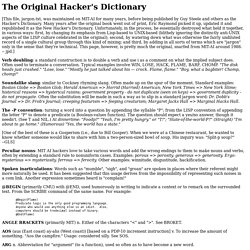
Many years after the original book went out of print, Eric Raymond picked it up, updated it and republished it as the New Hacker's Dictionary. Unfortunately, in the process, he essentially destroyed what held it together, in various ways: first, by changing its emphasis from Lisp-based to UNIX-based (blithely ignoring the distinctly anti-UNIX aspects of the LISP culture celebrated in the original); second, by watering down what was otherwise the fairly undiluted record of a single cultural group through this kind of mixing; and third, by adding in all sorts of terms which are "jargon" only in the sense that they're technical.
This page, however, is pretty much the original, snarfed from MIT-AI around 1988. -- jpd.] Verb doubling: a standard construction is to double a verb and use i as a comment on what the implied subject does. ARG n. BANG n. J. William Gibson. Sprawl trilogy. The Sprawl trilogy (also known as the Neuromancer, Cyberspace, or Matrix trilogy) is William Gibson's first set of novels, composed of Neuromancer (1984), Count Zero (1986), and Mona Lisa Overdrive (1988).

The novels are all set in the same fictional future, and are subtly interlinked by shared characters and themes (which are not always readily apparent). The Sprawl trilogy shares this setting with Gibson's short stories "Johnny Mnemonic," "New Rose Hotel," and "Burning Chrome," and events and characters from the stories appear in or are mentioned at points in the trilogy. Setting and themes[edit] The novels are set in a near-future world dominated by corporations and ubiquitous technology, after a limited World War III. The events of the novels are spaced over 16 years, and although there are familiar characters that appear, each novel tells a self-contained story. Story elements[edit] Glossary[edit] Cobra Cyberspace Cyberspace Deck.
Bridge trilogy. Setting[edit] The first book of the Bridge trilogy is set in an imaginary 2006, with the subsequent books set a few years later.[1] The books deal with the race to control the beginnings of cyberspace technology and are set on the United States' West coast in a post-earthquake California (divided into the separate states of NoCal and SoCal), as well as a post-earthquake Tokyo, Japan, that had been rebuilt using nanotechnology.

The trilogy derives its name from the San Francisco – Oakland Bay Bridge, which was abandoned in an earthquake and has become a massive shantytown and a site of improvised shelter. The bridge becomes a pivotal location in Virtual Light and All Tomorrow's Parties. Request for Comments. A Request for Comments (RFC) is a publication of the Internet Engineering Task Force (IETF) and the Internet Society, the principal technical development and standards-setting bodies for the Internet.
An RFC is authored by engineers and computer scientists in the form of a memorandum describing methods, behaviours, research, or innovations applicable to the working of the Internet and Internet-connected systems. It is submitted either for peer review or simply to convey new concepts, information, or (occasionally) engineering humour. The IETF adopts some of the proposals published as RFCs as Internet standards. Request for Comments. Official Internet Protocol Standards.

This list is updated daily. Search RFCs by number, title, keywords, author, and more. Includes the STD, BCP, and FYI subseries identifiers. Hyperlinks to RFCs and errata, if any. Useful for finding all RFCs on a particular topic and tracing the relationships among them. RFC Errata Published RFCs never change. RFC Bibliographic Listing Listing of bibliographic entries for all RFCs, formatted for use in a References section of an RFC.
Hyperlinked index of RFCs or subseries: Get RFCs by category and maturity level (Internet Standard, Proposed Standard, and more) View a list of RFCs that have changed status (i.e., category or maturity level) after publication. Download the RFC collection (tar or zip files).