
Scientists: Magnetic polar reversal may have started - by Terrence Aym. Terrence Aym's image for: "Scientists Magnetic Polar Reversal may have Started" Caption: Location: Image by: Concern has been mounting for almost a decade as scientists hunched over their instruments and double-checked new data concerning the status of the Earth's crucial magnetic field.
The magnetic field protects all life from damaging solar radiation. Tipping point Now new evidence has emerged leading some scientists to believe that the magnetic pole shift—an ongoing phenomenon that has been happening for decades—has reached a tipping point. According to a report issued by the prestigious British Geological Survey (BGS), evidence suggests the magnetic reversal has begun. The BGS has taken this position based on careful analysis of a region of the Earth known as the South Atlantic Anomaly (SAA). All of this indicates the Earth's liquid core is changing. The horrible truth There are educated guesses and best guesses. Data points 33,500 years ago the Lake Mungo magnetic reversal happened. World Environmental Facts. "They Just Don't Know Who They're Messing With" If you've been reading Mother Jones lately, you've heard about BP's stranglehold on media access in the Gulf, which has included preventing reporters from visting oil-soaked public beaches and barring its spill cleanup workers from talking to the press.
Now, one of BP's ex-media enforcers is speaking out. Former BP contractor Adam Dillon went public last Friday, telling a local news station in New Orleans that he was fed up with BP's handling of the spill response, not least of all its information clampdown. In an interview with Mother Jones this week, Dillon, who claims he was fired for raising concerns about the cleanup with his bosses, elaborated on his experiences in the Gulf and vented his frustrations with BP. A retired Army special operations soldier who lives in Wilmington, North Carolina (and is running for sheriff in his home county), Dillon first worked management* for BP on the beaches of Louisiana.
In June, a camera crew caught him chasing reporters off a Grand Isle beach. Emergency and Disaster Information Service. Life on this Earth Just Changed: The North Atlantic Current is Gone. Update: - Naval Research Laboratory Charts Show Damaged Loop Current - Jesse Ventura Conspiracy Theory: ‘Gulf Coast Oil Spill’ - Europe: Coldest Winter in 1,000 Years On Its Way, Connected To Gulf Stream Changes, Say Scientists - Global Cooling and the New World Order: The Bilderberg group discussion agenda in 2010:“The 58th Bilderberg Meeting will be held in Sitges, Spain 3 – 6 June 2010.
Related article: - Loop Current in the Gulf of Mexico Has Stalled From BP Oil Disaster! I am not saying that you should panic now. I was thinking for a few days about whether I should post this article or not. This is just for your information. (Click on images to enlarge) Athos extreme quad-cycle brings four-wheeled, pedal-powered off-road mayhem. If the funky, Segway-powered Centaur, shown in our recent look at Dual Mode transportation, is still too powerful and heavy for you, it may be time to go Athos.
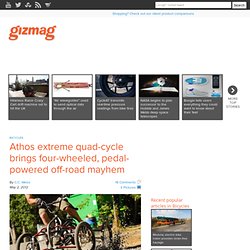
Sort of an unnatural cross between a pedal-powered bicycle and a four-wheeled quad, this burly "extreme quad-cycle" aims to give riders a new option in off-road travel that blends BMX, motocross and downhill biking. According to its builder Contes Engineering, the Athos combines the stability and handling of a quad with the flexibility of a bicycle. We're not sure how Contes defines "flexibility," but we really don't see a wide-track four-wheel cycle being equal to a bicycle in that department.
Unlike the Sway and Veliac three-wheelers, the Athos wheels do not tilt, so the turning radius has to be somewhat large and clunky when compared to a bike. However, we can dig the combination of a quad footprint and lighter, motor-less frame. Source: Contes Engineering Share. Seeds of Suicide. Before BP destroyed habitats and livelihoods in the Gulf, Monsanto landed in India.
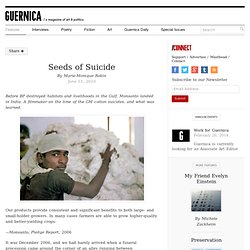
A filmmaker on the time of the GM cotton suicides, and what was learned. Our products provide consistent and significant benefits to both large- and small-holder growers. In many cases farmers are able to grow higher-quality and better-yielding crops. —Monsanto, Pledge Report, 2006 It was December 2006, and we had barely arrived when a funeral procession came around the corner of an alley running between whitewashed walls, shattering the torpor of the little Indian village under the burning sun. Three Suicides a Day “Can we film?” Gulf Oil Disaster - BP Oil Disaster: Methane, Climate & Dead Zones. (July 11, 2010) As much as one million times the normal level of methane is showing up near the Gulf of Mexico oil gusher, enough potentially to create dead zones in the water.
"These are higher levels than we have ever seen at any other location in the ocean itself," according to sources cited by Reuters. The "flow team" of the US Geological Survey estimates that 2,900 cubic feet of natural gas, which primarily contains methane, is being released into the Gulf waters with every barrel of oil.
The constant flow of around 65,000 barrels of crude oil places the total daily amount of natural gas at over 188 million cubic feet. So far, over 13 billion cubic feet may have been released, making it one of the most vigorous methane eruptions in modern human history.