
Plato.
Plato. Plato (/ˈpleɪtoʊ/; Greek: Πλάτων Plátōn "broad"pronounced [plá.tɔːn] in Classical Attic; 428/427 or 424/423 – 348/347 BCE) was a philosopher, as well as mathematician, in Classical Greece.
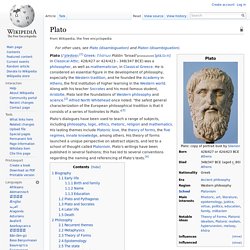
He is considered an essential figure in the development of philosophy, especially the Western tradition, and he founded the Academy in Athens, the first institution of higher learning in the Western world. Along with his teacher Socrates and his most famous student, Aristotle, Plato laid the foundations of Western philosophy and science.[2] Alfred North Whitehead once noted: "the safest general characterization of the European philosophical tradition is that it consists of a series of footnotes to Plato. " Plato's dialogues have been used to teach a range of subjects, including philosophy, logic, ethics, rhetoric, religion and mathematics.
His lasting themes include Platonic love, the theory of forms, the five regimes, innate knowledge, among others. Biography Early life Birth and family Name Education. Plato, Philosopher & Sage. Plato ~427 - 348 BC Greek Philosopher Wisdom of the Ancient Sages Philosopher & Sage An Introduction to Plato In the history of human civilization, the philosophers who can approximate the depth and range of Plato are few and far between.
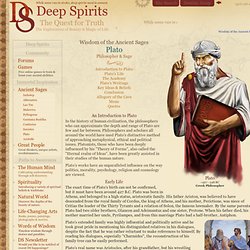
Plato's works have an unparalleled influence on the way politics, morality, psychology, religion and cosmology are viewed. Early Life The exact time of Plato's birth can not be confirmed, but it must have been around 427 B.C. Plato & Aristotle, from the painting "The School of Athens" (Scuola di Atene) by Raphael (~1510). Plato's extended family was highly influential and politically active and he took great pride in mentioning his distinguished relatives in his dialogues, despite the fact that he was rather reluctant to make references to himself. Plato's real name was Aristocles, after his grandfather, but his wrestling teacher gave him the nickname Plato, from the Greek word "Platos" meaning "width", because of his physique or the breadth of his forehead. Allegory of the Cave » Wisdom of the Ancient Sages « Articles & Wisdom.
Wisdom & Quotes by Plato. Plato Famous Quotes "How can you prove whether at this moment we are sleeping, and all our thoughts are a dream; or whether we are awake, and talking to one another in the waking state?

" "Any man may easily do harm, but not every man can do good to another. " "He who commits injustice is ever made more wretched than he who suffers it. " "He who is not a good servant will not be a good master. " "Good people do not need laws to tell them to act responsibly, while bad people will find a way around the laws. " "Hardly any human being is capable of pursuing two professions or two arts rightly. " "Entire ignorance is not so terrible or extreme an evil, and is far from being the greatest of all; too much cleverness and too much learning, accompanied with ill bringing-up, are far more fatal.
" "Death is not the worst that can happen to men. " "Attention to health is life greatest hindrance. " "Be kind, for everyone you meet is fighting a hard battle. " "At the touch of love everyone becomes a poet. " Back to Top. Allegory of the Cave » Wisdom of the Ancient Sages « Articles & Wisdom.