
Category:Creativity Techniques. This A to Z of Creativity and Innovation Techniques, provides an introduction to a range of tools and techniques for both idea generation (Creativity) and converting those ideas into reality (Innovation).
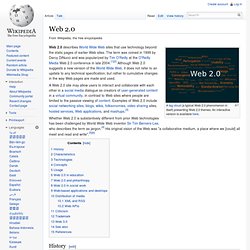
Like most tools these techniques all have their good and bad points. I like to think of these creativity and innovation techniques as tools in a toolbox in much the same way as my toolbox at home for DIY. It has a saw, spanner, hammer, knife and all sorts of other things in it, they are all very useful, but you have to pick the right tool (creativity / Innovation technique) for each job. This site will try and provide a little guidance along with each tool to let you know whether it's best used for cutting paper or putting in nails. ++Semanticweb.org. Web 3.0. A tag cloud (a typical Web 2.0 phenomenon in itself) presenting Web 2.0 themes.
An interactive version is available here. Web 2.0 describes World Wide Web sites that use technology beyond the static pages of earlier Web sites. The term was coined in 1999 by Darcy DiNucci and was popularized by Tim O'Reilly at the O'Reilly Media Web 2.0 conference in late 2004.[1][2] Although Web 2.0 suggests a new version of the World Wide Web, it does not refer to an update to any technical specification, but rather to cumulative changes in the way Web pages are made and used. Whether Web 2.0 is substantively different from prior Web technologies has been challenged by World Wide Web inventor Sir Tim Berners-Lee, who describes the term as jargon.[4] His original vision of the Web was "a collaborative medium, a place where we [could] all meet and read and write".[5][6] History[edit]