
JasperReports. It can be used in Java-enabled applications, including Java EE or web applications, to generate dynamic content.
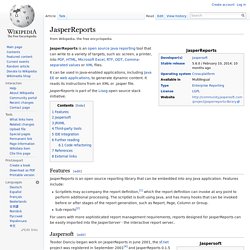
It reads its instructions from an XML or .jasper file. JasperReports is part of the Lisog open source stack initiative. Features[edit] JasperReports is an open source reporting library that can be embedded into any Java application. Features include: Scriptlets may accompany the report definition,[1] which the report definition can invoke at any point to perform additional processing. For users with more sophisticated report management requirements, reports designed for JasperReports can be easily imported into the JasperServer - the interactive report server.. Jaspersoft[edit] Teodor Danciu began work on JasperReports in June 2001, the sf.net project was registered in September 2001[4] and JasperReports 0.1.5 was released on November 3, 2001.[5]
SAM - Service Activity Monitor. Apache Karaf. REST. Jetty (web server) Apache Hadoop is an example of how Jetty is used in a framework.
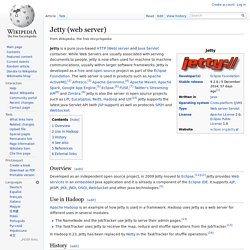
Hadoop uses Jetty as a web server for different uses in several modules: The NameNode and the JobTracker use Jetty to serve their admin pages.[13]The TaskTracker uses Jetty to receive the map, reduce and shuffle operations from the JobTracker.[13] Originally developed in the Sydney suburb of Balmain by software engineer Greg Wilkins, Jetty was originally a HTTP server component of Mort Bay Server (Mort Bay is an area of Balmain.)[15] Jetty was originally called IssueTracker (its original application) and then MBServler (Mort Bay Servlet server).
Neither of these were much liked, so Jetty was finally picked.[15] Apache Karaf 2.3.7-SNAPSHOT Guides. Fuse ESB Enterprise - Configuring and Running Fuse ESB Enterprise - JAAS Console Commands. Editing user data from the console Fuse ESB Enterprise provides a set of jaas:* console commands, which you can use to edit JAAS user data from the console.
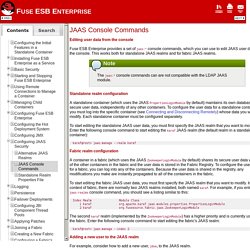
This works both for standalone JAAS realms and for fabric JAAS realms. The jaas:* console commands can are not compatible with the LDAP JAAS module. Standalone realm configuration A standalone container (which uses the JAAS PropertiesLoginModule by default) maintains its own database of secure user data, independently of any other containers. To start editing the standalone JAAS user data, you must first specify the JAAS realm that you want to modify.
Understanding Java Security and JAAS (part 3 a Custom Login Module) In this third and last part on JAAS (part 1 part 2) we will look into writing your own login module to a particular security domain.
Writing your own login module may be necessary when you are trying to login to a security domain for which no existing JAAS login module exists (for example to integrate some Java EE servers up with that security domain). Java EE Servers such as Red Hat JBoss and Oracle WebLogic leveraged the JAAS architecture and used it for their connection with the security domain (LDAP, Database etc) Where can I change the default users of ESB Runtime server? - Talend Knowledge Base. Apache Karaf 2.2.11 Guides. Configuring remote instances It does not always make sense to manage an instance of Karaf using its local console.
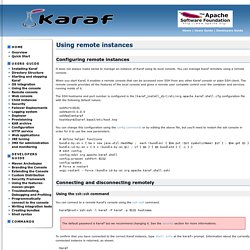
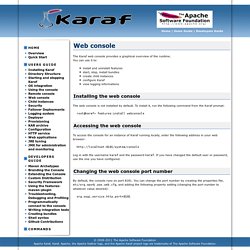
You can manage Karaf remotely using a remote console. When you start Karaf, it enables a remote console that can be accessed over SSH from any other Karaf console or plain SSH client. The remote console provides all the features of the local console and gives a remote user complete control over the container and services running inside of it. Apache Karaf 2.3.7-SNAPSHOT Guides. The Karaf web console provides a graphical overview of the runtime.You can use it to: install and uninstall featuresstart, stop, install bundlescreate child instancesconfigure Karafview logging informations Installing the web console.
DYNAMIC_SETTINGS in Talend Open Studio Custom Components. The "Dynamic settings" tab is present on all Talend Open Studio components, but few components actually use it.
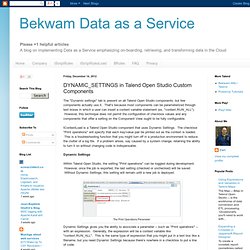
That's because most components can be parameterized through text boxes in which a user can insert a context variable statement (ex, "context.RUN_ALL"). However, this technique does not permit the configuration of checkbox values and any components that offer a setting on the Component View ought to be fully configurable. tContextLoad is a Talend Open Studio component that uses Dynamic Settings. The checkbox "Print operations" will specify that each key/value pair be printed out as the context is loaded. This is a troubleshooting function that you might turn off in a production environment to reduce the clutter of a log file.
Glob (programming) In computer programming, in particular in a Unix-like environment, the term globbing is sometimes used to refer to pattern matching based on wildcard characters.
[citation needed] The noun "glob" is used to refer to a particular pattern, e.g. "use the glob *.log to match all those log files". [citation needed] Its notation is simpler than regular expressions, and without their expressive power. The command interpreters of the early versions of Unix (1st through 6th Editions, 1969–75) did not expand wildcard characters in file path arguments to a command; a separate program, /etc/glob,[1] performed the expansion and supplied the expanded list of file paths to the command for execution. Its name is an abbreviation for "global command".[2] Later, this functionality was provided as a library function, glob(), used by programs such as the shell.
External Libraries. 4.5.5 How to use the tPrejob and tPostjob components - Talend Open Studio for Data Integration v5.4.2 - User Guide (EN) To Iterate or Flow in Talend Open Studio. tRouteInput - Talend Open Studio Components v5.4.2 - Reference Guide (EN) Apache Camel. Apache Caml SQL Query Message. Quartz. 3.53.4 Starting the Quartz scheduler - Talend ESB Mediation v5.4.2 - Developer Guide (EN) Quartz. The quartz: component provides a scheduled delivery of messages using the Quartz Scheduler 1.x .
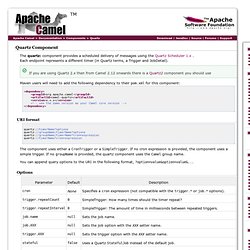
Each endpoint represents a different timer (in Quartz terms, a Trigger and JobDetail). Icon If you are using Quartz 2.x then from Camel 2.12 onwards there is a Quartz2 component you should use Maven users will need to add the following dependency to their pom.xml for this component: URI format The component uses either a CronTrigger or a SimpleTrigger. You can append query options to the URI in the following format, ? Options For example, the following routing rule will fire two timer events to the mock:results endpoint: When using a StatefulJob, the JobDataMap is re-persisted after every execution of the job, thus preserving state for the next execution. Running in OSGi and having multiple bundles with quartz routes. Quartz scheduler (Page 1) / Product usage, architecture, user scenarios, suggestions & feedback / Talend Community Forum. The route for this would be very simple.
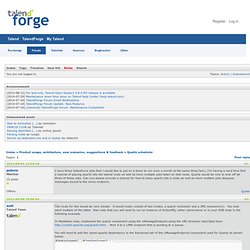
It would really consist of two routes, a quartz consumer and a JMS consumer(s). You may want multiple of the latter. Also note that you will need to run an instance of ActiveMQ, either stand-alone or in your ESB node in the following example. In Mediation view, implement the quartz component using the cMessageEndpoint using the URI structure described here .
Contexts. Parallelization. Convert routines.system.Document to String (Page 1) / Usage, Operation / Talend Community Forum. Talend Sub/Child Jobs. Error Handling. Downloaded. Talend Services. Talend Configuration Settings. Subversion for Talend.