
Chi. From Wikipedia, the free encyclopedia Chi may refer to: Greek[edit] Chinese[edit] Japanese[edit] Other[edit]

Qi. Etymology[edit] The etymological explanation for the form of the qi logogram (or chi) in the traditional form 氣 is "steam (气) rising from rice (米) as it cooks".
The earliest way of writing qi consisted of three wavy lines, used to represent one's breath seen on a cold day. A later version, 气, identical to the present-day simplified character, is a stylized version of those same three lines. For some reason, early writers of Chinese found it desirable to substitute for 气 a cognate character that originally meant to feed other people in a social context such as providing food for guests. [citation needed] Appropriately, that character combined the three-line qi character with the character for rice. Qigong. Qigong, qi gong, chi kung, or chi gung (simplified Chinese: 气功; traditional Chinese: 氣功; pinyin: qìgōng; Wade–Giles: chi gong; literally: "Life Energy Cultivation") is type of spiritual practice intended to "align" body, breath, and mind for health, meditation, and martial arts training.
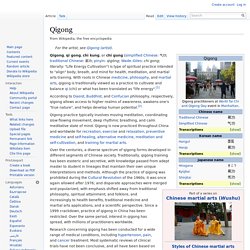
With roots in Chinese medicine, philosophy, and martial arts, qigong is traditionally viewed as a practice to cultivate and balance qi (chi) or what has been translated as "life energy".[1] According to Daoist, Buddhist, and Confucian philosophy, respectively, qigong allows access to higher realms of awareness, awakens one's "true nature", and helps develop human potential.[2] Qigong practice typically involves moving meditation, coordinating slow flowing movement, deep rhythmic breathing, and calm meditative state of mind.
Over the centuries, a diverse spectrum of qigong forms developed in different segments of Chinese society. Etymology[edit]