
Hero's journey. "A Practical Guide to Joseph Cambell’s The Hero with a Thousand Faces" by Christopher Vogler © 1985 “There are only two or three human stories, and they go on repeating themselves as fiercely as if they had never happened before.”

In the long run, one of the most influential books of the 20th century may turn out to be Joseph Campbell’s THE HERO WITH A THOUSAND FACES. The book and the ideas in it are having a major impact on writing and story-telling, but above all on movie-making. Filmmakers like John Boorman, George Miller, Steven Spielberg, George Lucas, and Francis Coppola owe their successes in part to the ageless patterns that Joseph Campbell identifies in the book. The ideas Campbell presents in this and other books are an excellent set of analytical tools. With them you can almost always determine what’s wrong with a story that’s floundering; and you can find a better solution almost any story problem by examining the pattern laid out in the book.
There’s nothing new in the book. The Hero with a Thousand Faces. The Hero with a Thousand Faces (first published in 1949) is a work of comparative mythology by Joseph Campbell.
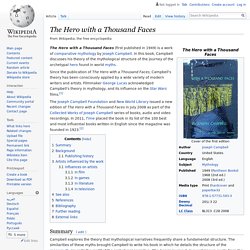
In this book, Campbell discusses his theory of the mythological structure of the journey of the archetypal hero found in world myths. Since the publication of The Hero with a Thousand Faces, Campbell's theory has been consciously applied by a wide variety of modern writers and artists. Filmmaker George Lucas acknowledged Campbell's theory in mythology, and its influence on the Star Wars films.[1] Summary[edit] Campbell explores the theory that mythological narratives frequently share a fundamental structure.
A hero ventures forth from the world of common day into a region of supernatural wonder: fabulous forces are there encountered and a decisive victory is won: the hero comes back from this mysterious adventure with the power to bestow boons on his fellow man.[3] In laying out the monomyth, Campbell describes a number of stages or steps along this journey. Background[edit] Star Wars Origins - Joseph Campbell and the Hero's Journey. In 1949 Joseph Campbell (1904-1987) made a big splash in the field of mythology with his book The Hero With a Thousand Faces.

This book built on the pioneering work of German anthropologist Adolph Bastian (1826-1905), who first proposed the idea that myths from all over the world seem to be built from the same "elementary ideas. " Swiss psychiatrist Carl Jung (1875-1961) named these elementary ideas "archetypes," which he believed to be the building blocks not only of the unconscious mind, but of a collective unconscious. In other words, Jung believed that everyone in the world is born with the same basic subconscious model of what a "hero" is, or a "mentor" or a "quest," and that's why people who don't even speak the same language can enjoy the same stories. Campbell's contribution was to take this idea of archetypes and use it to map out the common underlying structure behind religion and myth.