
Amazon fungi found that eat polyurethane, even without oxygen. (PhysOrg.com) -- Until now polyurethane has been considered non-biodegradable, but a group of students from Yale University in the US has found fungi that will not only eat and digest it, they will do so even in the absence of oxygen.

(PhysOrg.com) -- Each year Yale University operates a Rainforest Expedition and Laboratory course, which includes an expedition to a tropical jungle in the spring recess and summer research on samples collected. Last year the group cultured microorganisms found on plants they collected in the Amazon, one of the most biologically diverse regions on Earth. Among the samples they discovered a fungus, Pestalotiopsis microspora, that will digest the plastic material, polyurethane. Polyurethane is a synthetic polymer developed in the 1940s, that is often used to replaces rubber, paint, wood, or metals. Quasicrystal. Potential energy surface for silver depositing on an aluminium-palladium-manganese (Al-Pd-Mn) quasicrystal surface.
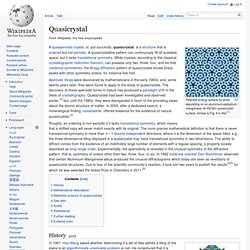
Similar to Fig. 6 in Ref.[1] Aperiodic tilings were discovered by mathematicians in the early 1960s, and, some twenty years later, they were found to apply to the study of quasicrystals. The discovery of these aperiodic forms in nature has produced a paradigm shift in the fields of crystallography. Introduction to Quasicrystals. This page is meant to be an introduction to the field of Quasicrystals in order to educate the interested reader on some basic concepts in this relatively new branch of Crystallography.

The more advanced reader may proceed to other sites and sources on quasicrystals. In classical crystallography a crystal is defined as a threedimensional periodic arrangement of atoms with translational periodicity along its three principal axes.