
Racket. Angularjs. TwitterBootstrap. Javascript. Ruby. JavaScript Touch and Gesture Events iPhone and Android. There are quite a few sites that describe the touch and gesture events that can be used in the mobile version of WebKit running on iPhone and iPod Touch.
There is, however, not so much info with regards to Android. I've placed a few links at the bottom of this article that contain information used to compile this brief explanation. Touch events are a bit like mouse events, but there are some very important differences when it comes to touch vs. mouse: A touch is very hard to keep steady whilst a mouse can stay at a fixed position - this means that we go from a touchStart event directly to a touchMove event.
Unlike a mouse where a mouseDown event is likely to fire without being followed up by a mouseMove event. There is no mouseOver equivalent since a touch can be discontinuous, i.e., we can get from point A to point B without the need of drawing a continuous line between these points. Android and iPhone touch events The Event object Example:
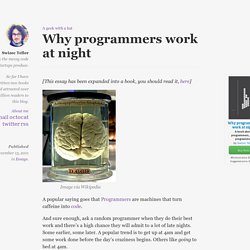
Why Programmers Work At Night. [This essay has been expanded into a book, you should read it, here] Image via Wikipedia A popular saying goes that Programmers are machines that turn caffeine into code.
And sure enough, ask a random programmer when they do their best work and there’s a high chance they will admit to a lot of late nights. Some earlier, some later. A popular trend is to get up at 4am and get some work done before the day’s craziness begins. At the gist of all this is avoiding distractions. I think it boils down to three things: the maker’s schedule, the sleepy brain and bright computer screens. The maker’s schedule Paul Graham wrote about the maker’s schedule in 2009 – basically that there are two types of schedules in this world (primarily?). On the other hand you have something PG calls the maker’s schedule – a schedule for those of us who produce stuff. This is why programmers are so annoyed when you distract them. The sleepy brain But even programmers should be sleeping at night. Bright computer screens. PANAXIOM.
A Filipino Programmer in Japan. Theres the itch again.
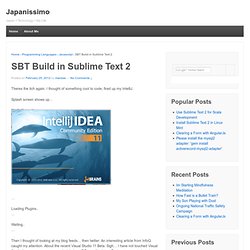
I thought of something cool to code, fired up my IntelliJ. Splash screen shows up… Loading Plugins. Softprops/np. Wuub/SublimeREPL. Resources: Developer-contest. The following Supported technologies are those that Lightbend will provide fixes and patches, and Production SLAs, including 24x7 for Supported products.

Supported Technologies. Structure and Interpretation of Computer Programs. Educators, generals, dieticians, psychologists, and parents program.

Armies, students, and some societies are programmed. An assault on large problems employs a succession of programs, most of which spring into existence en route. These programs are rife with issues that appear to be particular to the problem at hand. To appreciate programming as an intellectual activity in its own right you must turn to computer programming; you must read and write computer programs -- many of them. It doesn't matter much what the programs are about or what applications they serve. Play! Framework. Nosql. Go. OpenLayers: Home. 1.3.11 - animated draggable connectors demonstration - jQuery. Js-graph.it homepage. Arbor.js.
20 Fresh JavaScript Data Visualization Libraries. There are plenty of JavaScript libraries out there for rendering your otherwise plain and boring numerical data into beautiful, interactive, and informative visualizations.

The beauty of using JavaScript for data visualization is that, if created correctly, your data will be highly accessible (usually via HTML tables). A long time ago (2008), I wrote about JavaScript solutions for graphing and charting data and this article revisits the topic with twenty more JavaScript libraries that you can use to bring your data to life. 1.
Highcharts Highcharts is one of the most promising JavaScript charting libraries to hit the scene recently, with its large array of features including seven charting types (line, pie, and bar among them), the ability to zoom in and out of charts, and tooltips for offering more information about data points. 2. gRaphaël. Graph Computation, Layout, Algorithms for JavaScript.
Scala - Tools - [scala-tools] Scala tool for formatting the source code. Ruby Programming Language. The Scala Programming Language. The Go Programming Language.