
Ukiyo-e - Virtual Culture. A Guide to the Ukiyo-e Sites of the Internet. Ukiyo-e. Ukiyo-e, or ukiyo-ye (浮世絵; Japanese pronunciation: [u.ki.jo.e]; "pictures of the floating world"), is a genre of woodblock prints and paintings that flourished in Japan from the 17th through 19th centuries.
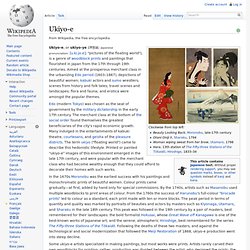
Aimed at the prosperous merchant class in the urbanizing Edo period (1603–1867), depictions of beautiful women; kabuki actors and sumo wrestlers; scenes from history and folk tales; travel scenes and landscapes; flora and fauna; and erotica were amongst the popular themes. Edo (modern Tokyo) was chosen as the seat of government by the military dictatorship in the early 17th century. The merchant class at the bottom of the social order found themselves the greatest beneficiaries of the city's rapid economic growth. Many indulged in the entertainments of kabuki theatre, courtesans, and geisha of the pleasure districts. The term ukiyo ("floating world") came to describe this hedonistic lifestyle. History[edit] Introduction - The Floating World of Ukiyo-e (Library of Congres. The Floating World of Ukiyo-e: Shadows, Dreams, and Substance showcases the Library's spectacular holdings of Japanese "Ukiyo-e" (translated as pictures of the floating, or sorrowful, world) and is the first public viewing of this important and previously unseen collection.
Ukiyo-e. Un article de Wikipédia, l'encyclopédie libre.
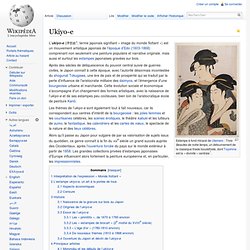
Estampe à fond micacé de Utamaro : Trois Beautés de notre temps, un détournement de la classique triade bouddhiste, dont Toyohina est la « divinité » centrale[1]. Japon - Ukiyo-e: images du monde flottant. Scène de kabuki, Katsukawa Shunko Les peintures et estampes Ukiyo-e sont parmi les arts les plus connus et les plus admirées de la période Edo . Avec la montée en puissance des marchants au cours du 17ème siècle, la demande pour des images représentant la vie urbaine contemporaine du bas peuple augmenta. Les artistes Ukiyo-e répondirent à cette demande en prenant exemple sur des scènes secondaires des peintures du 16ème et 17ème siècles de l’école Tosa ainsi que sur d’autres sources (comme les artistes Kanô et les parchemins et livres illustrés de type Nara-e), puis en les mélangeant avec une approche moderne à la mode en une forme hybride d’art populaire.
La vie de tous les jours devint le sujet extraordinaire , et rapidement plusieurs thèmes fondamentaux apparurent. L’ ukiyo-e était le résultat d’une collaboration entre les artistes, les graveurs, les imprimeurs et les éditeurs . Ukiyo-e: The Pictures of the Floating World. Ukiyo-e - Styles & Movements - Art in the Picture.com. Ukiyo-e Techniques. About the Site This site is intended to help students, collectors and researchers better understand the Ukiyo-e technique.
Taking the Davison Art Center Collection of 18th and 19th century Japanese prints as its starting point, the site focuses on techniques utilized in prints from the collection, and is not meant to be a survey of Japanese prints or a history of Ukiyo-e. Photographs and video clips show demonstrations of the techniques by master printmaker Keiji Shinohara. These demonstrations are accompanied by traditional prints from the DAC collection, and contemporary prints by Keiji Shinohara. Credits Keiji Shinohara: Ukiyo-e technique demonstrations Dan Schnaidt: Project Manager Anne Loyer: Art Direction Wolasi Kofi Konu: Art Direction, Site design, Flash, HTML Luis Miguel Henao: Video Production Colin Theys: Video Production Rob Lancefield: DAC Collection Photography Digital image copyright © Davison Art Center, Wesleyan University; used by permission.
Une brève présentation de la peinture japonaise - l'ukiyo-e - pr. Ukiyo-e signifit "image du monde flottant".
C'est ainsi que le bouddhisme appelle le monde des plaisirs. Ce n'est pas à proprement parler une école, ni la technique des estampes, mais un groupe de sujets, qui n'est pas sans rappeler la peinture de genre européenne. Les oeuvres ukiyo-e existent sous forme d'estampes, et portent alors le nom de hanga, mais aussi de peintures, qui portent le nom de nikuhitsuga. Les sujets au départ étaient les acteurs (yakusha-e), les lutteurs de sumo (sumo-e), les belles femmes (bijinga) et les scènes érotiques (shunga ou higa). Ensuite se sont rajoutés d'autres sujets, comme les paysages, qui ne sont pas à proprement parler des ukiyo-e, mais qui sont en directe filiation. Outre les sujets, ce qui caractérise l'ukiyo-e, du moins les estampes, c'est la commercialisation des oeuvres. Ukiyo-e - Images from the Floating World. Japan, Edo Period (1600s to 1867)
Digital Clendening: Japanese Medical Prints Woodblock Ukiyo-e: H. Ukiyo-e Woodblock Technique. Introduction More than 25 years ago, in the fall of 1984, Sweet Briar College renovated the 1906 former Refectory (now known as the Anne Gary Pannell Center) to house the school's art collection and art library, to provide an exhibition hall, and to provide offices and classrooms for the art history department.
Pannell Gallery also functions as a venue for lectures, classes and other educational programs and public events. Art acquisitions and art collection-related programs and activities are supported in part by the College's Friends of Art. This main gallery is supplemented by two satellite galleries, one located in the lobby of Benedict Hall and one adjacent to the theater and dance studios in Babcock Fine Arts Center. Babcock Gallery is used as a venue for temporary exhibitions featuring recent work by mid-career practicing professional artists, generally from the Mid-Atlantic region, in a variety of media. Vision Statement Mission Statement Affiliations.
Une brève présentation de la peinture japonaise - l'ukiyo-e - de. À cette époque, tous les éléments, tant techniques que sociaux, sont en place pour que l'ukiyo-e atteigne son âge d'or.
Outre la technique des "images de brocart" (nishiki-e), on utilisera celles des laques (urushi-e), des gaufrages et la perspective (uki-e). Socialement, la classe des marchands, bénificiant de la stabilité politique de l'ère Edo et ayant profité de l'incendie qui ravagea Edo en 1657, sont plus riches que jamais. Leur statut est cependant toujours au bas de l'échelle sociale et ils dépensent leurs fortunes dans les plaisirs, comme les estampes. Isoda Koryusai, vu précédemment, est peut-être la charnière entre le style de Harunobu et ce qui viendra plus tard. Son style est déjà plus réaliste et plus décoratif que ceux de ses prédécesseurs. Une des premières manifestations de ce style plus mature est l'apparition dans la seconde moitié du 18ième siècle de la famille Kitao. Mais le premier maître de l'âge d'or est sans doute Torii Kiyonaga (1752-1815).
Musée Critique de la Sorbonne ( MUCRI ) DEGAS Edgar : Femmes à l. The Art of Japan - Japanese prints, woodblock prints, paintings, The Floating World of Ukiyo-E (Library of Congress Exhibition) Modernization in Japan and the Ukiyo-e. Ukiyo-e Gallery. Ukiyo-e. Portrait de Naniwaya Okita par Kitagawa Utamaro. Ukiyo-e 浮世絵, Ukiyo-e est un terme japonais signifiant « image du monde flottant », utilisé durant l'époque d’Edo (1603-1868) pour désigner un nouveau genre de peinture, comprenant non seulement une nouvelle peinture populaire et narrative, mais aussi et surtout les estampes japonaises gravées sur bois. Après des siècles de déliquescence du pouvoir central suivies de guerres civiles, le Japon connaît à cette époque, avec le pouvoir central fort du shogunat Tokugawa, une ère de paix et de prospérité qui se traduit par la perte d'influence de l'aristocratie militaire des daimyō, et l'émergence toute nouvelle d'une bourgeoisie urbaine et marchande.
Cette évolution sociale et économique s'accompagne d'un changement des formes artistiques, avec la naissance de l’ukiyo-e et de ses estampes peu coûteuses, bien loin de l'aristocratique école de peinture Kanō. Ukiyo-E slideshow. Ukiyo-e. L'estampe japonaise. « Vivre uniquement le moment présent, se livrer tout entier à la contemplation de la lune, de la neige, de la fleur de cerisier et de la feuille d’érable […], ne pas se laisser abattre par la pauvreté et ne pas la laisser transparaître sur son visage, mais dériver comme une calebasse sur la rivière, c’est ce qui s’appelle ukiyo. » Le Japon à l’époque d’Edo (1603-1868) L’époque d’Edo correspond au gouvernement des Tokugawa, qui siégea pendant plus de deux siècles et demi.
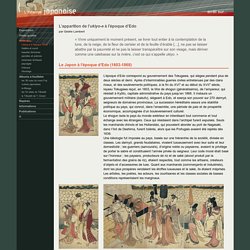
Après d’interminables guerres civiles entretenues par des clans rivaux, et des soulèvements politiques, à la fin du XVIe et au début du XVIIe siècle, Ieyasu Tokugawa reçut, en 1603, le titre de shogun (généralissime), de l’empereur, qui résidait à Kyôto, capitale administrative du pays jusqu’en 1868. Il instaura un gouvernement militaire (bakufu), siégeant à Edo, et exerça son pouvoir sur 270 daimyô, seigneurs de domaines provinciaux. Une discipline sévère fut imposée. Une effervescence urbaine Des quartiers réservés. Jim Breen's Ukiyo-E Gallery. 82.04.03: Visions of People: The Influences of Japanese Prints—U.
During the 1860s Japanese art flowed into France as a result of the reopening of trade relations between Europe and Japan, brought about by Commodore Matthew C.
Perrys diplomatic trips to Japan and a subsequent trade treaty. Ukiyoe Gallery - Thumbnails. Ukiyo-e. Ukiyo-e, images du monde flottant. Ukiyo-e, un grand symbole dans l’art du japon est né de l’époque EDO (1605-1868). Cette période florissante est née à l'arrivée de Ieyasu Tokugawa après de la bataille de Sekigahara, et se termine vers 1868 avec la restauration Meiji. Tokugawa a choisi Edo (ancien nom de Tōkyō) comme capitale. A cet époque, Edo était déjà une grande agglomération de plus d'un million habitants. Carrefour économique et centre de la culture japonaise, Edo était le phare du Japon. Aussi, per Edo que les occidentaux ont découvert Ukiyo-e, grâce à l'ouverture du Japon vers la mondernisation. Ukiyo-e (se traduit « images du monde flottant ») est une perle de la culture d’Edo (aujourd’hui Tokyo).Cet art populaire et narrative connaissait l'euphorie sous le règne su shogonat Ieyasu Tokugawa. crédit photo artcyclopedia.
Ukiyo-e - une vidéo. Ukiyoe-Gallery - Ukiyo-e & Shin Hanga Japanese Woodblock Prints,