
Challenges in Cardiac Tissue Engineering. The Radicalness Of 3D Printing. Way back in February of 2011, I wrote an extensive article for H+ on 3D printing and how it would allow a transition between an economy based on material “value” and scarcity to one based on nonmaterial “value” and abundance.
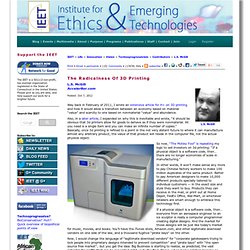
Also, in a later article, I expanded on why this is inevitable and wrote, “it should be obvious that 3d printers allow for goods to behave as if they were nonmaterial. All you need is a single item and you can make an infinite number of copies.” Basically, once 3d printing is refined to a point in the not very distant future to where it can manufacture almost any arbitrary product, the value of that product will reside in the computer file, not the actual physical object. So now, “The Motley Fool” is repeating my logic to sell investors on 3d printing: “If a physical object is a software code, then… there are no longer economies of scale in manufacturing.”
Replacement Parts. For Joseph Vacanti, the quest to build new organs began after watching the death of yet another child.

In 1983, the young surgeon was put in charge of a liver transplantation program at Boston Children’s Hospital in Massachusetts. His first operation was a success, but other patients died without ever being touched by a scalpel. “In the mid-80s, kids who were waiting for organs had to wait for a child of the same size to die,” says Vacanti. “Many patients became sicker and sicker before my eyes, and I couldn’t provide them with what they needed. Cardiac HA mechanotransduction. Injectable cardiac scaffold.