
20120999.full. New Learning Environments final _4_.doc. The Art of Teaching Science. If only teaching K-12 science was itself a science – assess student knowledge deficits and remedy them.
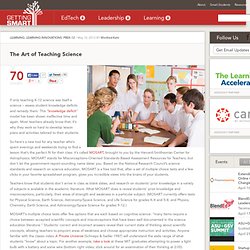
This “knowledge deficit” model has been shown ineffective time and again. Most teachers already know that; it’s why they work so hard to develop lesson plans and activities tailored to their students. So here’s a new tool for any teacher who’s spent evenings and weekends trying to find a lesson that’s the perfect fit for their class: it’s called MOSART, brought to you by the Harvard-Smithsonian Center for Astrophysics. MOSART stands for Misconceptions-Oriented Standards-Based Assessment Resources for Teachers, but don’t let the government-report-sounding name deter you. Based on the National Research Council’s science standards and research on science education, MOSART is a free tool that, after a set of multiple choice tests and a few clicks in your favorite spreadsheet program, gives you incredible views into the brains of your students.
BioVisions. Beard. The need for ‘Why To’ guides. The need for 'Why To' guides I’m not a fan of telling people how to do things.

OK, that may not strictly speaking be true, but I do believe that just explaining how to solve a problem is unlikely to result in much learning. The best way is to learn is to think about why a problem should be solved. As teachers we often bemoan the fact that we’re not treated with respect as a profession. There are probably all sorts of reasons for this but one reason is the extent to which we’ve allowed ourselves to be told how we should teach. We all learn how to do these things, but do we know why?
So, how has this come to pass? Related posts Like this: Like Loading... Sketchnotes 101: The Basics of Visual Note-taking. Welcome to the second article in the the new Core77 "Sketchnotes Channel" (www.core77.com/sketchnotes) where we'll be exploring the application of visual thinking tools in the worlds of design and creative thinking.
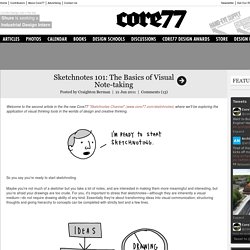
So you say you're ready to start sketchnoting. Maybe you're not much of a sketcher but you take a lot of notes, and are interested in making them more meaningful and interesting, but you're afraid your drawings are too crude. For you, it's important to stress that sketchnotes—although they are inherently a visual medium—do not require drawing ability of any kind. Essentially they're about transforming ideas into visual communication; structuring thoughts and giving hierarchy to concepts can be completed with strictly text and a few lines. Maybe you're perpetually drawing and want to try and make your notes more useful and engaging but you are afraid of imposing structure to your normally freeform way of sketching.
In the end, it's up to you. So let's get tactical. Comenius. Request Vernier White Paper. Watch 32 discordant metronomes achieve synchrony in a matter of minutes. Sperm Trajectories, Evolving Humans and a Tomato Tapestry: The Best Scientific Figures of 2012. Figures contained in scientific reports are a neglected area of the design world.

Typically intended for display to academic audiences in the cramped confines of a journal, they tend to be utilitarian and esoteric -- yet while looking through hundreds of articles in the course of 2012, certain figures transcended the technical and rose to the level of communication art. They combined visual clarity, information density and insight into some fact of fundamental interest. The Rap Guide to Evolution. Artificial selection, it starts with a question How did people ever get cows, chickens and pigs And other animals and plants to act so domestic?

We took them from the wild and we bred them, brethren Welcome to the Charles Darwin Bicentennial So, why does everybody think this guy is so special? Maybe because a man was born two centuries ago Who, as far as anyone knows, was the first To recognize the underlying pattern behind the pageant Affectionately known as “life on this planet” He was the first to understand it The first to translate his amazement At the wonder of life, into a way to explain it So this is a celebration of Darwin’s greatness In the form of a rap – some would say “a debasement” I would say “be patient”, just think of this as A manifestation of the evolutionary equation A recapitulation of life, a re-enactment So, how do you go from amoebas to rappers?
Scratch: “Too many MCs, not enough Mics” (Pras from the Fugees) Ifitsgreenitsbiology. The news today that the fact that our fingers wrinkle when they are wet is possibly an evolutionary adaptation for handling objects in wet conditions is quite an interesting piece of research.

I am sure that the question “Why do our fingers get wrinkly when we are in the bath?” Is a question that teachers have heard many times. Probably somewhere in the top 10 along with “How do identical twins happen?” “How do Siamese twins happen?” You get the idea… Anyway, I was impressed that The Guardian to link to the paper in their story (unlike the BBC and most science news stories in general) and was even further impressed that the paper is open access. The first interesting thing is that our fingers do not become wrinkly “because of osmosis or something” which has always been my get out of jail answer, but is actually an autonomic nervous response. Best science stories of 2012 – in pictures.