
Top 10 Philosophical One Liners. Miscellaneous Philosophy is no more or less than the search for wisdom.
It deals with all manner of problems which everyone faces in their lives, and by thought and logic attempts to solve them. Since we live in a terrifically complex universe lots of philosophy is itself, very complex. Modern academic philosophy can be almost impenetrable to an outsider, and anything not couched in the terms of the academic philosopher is considered simple musing. However, philosophy has thankfully provided lots of short, pithy philosophical statements to ponder.
You cannot step in the same river twice. Heraclitus of Ephesus, also known as the Weeping Philosopher and Heraclitus the Obscure, has left us only a few philosophical sentences. Death need not concern us because when we exist death does not, and when death exists we do not. Epicurus and Epicureanism, has suffered for many years from a misapprehension about what his philosophy teaches.
God is dead. Man is the measure of all things. Philosophy: Guide to Happiness. We tend to accept that people in authority must be right.

It's this assumption that Socrates wanted us to challenge by urging us to think logically about the nonsense they often come out with, rather than being struck dumb by their aura of importance and air of suave certainty. This six part series on philosophy is presented by popular British philosopher Alain de Botton, featuring six thinkers who have influenced history, and their ideas about the pursuit of the happy life.
Socrates on Self-Confidence (Part 1) - Why do so many people go along with the crowd and fail to stand up for what they truly believe? Partly because they are too easily swayed by other people's opinions and partly because they don't know when to have confidence in their own. Seneca on Anger (Part 3) - Roman philosopher Lucious Annaeus Seneca (4BCE-65CE), the most famous and popular philosopher of his day, took the subject of anger seriously enough to dedicate a whole book to the subject. Bertrand Russell. Russell led the British "revolt against idealism" in the early 20th century.[58] He is considered one of the founders of analytic philosophy along with his predecessor Gottlob Frege, colleague G.
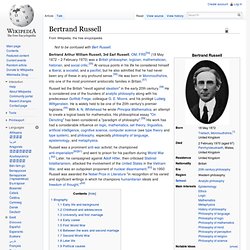
E. Moore, and his protégé Ludwig Wittgenstein. He is widely held to be one of the 20th century's premier logicians.[55] With A. N. Whitehead he wrote Principia Mathematica, an attempt to create a logical basis for mathematics. Russell was a prominent anti-war activist; he championed anti-imperialism[60][61] and went to prison for his pacifism during World War I.[62] Later, he campaigned against Adolf Hitler, then criticised Stalinist totalitarianism, attacked the involvement of the United States in the Vietnam War, and was an outspoken proponent of nuclear disarmament.[63] In 1950 Russell was awarded the Nobel Prize in Literature "in recognition of his varied and significant writings in which he champions humanitarian ideals and freedom of thought Biography Early life and background Early career.
Ludwig Wittgenstein. Ludwig Josef Johann Wittgenstein (26 April 1889 – 29 April 1951) was an Austrian-British philosopher who worked primarily in logic, the philosophy of mathematics, the philosophy of mind, and the philosophy of language.[4] From 1939–1947, Wittgenstein taught at the University of Cambridge.[5] During his lifetime he published just one slim book, the 75-page Tractatus Logico-Philosophicus (1921), one article, one book review and a children's dictionary.[6] His voluminous manuscripts were edited and published posthumously.
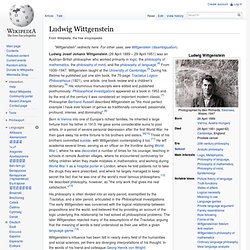
Philosophical Investigations appeared as a book in 1953 and by the end of the century it was considered an important modern classic.[7] Philosopher Bertrand Russell described Wittgenstein as "the most perfect example I have ever known of genius as traditionally conceived; passionate, profound, intense, and dominating".[8] Born in Vienna into one of Europe's richest families, he inherited a large fortune from his father in 1913. Background[edit] The Wittgensteins[edit]