
Hobbes' Internet Timeline - the definitive ARPAnet & Internet history. 1950s | 1960s | 1970s | 1980s | 1990s | 2000s | 2010s | Growth | FAQ | Sources by Robert H'obbes' Zakon with support from Zakon Group LLC and OpenConf Interested in having Hobbes speak on the history of Internet technology and innovation at your event?
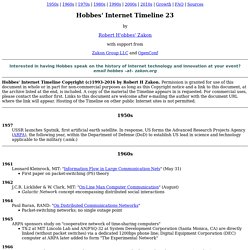
Hobbes' Internet Timeline Copyright (c)1993-2016 by Robert H Zakon. 1950s USSR launches Sputnik, first artificial earth satellite. 1960s Leonard Kleinrock, MIT: "Information Flow in Large Communication Nets" (May 31) First paper on packet-switching (PS) theory J.C.R. Paul Baran, RAND: "On Distributed Communications Networks" Packet-switching networks; no single outage point ARPA sponsors study on "cooperative network of time-sharing computers" TX-2 at MIT Lincoln Lab and AN/FSQ-32 at System Development Corporation (Santa Monica, CA) are directly linked (without packet switches) via a dedicated 1200bps phone line; Digital Equipment Corporation (DEC) computer at ARPA later added to form "The Experimental Network" Lawrence G. 1970s 1980s 1990s 2000s.
70 Things Every Computer Geek Should Know. The term ‘geek’, once used to label a circus freak, has morphed in meaning over the years. What was once an unusual profession transferred into a word indicating social awkwardness. As time has gone on, the word has yet again morphed to indicate a new type of individual: someone who is obsessive over one (or more) particular subjects, whether it be science, photography, electronics, computers, media, or any other field. A geek is one who isn’t satisfied knowing only the surface facts, but instead has a visceral desire to learn everything possible about a particular subject. A techie geek is usually one who knows a little about everything, and is thus the person family and friends turn to whenever they have a question. If you’re that type of person and are looking for a few extra skills to pick up, or if you’re a newbie aiming to get a handhold on the honor that is geekhood, read on to find out what skills you need to know.
How to become a real computer Geek? You may get the answer here: Wired 7.01: Look Who's Talking. Look Who's Talking The Amish are famous for shunning technology.

But their secret love affair with the cell phone is causing an uproar. By Howard Rheingold Technology is my native tongue. I'm online six hours a day. Of course, I'm not the only one asking. Amish settlements have become a cliché for refusing technology. Last summer, armed with these questions and in the company of an acquaintance with Amish contacts, I traveled around the countryside of Lancaster County, Pennsylvania. "Whenever you see an Amish woman sitting in the field like that," my guide said, "she's probably talking on a cell phone.
" "It's a controversy in the making," he continued. Collective negotiations over the use of telephones have ignited intense controversies in the Amish community since the beginning of the 20th century. Eventually, certain Amish communities accepted the telephone for its aid in summoning doctors and veterinarians, and in calling suppliers. Page 2 >> Previous Story: Short Term Prophets.