
Designing MongoDB Schemas with Embedded, Non-Embedded and Bucket Structures. With the rapid adoption of schema-less, NoSQL data stores like MongoDB, Cassandra and Riak in the last few years, developers now have the ability enjoy greater agility when it comes to their application’s persistence model.

However, just because a datastore is schema-less, doesn’t mean the structure of the stored documents won’t play an important role in the overall performance and resilience of the application. In this first, of a four part blog series about MongoDB we’ll explore a few strategies you should consider when designing your document structure. Application requirements should drive schema design If you ask a dozen experienced developers to design the relational database structure of an application, such as a book review site, it’s likely that each of the structures will be very similar. You’ll likely see tables for authors, books, commenters and comments and so on.. 10gen, the MongoDB company.
Forbes is nearly 100 years old and is the largest U.S-based business media brand.
An online version of the print publication was established more than a decade ago, with 2% of its content originating from the magazine and the remaining 98% exclusively created for the web. The changing media landscape and the drive for more dynamic content required a nimble site that didn’t involve reengineering with every addition or change. Now, Forbes.com stores all of its core assets, including data for articles and the company’s renowned Lists (e.g. MongoDB vs. SQL Server 2008 Performance Showdown. This article is a follow up one I wrote last week entitled “The NoSQL Movement, LINQ, and MongoDB – Oh My!”.
In that article I introduced the NoSQL movement, MongoDB, and showed you how to program against it in .NET using LINQ and NoRM. Thoughts on MongoDB from a SQL Server Dev. As someone with a background in SQL Server development dating back to 2000, the whole NoSQL jazz has been something that's been on the radar for a while but never made it under the microscope so to speak.

Partly because SQL Server is my comfort zone and there's plenty more to still learn about that; partly because I've had my career mapped out in my head and NoSQL didn't feature much in that vision; partly because until you have something real-world driving a push into a technology then you tend to have that technology remaining as a distant dot on the radar. Back at QCon London last year, I had the opportunity to hear a bit more about the NoSQL world from some great speakers - I think the CAP theorem cropped up in most sessions I attended. The dot on the radar moved a bit closer. Back To The Future Fast forward a bit and the real-world driver to take a look into NoSQL technologies appeared.
NoSQL with a capital NOT ONLY The whole "NoSQL" term has been done to death. Migrating from Microsoft SQL Server to MongoDB - Lessons Learned. Migrating from Microsoft SQL Server to MongoDB - Lessons Learned Your database is one of your most important technical stakeholders and will influence every major decision you make during the lifetime of your product.
Once you have made your choice and built on top of it, chances are that you would never consider migrating to a radically different solution. As difficult of a decision as it was, early this year we migrated all our data from Microsoft SQL Server, a traditional relational database, to MongoDB which is a “NoSQL” document-based database. Production Deployments. Transitioning from Mongoose-Auth to Passport for Authentication in Node.js. Up until about a week ago, I was using Mongoose-Auth, when I decided my app needed some cleaning up.
For most simple Node.js apps, it makes sense to route everything through your app.js (or server.js, depending on your preference/framework) file. But once your app starts to get a bit more developed, it makes more sense to break some of the code out into separate files, not only to make it easier to read, but also to make it easier to debug. NoSQL Data Modeling Techniques « Highly Scalable Blog.
NoSQL databases are often compared by various non-functional criteria, such as scalability, performance, and consistency.
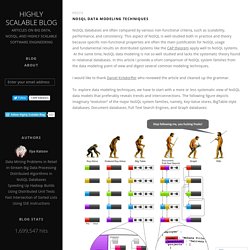
This aspect of NoSQL is well-studied both in practice and theory because specific non-functional properties are often the main justification for NoSQL usage and fundamental results on distributed systems like the CAP theorem apply well to NoSQL systems. At the same time, NoSQL data modeling is not so well studied and lacks the systematic theory found in relational databases. In this article I provide a short comparison of NoSQL system families from the data modeling point of view and digest several common modeling techniques. How This Web Site Uses MongoDB. Warning: this post is intended for developers.

It gets a bit technical! Sometimes I'm asked what platform we're running the Business Insider on. Well, we're using LAMP, of course: Linux, Apache, Mongo, PHP. After I get past defending our choice of PHP to the haters (you know who you are!) M101 Courseware.