
Fictional universe. A fictional universe can be almost indistinguishable from the real world, except for the presence of the invented characters and events that characterize a work of fiction; at the other extreme it can bear little or no resemblance to reality, with invented fundamental principles of space and time. Definition[edit] What distinguishes a fictional universe from a simple setting is the level of detail and internal consistency. A fictional universe has an established continuity and internal logic that must be adhered to throughout the work and even across separate works.
So, for instance, many books may be set in conflicting fictional versions of Victorian London, but all the stories of Sherlock Holmes are set in the same Victorian London. However, the various film series based on Sherlock Holmes follow their own separate continuities, and so do not take place in the same fictional universe. Science fiction. §Definition[edit] A futuristic setting is a common but not a necessary hallmark of science fiction.

A common thread in science fiction is exploring the potential consequences of scientific and other innovations on people's lives. According to science fiction writer Robert A. Heinlein, "a handy short definition of almost all science fiction might read: realistic speculation about possible future events, based solidly on adequate knowledge of the real world, past and present, and on a thorough understanding of the nature and significance of the scientific method. Science fiction is largely based on writing rationally about alternative possible worlds or futures.[8] It is similar to, but differs from fantasy in that, within the context of the story, its imaginary elements are largely possible within scientifically established or scientifically postulated physical laws (though some elements in a story might still be pure imaginative speculation). §History[edit] §The term "sci-fi"[edit]
Terry Pratchett. Pratchett was the UK's best-selling author of the 1990s,[6][7] and has sold over 85 million books worldwide in 37 languages.[8][9] He is currently the second most-read writer in the UK, and seventh most-read non-US author in the US.[10] Pratchett was appointed Officer of the Order of the British Empire (OBE) in 1998 and was knighted for services to literature in the 2009 New Year Honours.[11][12] In 2001 he won the annual Carnegie Medal for The Amazing Maurice and his Educated Rodents, the first Discworld book marketed for children.[13][14] He received the World Fantasy Award for Life Achievement in 2010.
In December 2007, Pratchett announced that he was suffering from early-onset Alzheimer's disease.[15] Subsequently he made a substantial public donation to the Alzheimer's Research Trust,[16] and filmed a programme chronicling his experiences with the disease for the BBC. Discworld (world) Great A'Tuin is the Giant Star Turtle (of the fictional species: Chelys galactica) who travels through the Discworld universe's space, carrying four giant elephants (named Berilia, Tubul, Great T'Phon, and Jerakeen) who in turn carry the Discworld. The narration has described A'Tuin as "the only turtle ever to feature on the Hertzsprung-Russell diagram. "
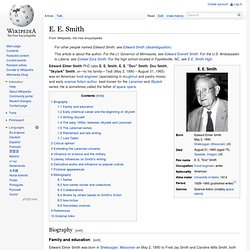
E. E. Smith. Biography[edit] Family and education[edit] Smith worked primarily as a manual laborer until he injured his wrist, at the age of 19, while escaping from a fire.
Lensman series. The Lensman series is a serial science fiction space opera by Edward Elmer "Doc" Smith.
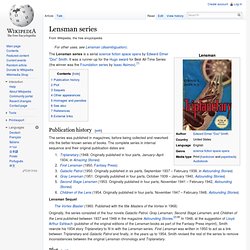
It was a runner-up for the Hugo award for Best All-Time Series (the winner was the Foundation series by Isaac Asimov).[1] Fantasy literature. History[edit] Stories involving paranormal magic and terrible monsters have existed in spoken forms before the advent of printed literature.
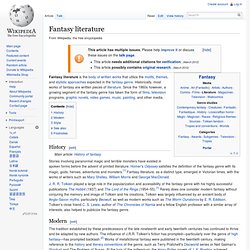
Homer's Odyssey satisfies the definition of the fantasy genre with its magic, gods, heroes, adventures and monsters.[1] Fantasy literature, as a distinct type, emerged in Victorian times, with the works of writers such as Mary Shelley, William Morris and George MacDonald. J. Robert E. Howard. Robert Ervin Howard (January 22, 1906 – June 11, 1936) was an American author who wrote pulp fiction in a diverse range of genres. Conan the Barbarian. Publication history[edit] Having digested these prior influences after he returned from his trip, Howard rewrote the rejected story "By This Axe I Rule!
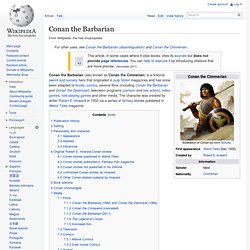
" (May 1929), replacing his existing character Kull of Atlantis with his new hero, and retitling it "The Phoenix on the Sword". Howard also wrote "The Frost-Giant's Daughter", inspired by the Greek myth of Daphne,[citation needed] and submitted both stories to Weird Tales magazine. Solomon Kane. Solomon Kane is a fictional character created by the pulp-era writer Robert E.
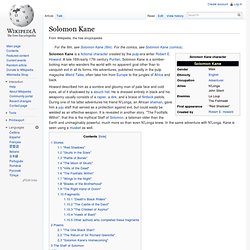
Howard. A late 16th/early 17th century Puritan, Solomon Kane is a somber-looking man who wanders the world with no apparent goal other than to vanquish evil in all its forms. Michael Moorcock. Michael John Moorcock (born 18 December 1939) is an English writer, primarily of science fiction and fantasy, who has also published literary novels.

Eternal Champion. The Eternal Champion is a fictional creation of the author Michael Moorcock and is a recurrent feature in many of his novels.

About the Eternal Champion[edit] The fictional Multiverse, which consists of several universes, many layered dimensions, spheres, and alternative worlds, is the place where the eternal struggle between Law and Chaos, the two main forces of Moorcock's worlds, takes place. In all these dimensions and worlds, these forces constantly war for supremacy.
Elric of Melniboné. Elric of Melniboné[1] is a fictional character created by Michael Moorcock, and the antihero of a series of sword and sorcery stories centring in an alternate Earth.

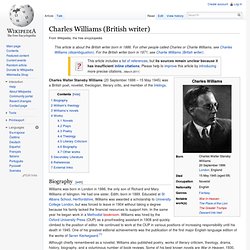
The proper name and title of the character is Elric VIII, 428th Emperor of Melniboné. Later novels by Moorcock mark Elric as a facet of the Eternal Champion. Elric first appeared in print in Moorcock's novella, "The Dreaming City" (Science Fantasy No. 47, June 1961); subsequent novellas were reformatted as the novel Stormbringer (1965), but his first appearance in an original novel wasn't until 1973 in Elric of Melniboné. Fritz Leiber. Fritz Leiber. The Wanderer. Swords and Deviltry. The swords of Lankhmar. Charles Williams (British writer) Charles Walter Stansby Williams (20 September 1886 – 15 May 1945) was a British poet, novelist, theologian, literary critic, and member of the Inklings.
Williams gathered many followers and disciples during his lifetime. The Place of the Lion. Platonic archetypes begin to appear throughout England, wreaking havoc and drawing to the surface the spiritual strengths and flaws of individual characters. Critical reception[edit] Boucher and McComas described The Place of the Lion as "one of the most daringly conceived and stunningly visualized of all [Williams's] novels.
".[1] Editions[edit] Pellegrini & Cudahy, 1933Regent College Publishing, 2003, ISBN 1-57383-108-5Victor Gollancz Ltd / London / 1947 References[edit] External links[edit] Project Gutenberg of Australia eBook.