
New Red Programming Language Gets Syllable Backend. There's a new REBOL like programming language in town.
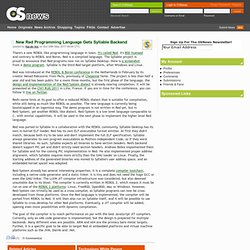
It's called Red, it's BSD licensed and contrary to REBOL and Boron, Red is a compiled language. The Syllable project is proud to announce that Red programs now run on Syllable Desktop. Here is a screenshot from a demo program. Syllable is the third Red target platform, after Windows and Linux. Red was introduced at the REBOL & Boron conference in the Netherlands in February by its creator Nenad Rakocevic from Paris, previously of Cheyenne fame.
Red's name hints at its goal to offer a reduced REBOL dialect that is suitable for compilation, while still being as much like REBOL as possible. Red was ported to Syllable in a collaboration with the REBOL community. Red/System already has several interesting properties. The goal of the compiler is to reach performance on par with the best JavaScript JIT compilers. Top 13 Most Absurd Programming Languages. An esoteric programming language (sometimes shortened to esolang) is a programming language designed as a test of the boundaries of computer programming language design, as a proof of concept, or as a joke.
There is usually no intention of the language being adopted for mainstream programming, although some esoteric features such as visuospatial syntax have inspired practical applications in the arts. Such languages are often popular among hackers and hobbyists. This use of esoteric is meant to distinguish these languages from more popular programming languages. I’m a programmer, I know my way through many languages from ASM and all the way to PHP. Learning a new programming language takes a lot of time and effort, but making a new one takes even more. 1. Lolcode was inspired by the language expressed in examples of the lolcat Internet meme. “Hello World” example:HAI CAN HAS STDIO? 2.Befunge “Hello World” example:"dlroW olleH">:v ^,_@ 3.
Top 10 Truly Bizarre Programming Languages. Technology This is a list of some of the most bizarre programming languages you will ever see.

These types of languages are usually called “Esoteric Programming Languages”. An esoteric programming language (sometimes shortened to esolang) is a computer programming language designed either as a test of the boundaries of programming language design, to experiment with weird ideas or simply as a joke, rather than for practical reasons.
There is usually no intention of the language being adopted for real-world programming. Such languages are often popular among hackers and hobbyists. Usability is rarely a high priority for such languages; often quite the opposite. Many fascinating and unlikely languages have been developed, and there is a small but active Internet community of people creating, programming in and debating them. A “Hello World” program has traditionally been the first program most people learn in a language that is new to them. Pictured above is “Hello World” in Whitespace. Poor, poor child. You have no idea. It's harder than you think.
Right now you're probably underestimating the amount of frustration and discomfort you're about to experience, without realizing that by doing so you're creating all sorts of subtle barriers to obtaining a deep understanding of programming. The problem is that while you've uncovered a wonderful world that makes coding seem so approachable and fun, you're unknowingly making a giant leap by thinking it's somehow also easy.
This might not seem like a big deal, but it's huge. Every single time (and this will happen constantly) you come across a concept that seems foreign or difficult or even just unintuitive, instead of thinking "It's OK. Programming is hard. " you're going to be thinking "This is supposed to be easy. Programming is not always intuitive, it's inherently complex, and it's challenging. You're lucky to have stumbled across a very good first language, but you're likely to encounter developers who will tell you that this decision doesn't matter. Honest to a Segfault» Blog Archive » Why programming languages? I am totally taken aback by the lack of hyperbolic romanticism in the foreword of the programming language book that I just got.
There are horribly boring-sounding hooks along the lines of "computers are ubiquitous in the 21st century" and "connecting the theoretical foundations of computer science to modern platform architectures". Hopefully people don't judge a book by its cover or its foreword. Pragmatic rhetoric is uninspiring — you could just as easily write a foreword for a book on ripping up floorboards and talk about how "floorboards are ubiquitous in the 21st century" and "connects the theoretical foundations of wood science to modern house architectures".
If I were to write a foreword that mentioned the reasons you should be interested in programming languages, it would go roughly like this, to which I hope there is no analogy for ripping up floorboards: Foreword Rejoice, programming languages are the irrigation ditches of your mind-goo! Christopher D. Guy With a Blog The Internet.
Semantica. AST. Data.