
Google Translate. Keeping Chickens Warm in Winter - Low Cost Living. Keeping chickens warm in the winter can be a bit difficult but they are pretty hardy creatures that come dressed in their own feather duvet.

Winter Poultry Housing When it comes to the colder weather you need to make a few basic checks of your coop or ark that your poultry are being kept in dry draught free conditions. Make sure ventilation is above head height and that there are no draughts coming through the coop. The waterproofing needs to be checked and any areas that are dripping water into the housing need to be sealed quickly. Chickens and ducks don’t mind the cold but they do mind draughts and the rain at night so these are a top winter priority for them.
If you have any escaping roosting chickens or hiding ducks now is the time to really encourage them to go into the coop. Although they hold body temperature well with their feathers keeping them toastie warm in freezing weather they do need shelter together as this allows them to share their body heat. Chicken Checks for Winter. C P Films, Inc. C P Films Inc. Les241 Gila Heat Control Insulating Window Film. Eco-principles. Principles of eco-design From all the many theories behind environmental design, this section pulls out just five core ideas.

They are all important, and they provide the tools for approaching most design challenges. There are also some excellent books that talk in far more detail about these concepts (see recommended books). In this section: Working with the sun Thermal mass Stack effect Thermal zoning Embodied energy Six principles for making priorities PRINCIPLES OF ECO-DESIGN: 1. Controlled glazing is the vital component of environmental design.
However, there are problems with glass too. So the use of glass is a juggling act - having enough glass to benefit from the free heat of the sun, enough glass to let in plenty of daylight, but not so much that the house overheats during sunny days and freezes at night. PRINCIPLES OF ECO-DESIGN: Orientation Orientation refers to the location of a house and direction to which a house points. 1. 1. PRINCIPLES OF ECO-DESIGN: 2. 1. DIY Kyoto Wattson Classic Energy Monitor. Benefits of Insulating Windows" As we mentioned, windows can be a costly feature of a home, accounting for substantial heat loss in cold weather and heat gain in warm weather.

Single-pane windows, found in nearly 50 percent of American homes, are the most extreme in terms of energy-inefficiency [source: Money Matters 101]. Improving the energy infrastructure of your home will reduce home heating and cooling costs and help reduce fossil fuel consumption, slowing down the carbon emissions that are disrupting the global climate. Heat loss through windows takes place in four distinct ways: Air leaks directly in and out from gaps along the edges (infiltration).Heat passes through the window glass (conduction).Heat energy flows from a warm object toward any cooler object nearby until equilibrium is achieved (radiation).
Effective window insulation prevents heat loss and also helps regulate the surface temperature of the interior glass. Thermosiphon. Thermosyphon circulation in a simple solar water heater Thermosiphon (alt. thermosyphon) is a property of physics and refers to a method of passive heat exchange based on natural convection, which circulates a substance (liquid, or gas such as air) without the necessity of a mechanical pump.
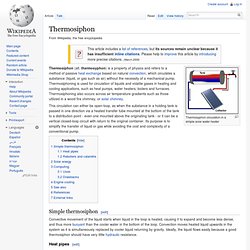
Thermosiphoning is used for circulation of liquids and volatile gases in heating and cooling applications, such as heat pumps, water heaters, boilers and furnaces. Thermosiphoning also occurs across air temperature gradients such as those utilized in a wood fire chimney, or solar chimney. This circulation can either be open-loop, as when the substance in a holding tank is passed in one direction via a heated transfer tube mounted at the bottom of the tank to a distribution point - even one mounted above the originating tank - or it can be a vertical closed-loop circuit with return to the original container.
Simple thermosiphon[edit] Heat pipes[edit] Reboilers and calandria[edit] Solar energy[edit] 5 Green NASA Inventions" This might seem odd considering how much of NASA researchers' focus is directed skyward, but from time to time, they also study how to improve soil conditions right here on Earth.

(Though to be fair, the main motivation behind at least one important innovation was cleaning up contamination that NASA caused in the first place.) During the Apollo program, NASA workers used toxic chemical solvents to clean the rockets waiting on the launch pad. These solvents are also employed in manufacturing processes as diverse as producing dry cleaning fluids or keeping pests away from growing crops.
Unfortunately, when released into the ground, they spread far, last a long time, and when they eventually do degrade, they often produce other harmful substances. So scientists from the Kennedy Space Center teamed up with researchers from the University of Central Florida, and together they developed a way to remediate the solvents that was faster and more cost-effective than the few existing methods.