
Jive Dictionary. An apostrophe ban? Whats next? American English Dialects. North American English Dialects, Based on Pronunciation Patterns Small-Scale Dialect Map The small map below is the same as the Full-Scale Dialect Map that follows, but shows the entire width of the map (on most monitors). 24-Aug.-2010 Click on any part of this map to move to the equivalent part of the Full-Scale Dialect Map.
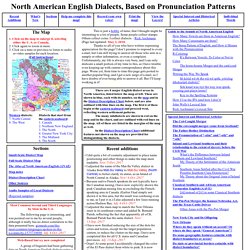
(For now this only moves to the far left or the far right of the Full-Scale Dialect Map, so unfortunately it doesn’t work well for the middle portions, and you will just have to scroll over.) 24-Aug.-2010 Full-Scale Dialect Map Instructions For many of the cities or towns on this map, you can listen to an audio or video sample of speech of a native (more specifically, someone who was raised there, though not necessarily born there, and whose dialect clearly represents that place). The cities and towns with a large dot are those which are larger or more important in each state or province. Help! Data from the Atlas of North American English (ANAE) Map Notes Other Sources.
ASL Sign Language Video Dictionary. Artificial Grammar Reveals Inborn Language Sense, JHU Study Shows « News from The Johns Hopkins University. May 12, 2011 FOR IMMEDIATE RELEASE MEDIA CONTACT: Lisa De Nike 443-287-9960Lde@jhu.edu Parents know the unparalleled joy and wonder of hearing a beloved child’s first words turn quickly into whole sentences and then babbling paragraphs.

But how human children acquire language-which is so complex and has so many variations-remains largely a mystery. Fifty years ago, linguist and philosopher Noam Chomsky proposed an answer: Humans are able to learn language so quickly because some knowledge of grammar is hardwired into our brains. In other words, we know some of the most fundamental things about human language unconsciously at birth, without ever being taught. Now, in a groundbreaking study, cognitive scientists at The Johns Hopkins University have confirmed a striking prediction of the controversial hypothesis that human beings are born with knowledge of certain syntactical rules that make learning human languages easier. Jennifer Culbertson learning process. Paul Smolensky. The Spelling Society. It is well known that English words derive mainly from old German and Norman French, and that its alphabet of 26 letters makes it impossible to represent its 43 ½ speech sounds with just one symbol.

But that is not why many English spellings, such as ‘daughter’, ‘brought’ and ‘people’, are now irregular, while their German and French relatives have much better spellings (Tochter, brachte, peuple). The pronunciations of all three languages have changed since 1066. But only in English have numerous spellings become highly unreliable guides to pronunciation (sound, southern, soup), and spellings for identical sounds have ended up exceptionally varied (blue, shoe, flew, through, to, you, two, too, gnu). The consistency of English spelling was first seriously corrupted during the reinstatement of English as the official language of England in 15th century. It suffered even more at the hands of foreign printers during the bible wars of the 16th century. The English spelling system. Nick Patrick - Did Americans in 1776 have British accents?
Morettian Graphology: » Personality traits in handwriting. Non-Errors. Unusual Words. Unusual Words A by no means exhaustive list of rare, obscure, strange and sometimes funny words and their meanings that only seem to crop up in crosswords and dictionaries. Words that are used so seldom, you wonder who invented them and why. Home ~ The Stories ~ Diversions ~ Links ~ Contact. Language pet peeves « brainsnorts inc >.< There are a few phrases that people are constantly saying that are just plain wrong, and apparently the people themselves just refuse to listen when i try to explain the errors. 1.
“it was all downhill (or uphill) from there.” the reason people get this phrase wrong is because they are mixing up what it is referring to. people are under the false impression that this has to do with a growth chart or line graph, in which a line going “up” is a good thing, line going “down” is a bad thing. however, what it really refers to is riding a bicycle either “uphill” or “downhill.” on a growth chart, down is bad. but on a bicycle, down is good. so when we believe that things are progressing smoothly and easily, we are supposed to be saying that “it was all DOWNhill.” and when things are difficult, we should be saying that the conditions were “UPhill.” please get it right. 2.
“i could care less.” 3. 4. The Greek Alphabet. Phonology and Orthography Oops!
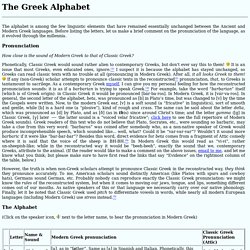
Twenty-four letters only? Surely some sounds must be missing? That’s correct. OneLook Dictionary Search. Alan Kennedy's Color/Language Project - The Idiom List. Glossary of linguistic terms. Context for this page: Modular book: Glossary of linguistic terms, by Eugene E.
Loos (general editor), Susan Anderson (editor), Dwight H., Day, Jr. (editor), Paul C. Jordan (editor), and J. Douglas Wingate (editor) In bookshelf: Linguistics. AmericanEnglishDialects.gif (GIF Image, 2717x2342 pixels) Speech accent archive: browse. Stephen Fry Kinetic Typography - Language.