
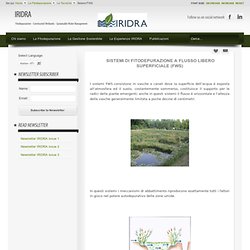
Fitodepurazione - Constructed Wetlands. I sistemi FWS consistono in vasche o canali dove la superficie dell'acqua è esposta all'atmosfera ed il suolo, costantemente sommerso, costituisce il supporto per le radici delle piante emergenti; anche in questi sistemi il flusso è orizzontale e l'altezza delle vasche generalmente limitata a poche decine di centimetri.
Integrated multi-trophic aquaculture. Integrated multi-trophic aquaculture (IMTA) provides the by-products, including waste, from one aquatic species as inputs (fertilizers, food) for another.
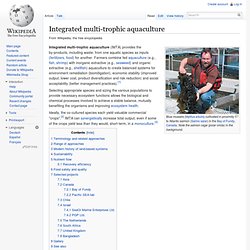
Farmers combine fed aquaculture (e.g., fish, shrimp) with inorganic extractive (e.g., seaweed) and organic extractive (e.g., shellfish) aquaculture to create balanced systems for environment remediation (biomitigation), economic stability (improved output, lower cost, product diversification and risk reduction) and social acceptability (better management practices).[1] Selecting appropriate species and sizing the various populations to provide necessary ecosystem functions allows the biological and chemical processes involved to achieve a stable balance, mutually benefiting the organisms and improving ecosystem health. Ideally, the co-cultured species each yield valuable commercial "crops".[2] IMTA can synergistically increase total output, even if some of the crops yield less than they would, short-term, in a monoculture.[3] Asia[edit]
Aquaculture Farm. The European fisheries fund (EFF) - Fisheries. The European fisheries fund (EFF) provides funding to the fishing industry and coastal communities to help them adapt to changing conditions in the sector and become economically resilient and ecologically sustainable.
The EFF has a budget of €4.3 billion for 2007-2013. Funding is available for all sectors of the industry – sea and inland fishing, aquaculture (the farming of fish, shellfish and aquatic plants), and processing and marketing of fisheries products. Particular attention is given to fishing communities most affected by recent changes in the industry. Projects are funded on the basis of strategic plans and operational programmes drawn up by national authorities. LIFE+ Programme - Department of the Environment, Community & Local Government. CIP Financial Instruments - Access to finance - Enterprise and Industry.
Each euro spent leverages an average €6 on risk capital or €50 on bank loans, which means it should generate some €30bn in new finance for SMEs from financial institutions and benefit up to 400 000 SMEs.
Under previous programmes over 360 000 SMEs have been helped by the €744m provided during the last decade. The CIP financial instruments are implemented for the Commission by the European Investment Fund (EIF) on a trust basis. They cover different needs depending on the stage of development of the small business: The high growth and innovative SME facility (GIF) It provides: risk capital for innovative SMEs in their early stages (GIF1): EIF can usually invest 10 to 25% of the total equity of the intermediary venture capital fund or up to 50% in specific cases; risk capital for SMEs with high growth potential in their expansion phase (GIF2): EIF can invest 7.5 to 15% of the total equity of the intermediary venture capital fund or, exceptionally, up to 50%.
Constructed Wetlands - Environment and Sustainable Development Directorate. Wetland Projects Since 2006, the ACT Government has developed a number of constructed wetlands toimprove Canberra's urban waterways.
Flemington Ponds 1 and 2, Flemington Rd, Mitchell, Sullivans Creek Catchment - construction completed 2009 Banksia Street, O'Connor, Sullivans Creek Catchment - construction completed 2010 Hawdon Street, Dickson, Sullivans Creek Catchment - construction completed 2011 Goodwin Street, Lyneham, Sullivans Creek Catchment - construction completed 2012 The Valley Ponds, The Valley Avenue, Gungahlin, Ginninderra Creek Catchment - construction due for completion 2014 Five of the six wetlands occur in the Sullivans Creek Catchment in Canberra's north. Today the creek is predominantly a concrete drain, however, Sullivans Creek once consisted of ponds, floodplains and rocky incised gullies. Wetland Benefits. TEDxWarwick - Charlie Price - Aquaponics - Getting More out of Less. Dan Barber: How I fell in love with a fish. Bioremediation – An Advanced Strategy To Restore The Health Of Aquaculture Pond Ecosystems - engormix.com. Aquaculture is concerned with 'the propagation and rearing of aquatic organisms under complete human control involving manipulation of atleast one stage of an aquatic organism's life before harvest, in order to increase its production'.

Fish catches from the marine environment have been steadily declining in many parts of the world due to over-exploitation and pollution, making many people turning to aquaculture to improve the food production and to contribute for economic development. Aquaculture, has made encouraging progress in the past two decades producing significant quantities of food, income and employment. Untitled. Sustainable Aquaculture: Net Profits. Veta La Palma Seafood. Since 1991, Browne Trading Co. has been offering the highest quality, freshest fish available anywhere in the United States.
We are proud to supply many of the Nation’s Most Celebrated Chefs with our products every day. Many of today’s seafood menu items were first introduced to the domestic market by Browne Trading. We continue to uphold our legacy by sourcing only the freshest and best seafoods from both our home port of Portland, Maine as well as those from fisheries across the Globe. We have many fish and shellfish selections available (pricing and inventory change daily with market conditions), a selection of which are shown throughout our website and online store.
However, if you are seeking something special, please don’t hesitate to contact us: our sales staff is happy to make recommendations based upon your menu needs. We ship our seafood for next day delivery to your door to ensure the highest quality of freshness.