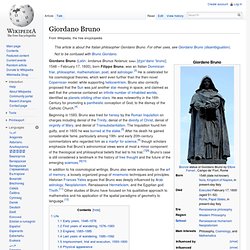
Giordano Bruno. Giordano Bruno (Latin: Iordanus Brunus Nolanus; Italian: [dʒorˈdano ˈbruno]; 1548 – February 17, 1600), born Filippo Bruno, was an Italian Dominican friar, philosopher, mathematician, poet, and astrologer.[3] He is celebrated for his cosmological theories, which went even further than the then-novel Copernican model: while supporting heliocentrism, Bruno also correctly proposed that the Sun was just another star moving in space, and claimed as well that the universe contained an infinite number of inhabited worlds, identified as planets orbiting other stars.
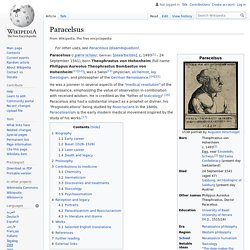
He was noteworthy in the 16th Century for promoting a pantheistic conception of God, to the dismay of the Catholic Church.[4] In addition to his cosmological writings, Bruno also wrote extensively on the art of memory, a loosely organized group of mnemonic techniques and principles. Life[edit] Early years, 1548–1576[edit] Paracelsus. Paracelsus (/ˌpærəˈsɛlsəs/; born Philippus Aureolus Theophrastus Bombastus von Hohenheim, 11 November or 17 December 1493 – 24 September 1541) was a Swiss German[3] Renaissance physician, botanist, alchemist, astrologer, and general occultist.[4] He founded the discipline of toxicology.[5] He is also known as a revolutionary for insisting upon using observations of nature, rather than looking to ancient texts, in open and radical defiance of medical practice of his day.[5] He is also credited for giving zinc its name, calling it zincum.[6][7] Modern psychology often also credits him for being the first to note that some diseases are rooted in psychological illness.[8] His personality was stubborn and independent.
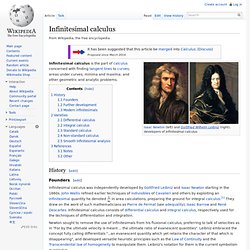
He grew progressively more frustrated and bitter as he became more embattled as a reformer.[9] Paracelsus' most important legacy is likely his critique of the scholastic methods in medicine, science and theology. Biography[edit] Gottfried Wilhelm Leibniz. Infinitesimal calculus. Infinitesimal calculus is the part of calculus concerned with finding tangent lines to curves; areas under curves; minima and maxima; and other geometric and analytic problems.
History[edit] Founders[edit]