
Reptilians. Reptilian - serpent - snake iconography is found throughout the planet in art work and petroglyphs, referring to the spiral of consciousness creation and human DNA.
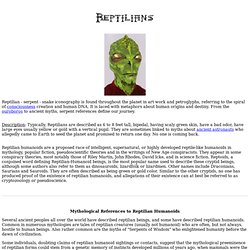
It is laced with metaphors about human origins and destiny. From the ouroboros to ancient myths, serpent references define our journey. Description: Typically, Reptilians are described as 6 to 8 feet tall, bipedal, having scaly green skin, have a bad odor, have large eyes usually yellow or gold with a vertical pupil. They are sometimes linked to myths about ancient astronauts who allegedly came to Earth to seed the planet and promised to return one day. No one is coming back. Reptilian humanoids are a proposed race of intelligent, supernatural, or highly developed reptile-like humanoids in mythology, popular fiction, pseudoscientific theories and in the writings of New Age conspiracists.
Mythological References to Reptilian Humanoids Americas Europe India East Asia The Japanese have tales of Kappa, a basically reptilian humanoid. Reptilians. Artist's depiction of a reptilian Reptilians (also called reptoids,[1] reptiloids, or draconians) are purported reptilian humanoids that play a prominent role in science fiction, as well as modern ufology and conspiracy theories.[2][3][4] The idea of reptilians on Earth was popularized by David Icke, a conspiracy theorist who says shape-shifting reptilian people control our world by taking on human form and gaining political power to manipulate our societies.
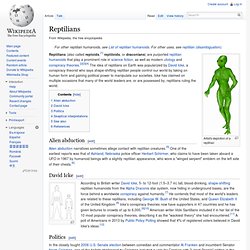
Icke has claimed on multiple occasions that many of the world leaders are, or are possessed by, reptilians ruling the world. Alien abduction[edit] Alien abduction narratives sometimes allege contact with reptilian creatures.[5] One of the earliest reports was that of Ashland, Nebraska police officer Herbert Schirmer, who claims to have been taken aboard a UFO in 1967 by humanoid beings with a slightly reptilian appearance, who wore a "winged serpent" emblem on the left side of their chests.[6] David Icke[edit] Politics[edit] Hungarian people. Hungarians, also known as Magyars (Hungarian: magyarok), are a nation and ethnic group who speak Hungarian and are primarily associated with Hungary.

There are around 13.1–14.7 million Hungarians, of whom 8.5–9.8 million live in today's Hungary (as of 2011).[21] About 2.2 million Hungarians live in areas that were part of the Kingdom of Hungary before the 1918–1920 dissolution of the Austro-Hungarian Monarchy and the Treaty of Trianon, and are now parts of Hungary's seven neighbouring countries, especially Romania, Slovakia, Serbia and Ukraine. Significant groups of people with Hungarian ancestry live in various other parts of the world, most of them in the United States, Canada, Germany, the United Kingdom, Brazil, Australia, Chile, and Argentina. Hungarians can be classified into several subgroups according to local linguistic and cultural characteristics; subgroups with distinct identities include the Székely, the Csángó, the Palóc, and the Jassic (Jász) people. Name[edit] Anunnaki. The Anunnaki (also transcribed as: Anunaki, Anunna, Anunnaku, Ananaki and other variations) are a group of deities in ancient Mesopotamian cultures (i.e.
Sumerian, Akkadian, Assyrian, and Babylonian). The name is variously written "da-nuna", "da-nuna-ke4-ne", or "da-nun-na", meaning something to the effect of "those of royal blood"[1] or "princely offspring".[2] According to The Oxford Companion to World Mythology, the Anunnaki "are the Sumerian deities of the old primordial line; they are chthonic deities of fertility, associated eventually with the underworld, where they became judges.
They take their name from the old sky god An (Anu).[3] Their relation to the group of gods known as the Igigi is unclear – at times the names are used synonymously but in the Atra-Hasis flood myth the Igigi are the sixth generation of the Gods who have to work for the Anunnaki, rebelling after 40 days and replaced by the creation of humans.[4] Notes[edit] External links[edit]