

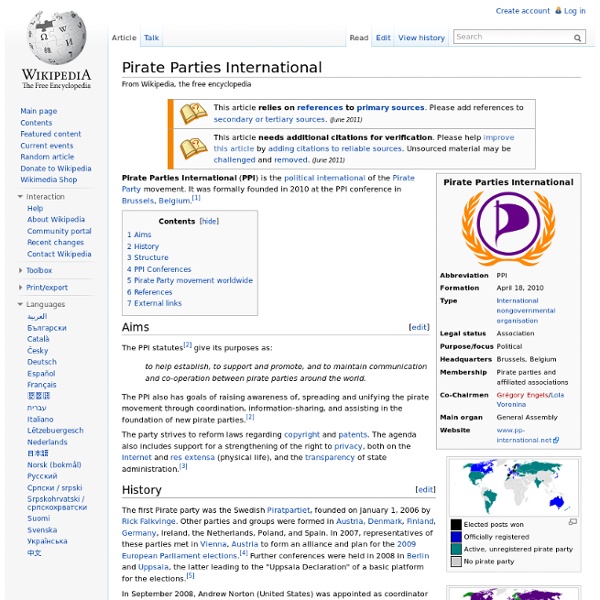
Pirate Party Australia Pirate Party (Sweden) The Pirate Party (Swedish: Piratpartiet) is a political party in Sweden founded in 2006. Its sudden popularity has given rise to parties with the same name and similar goals in Europe and worldwide, forming the International Pirate Party movement. Rick Falkvinge, founder of the party, stepped down on 1 January 2011 after five years as party leader, making vice leader Anna Troberg the current party leader.[1] The Pirate Party believes that people with an access to free communication, culture and knowledge grow, feel better and create a more fun and humane society for everyone to live in. We see the modern information technology opening up possibilities for people to take action for their own lives and participate in affecting the development of society. The party advocates a severe reduction of economic sole right of copyrighted works, which today exist for 70 years after the creator's death. Works related to Pirate Party Declaration of Principles at Wikisource No pirate party
PirateTimes Winnipeg North first Canadian battleground for Pirate Party A 25-year-old Winnipeg businessman is the first Pirate Party of Canada candidate to run for federal election. Jeff Coleman, a former ESL teacher who owns a design and 3-D company, is running in the upcoming federal by-election on November 29 in Winnipeg North. His plan: to take to the streets of his home riding to engage voters in issues that surround the digital age. Coleman plans to campaign on his party’s key principles: confidentiality on the internet, intellectual copyright and patent law reform, keeping the internet democratic and free and using the web to make government practices and information available to the public. But he’ll also be adding to his platform some local issues, determined by his constituents through Twitter and Facebook. It’s all part of the party’s campaign model to bring a platform of information reform coupled with “a crowdsourced listening campaign” which is designed to identify the distinct needs of each riding.
forum.pirate.is • Index page Can Social Software Change the World? Loomio Just Might Let's face it. After nearly fifty years of development and roughly twenty years of mass adoption, the Internet hasn't created many truly useful tools for groups. We may live in the age of "ridiculously easy group formation," but if you've spent any time as part of a group, you know that all the most popular internet tools --email, list-servs, blogs, chats, and wikis --basically suck at group coordination. It's not a coincidence, I think, that most of us rarely, or never, experience working in a group where everyone actually gets a meaningful chance to participate in the decisions that group makes. This isn't to say that big groups never manage to make coherent decisions using the tools we have. But as the saying goes, when you have a hammer, everything looks like a nail. Ten or eleven years ago, there was a burst of interest in "social software," but there hasn't been a game-changing innovation in that arena since the launch of Twitter, seven years ago. Why Can't We All Get Along?
Pirate Party Statement Concerning "Anonymous" Arrests Pirate Party spokespeople are always ready to give a lively, informed, and often provocative view on the issues of the day. Whether it's tech politics, civil liberties, the EU, local issues or anything else we'll have something to say. For interview requests, specific statements or quotes, or to automatically receive press releases email the Press Office at press@pirateparty.org.uk or call us on 0161 987 7880. If you would like further information about a specific person you can find biographies and images on their profile page by searching our staff and volunteer list and you can access some of the many appearances online, in print, on TV and radio on our press archive.
Government to launch inquiry into 'outdated' cyberstalking laws - Crime, UK The cross-party crackdown will tackle the country's "outdated" legislation on internet harassment, which includes no legal definition of "stalking". The inquiry will be conducted by the Justice Select Committee, chaired by the Plaid Cymru MP Elfyn Llwyd. It was prompted by a flurry of recent cases in which stalkers have used texts, tweets, chatrooms and sites such as Facebook to intimidate their victims – sometimes with tragic consequences. "Around one in five people will experience stalking in the UK in their lifetime and unfortunately what we are now seeing is a growing trend in 'cyberstalking'," Mr Llwyd told The Independent. Cyberstalkers can currently be charged under the Protection from Harassment Act, which dates back to 1997 – long before the explosion of social networking. But the Act takes a broad approach to the crime of harassment, which it defines as "putting people in fear of violence", and carries a maximum penalty of six months in prison. Cases of Online Harassment
Anthony Stafford Beer Stafford Beer (25 September 1926 – 23 August 2002) was a British theorist, consultant and professor at the Manchester Business School. He is best known for his work in the fields of operational research and management cybernetics. Biography[edit] Beer was born in London in 1926. He joined United Steel and persuaded the management to found an operational research group, the Department of Operations Research and Cybernetics, which he headed. In mid-1971, Beer was approached by Fernando Flores, then a high-ranking member of the Chilean Production Development Corporation (CORFO) in the newly elected socialist government of Salvador Allende, for advice on applying his cybernetic theories to the management of the state-run sector of the Chilean economy. In the mid-1970s, Beer renounced material possessions and moved to mid-Wales where he lived in an almost austere style, developing strong interests in poetry and art. Work[edit] Management cybernetics[edit] Cybersyn[edit] Viable System Model[edit]
torrentfreak Sweden's Prosecutor General believes that the founders of The Pirate Bay have already had enough opportunities to prove their innocence. The defendants want to take their case all the way to the Supreme Court but the Prosecutor says that there is no reason to prolong proceedings. Site co-founder Peter Sunde tells TorrentFreak there are still complex issues to be dealt with and that the Supreme Court is the perfect venue. During November last year, the Swedish Court of Appeal found three people behind The Pirate Bay guilty of criminal copyright infringement offenses. Fredrik Neij, Peter Sunde and Carl Lundström were handed prison sentences and ordered to pay millions of dollars in damages. A fourth defendant, Pirate Bay co-founder Gottfrid Svartholm, was absent from the appeal hearings due to medical circumstances. For the three defendants who did appeal, the road has not yet come to an end. “This is boring,” says Jonas Nilsson, lawyer for Fredrik Neij.
Friedrich Nietzsche Friedrich Wilhelm Nietzsche (/ˈniːtʃə/[1] or /ˈniːtʃi/;[2] German: [ˈfʁiːdʁɪç ˈvɪlhɛlm ˈniːt͡sʃə]; 15 October 1844 – 25 August 1900) was a German philosopher, cultural critic, poet, composer and Latin and Greek scholar. He wrote several critical texts on religion, morality, contemporary culture, philosophy and science, displaying a fondness for metaphor[3] and irony. Nietzsche's key ideas include perspectivism, the will to power, the death of God, the Übermensch and eternal recurrence. Nietzsche began his career as a classical philologist—a scholar of Greek and Roman textual criticism—before turning to philosophy. As his caretaker, his sister assumed the roles of curator and editor of Nietzsche's manuscripts. Life[edit] Youth (1844–69)[edit] Born on 15 October 1844, Nietzsche grew up in the small town of Röcken, near Leipzig, in the Prussian Province of Saxony. While at Pforta, Nietzsche had a penchant for pursuing subjects that were considered unbecoming. Nietzsche in his younger days
Busted: BitTorrent Pirates at Sony, Universal and Fox With increasing lobbying efforts from the entertainment industry against BitTorrent sites and users, we wondered whether these companies hold themselves to the same standards they demand of others. After some initial skimming we've discovered BitTorrent pirates at nearly every major entertainment industry company in the US, including Sony Pictures Entertainment, Fox Entertainment and NBC Universal. Busted. A few days ago we wrote about a new website that exposes what people behind an IP-address have downloaded on BitTorrent. Armed with the IP-ranges of major Hollywood studios we decided to find out what they’ve been downloading. First up is Sony Pictures Entertainment. Downloads from a Sony Pictures IP Another Hollywood studio where it’s not uncommon to download music, TV-shows and movies is NBC Universal. Downloads from a NBC Universal IP And then there are the fine upstanding people at Fox Entertainment checking out the work of a competing studio. Download from a Fox Entertainment IP
Tragedy of the commons Self-interests causing depletion of a shared resource The tragedy of the commons is a metaphoric label for a concept that is widely discussed, and criticised, in economics, ecology and other sciences. According to the concept, should a number of people enjoy unfettered access to a finite, valuable resource such as a pasture, they will tend to over-use it, and may end up destroying its value altogether. The metaphor is the title of a 1968 essay by ecologist Garrett Hardin. The principal concern of Hardin's essay was overpopulation of the planet. Some scholars have argued that over-exploitation of the common resource is by no means inevitable, since the individuals concerned may be able to achieve mutual restraint by consensus. Other criticisms have focused on Hardin's racist and eugenicist views, claiming that his arguments are directed towards forcible population control, particularly for people of colour.[3][4] Expositions[edit] Classical[edit] Lloyd's pamphlet[edit] System archetype[edit]
Cable Reveals Extent Of Lapdoggery From Swedish Govt On Copyright Monopoly Among the treasure troves of recently released WikiLeaks cables, we find one whose significance has bypassed Swedish media. In short: every law proposal, every ordinance, and every governmental report hostile to the net, youth, and civil liberties here in Sweden in recent years have been commissioned by the US government and industry interests. I can understand that the significance has been missed, because it takes a whole lot of knowledge in this domain to recognize the topics discussed. When you do, however, you realize that the cable lists orders for the Swedish Government to implement a series of measures that significantly weakens Sweden’s competitive advantage in the IT field against the US. We had concluded this was the case, but had believed things had come from a large number of different sources. That was wrong. But all of a sudden, there it was, in black on white. This sounds like fiction, right? Now, these steps are written in copyright industry legalese. 1. 2. 3. [...] 1.