

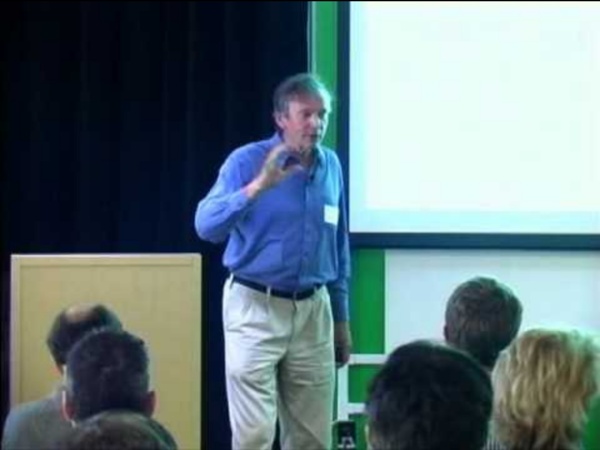
Terence McKenna Land media/McKenna streaming audio and video Rupert Sheldrake hosts many excellent realaudio streams including Trialogues at the Edge of the MilleniumPart I and Part II led by Terence (1.5 hours each) The Trip Receptacles : MP3 clips from all-psychedelic, all-entheogen radio, transmitted via KPFA in Berkeley with Stanislav Grof, Alexander (Sasha) Shulgin, Timothy Leary, Terence McKenna, Albert Hoffman, Rick Strassman, Fritjof Capra, Andrew Weil, D.M. Turner and many others. Several rare video clips at Global Webtrance. Let Talk With Terence! Hyperspace, the Gaian supermind, global rave telepathy, and more inRe-Evolution. Ordinary Language, Visible Language, and Virtual Reality.Excerpts from A Weekend with Terence McKenna parts ONE and TWO. The monstrously vast Camden Centre Talk. Abrupt TranscriptionsLive at Wetlands PreserveNew York City, July 28, 1998 - Realaudio stream or downloadLive at The LighthouseNew York City, April 23, 1997Live at St.
Rupert Sheldrake Alfred Rupert Sheldrake is an English author,[3] public speaker,[4] and researcher in the field of parapsychology,[5] known for his "morphic resonance" concept.[6] He worked as a biochemist and cell biologist at Cambridge University from 1967 to 1973[3] and as principal plant physiologist at the International Crops Research Institute for the Semi-Arid Tropics until 1978.[7] Sheldrake's morphic resonance posits that "memory is inherent in nature"[3][8] and that "natural systems, such as termite colonies, or pigeons, or orchid plants, or insulin molecules, inherit a collective memory from all previous things of their kind".[8] Sheldrake proposes that it is also responsible for "telepathy-type interconnections between organisms".[9] His advocacy of the idea encompasses paranormal subjects such as precognition, telepathy and the psychic staring effect[10][11] as well as unconventional explanations of standard subjects in biology such as development, inheritance, and memory.[12] Background
Jason Silva Rupert Sheldrake - Richard Dawkins comes to call Metaphysics Colleges, Metaphysical University, Spiritual Enlightenment Epigenetics and Soviet Biology One of the biggest controversies in twentieth-century biology was about the inheritance of acquired characteristics, the ability of animals and plants to inherit adaptations acquired by their ancestors. For example, if a dog was terrified of butchers because he had been mistreated by one, his offspring would tend to inherit his fear. Charles Darwin wrote a letter to Nature describing just such a case. In Darwin's day, most people assumed that acquired characteristics could indeed be inherited. Lamarck emphasized the role of behaviour in evolution. The problem was that no one knew how acquired characteristics could be inherited. Pangenesis was rejected by Mendelian genetics, the theory that dominated twentieth century biology in the West. Meanwhile, in the Soviet Union the inheritance of acquired characteristics was the orthodox doctrine from the 1930s to the 1960s.
7 Extraordinary Books You Need to Read to Become Ecoliterate Complex networks and their unpredictable nature are rapidly transforming the world around us. The challenge is to learn to live with life, because we are embedded in it. We are systems, nested within systems, nested within systems. Luckily, great minds have seen this ‘crisis of perception’ coming and they have shared their thoughts with us. Thoughts that are inspiring, sometimes shaking the ground beneath our feet and sometimes giving us hope-filled vistas on the future. Thoughts that connect the dots and show us an endlessly complex system, called life, continuously emerging in ever more complex forms. What is Ecoliteracy? An ecoliterate is someone who has learned (to some degree, in some way) that human life is embedded within larger ecosystems that provide the conditions for it to develop. The (aspiring) ecoliterate could, in my opinion, come a long way in creating his own understanding of living systems, by reading these 7 classic books. 1. 2. A brilliant and important book. 3. 4.
Sheldrake-Shermer, God and Science, Opening Statements Through the months of May, June, and July of 2015, TheBestSchools.org is hosting an intensive Dialogue on the Nature of Science between Rupert Sheldrake and Michael Shermer. During the third month, July, the focus will be on God and science. Dr. Sheldrake will defend the position that there is no conflict between science and the existence of God; evidence from conscious experience renders belief in God reasonable. Dr. For details about this dialogue, along with a complete guide to other portions of it, click here. To give our readers context for this dialogue, Drs. Sheldrake Opening Statement Dear Michael, I believe in God, and I am a church-going Christian, an Anglican (Episcopalian in the United States). Nevertheless, we probably agree about many things. For those who believe in God, the intelligibility of nature and the ability of human minds to understand some aspects of the natural world make sense because they have a common source, namely God. Rupert 1. Shermer Opening Statement Michael
The Study Society - Talks and downloads This page contains a variety of material for you to listen to or read. Contact Magazine You can view recent issues of the magazine online:Contact Magazine issue 62, Autumn 2013Contact Magazine issue 61, Summer 2013Contact Magazine issue 60, Spring 2013Contact Magazine issue 59, Autumn 2012Contact Magazine issue 58, Summer 2012Contact Magazine issue 57, Spring 2012Contact Magazine issue 55, Summer 2011Contact Magazine issue 54, Spring 2011Contact Magazine issue 53, Autumn 2010 Open Sunday Meeting Ruth White & Narain Ishaya: ‘Sweet are the uses of adversity’ ‘Every cloud has a silver lining’: Often we are so focused on what we want to happen we miss the lessons and blessings found in what is happening. Ruth White is a teacher of Iyengar Yoga who has developed a unique style of teaching that unites pupil and teacher in an atmosphere of happiness and well-being. Narain Ishaya was born in England in 1969. 2 March 2014 Ruth White, 121 minutes. Narain Ishaya, 71 minutes. Listen to talk Dr B. Dr B.
Banned TED Talk: Rupert Sheldrake – The Science Delusion Rupert Sheldrake is a fascinating member of the scientific world. The video below is of his TED talk where he covers “The Science Delusion.” This TED talk was controversially censored by the TED community after being aired. If you have studied any area of science on your own or in school, you may have noticed or have come across the fact that there are many differing beliefs in the scientific world. While this statement seems impossible given that science is supposed to be based on evidence which produces theory, it is a delusion not to realize that much of what is strictly believed in the scientific world is only believed due to the common acceptance that is put into mainstream ideas — much like what takes place within religion. “How can science be stuck? I have been researching many areas of science, world events, health etc. over the past 5.5 years. Rupert Sheldrake outlines 10 dogmas he has found to exist within mainstream science today. 1. 2. 3. 4. 5. 6. 7. 8. 9. 10.
Rupert Sheldrake at EU 2013—"Science Set Free" (Parts 1 & 2) Part 1 of a talk by Rupert Sheldrake at the conference ELECTRIC UNIVERSE 2013: The Tipping Point, in Albuquerque, New Mexico. Many scientists like to think that science already understands the ways of the natural world. The fundamental questions are answered, leaving only the details to be filled in. The impressive achievements of science seemed to support this confident attitude. But recent research has revealed unexpected problems at the heart of physics, cosmology, biology, medicine and psychology. Dr. Part 2 of a talk by Rupert Sheldrake at the conference ELECTRIC UNIVERSE 2013: The Tipping Point, in Albuquerque, New Mexico: SEE PART 2: The Ten Dogmas Of Modern Science. Are Minds Confined to Brains? chapter 9 Animal psi Rupert Sheldrake. Change the Morphic Field…Change the World! DNA and Planetary Upliftment. Esu Speaks on Change and Creating Reality. see:
Rupert Sheldrake Online - Homepage Peter Sloterdijk in English [updated July 2013] | Te Ipu Pakore: The Broken Vessel Peter Sloterdijk (b.1947) is the coming man in philosophical anthropology (or rather, on the comeback after his first brush with fame in the 80s) — though his work is translated more often in French and Spanish than in English. His Sisyphean Spheres trilogy (1998, 1999, 2004), a decade in the making and as yet untranslated in English, seems to have prevented his work becoming more broadly known in the Anglo world. This has begun to change over the past year, as his hyperbolic philosophy has returned parabolically, as it were, his motifs of anthropo-technology, spherology and atmoterrorism having found their moment in this time of genetics, globalization and global warming. (Note that some of these texts are subscription only — I include these for my own reference and for those who have institutional access to journals.) Texts already translated into English (in chronological order) Critique of Cynical Reason, trans. Thinker on Stage: Nietzsche’s Materialism, trans. “Analytic Terror.
Philosophy of the Acrobat: On Peter Sloterdijk |