

42 Fill-in-the-Blank Prompts For Students To Design Their Own Projects 42 Fill-in-the-Blank Prompts For Students To Design Their Own Projects by Terry Heick So often, we make learning more complicated than it has to be. Local planning requirements are usually at fault here–plan this way and prove that you’ve done so here and here, fill out this and this, etc. Those legitimate concerns aside, the following series of fill-in-the-blank prompts can be used by teachers to create lessons, students to create projects–or teachers to collaborate with students to create lessons–or projects. Or, well, you get the idea. Please steal them, add to them, or otherwise do with them what you will. 42 Project-Based Learning Ideas For Any Content Area A few examples of how it might work? Clarify racism in the United States for a high school in India. Design and publish a compelling eBook your friends would actually want to read using a simple smartphone app. Practice coding until you can make a ball bounce. Compare the force of a tsunami with a nuclear bomb.
Picture Book Month — International Literacy Initiative Celebrating the Print Picture Book in November Digital Collections and Services: Access to print, pictorial and audio-visual collections and other digital services Historic Newspapers Enhanced access to America's historic newspapers through the Chronicling America project. Historic Sound Recordings The National Jukebox features over 10,000 78rpm disc sides issued by the Victor Talking Machine Co. between 1900 and 1925. Performing Arts Collections, articles and special presentations on music, theater and dance materials from the Performing Arts Encyclopedia. Prints and Photographs Catalog of about half of the Library's pictorial holdings with over 1 million digital images. Veterans History Project Experience first-person stories of wartime service through personal artifacts, audio and video interviews.
Project Look Sharp :: K-12 & Higher Ed. Media Literacy Lesson Plans :: Ithaca College Many, Many Examples Of Essential Questions Many, Many Examples Of Essential Questions by Terry Heick Essential questions are, ask Grant Wiggins defines, “‘essential’ in the sense of signaling genuine, important and necessarily-ongoing inquiries.” These are grapple-worthy, substantive questions that not only require wrestling with, but are worth wrestling with–that could lead students to some critical insight in a 40/40/40-rule sense of the term. I collected the following set of questions through the course of creating units of study, most of them from the Greece Central School District in New York. In revisiting them recently, I noticed that quite a few of them were closed/yes or no questions, so I went back and revised some of them, and added a few new ones, something I’ll try to do from time to time. Or maybe I’ll make a separate page for them entirely. Decisions, Actions, and Consequences What is the relationship between decisions and consequences? Social Justice What is social justice? Culture: Values, Beliefs & Rituals Creation
5 Easy Ways to Pick Great Children’s Books One of the most vivid memories from my childhood is when each evening, our babysitter would tell us stories of mysterious creatures from faraway lands. Growing up, those memories played a huge role in shaping me. They also set me up for further exploration through reading. Research states that we’re wired for storytelling. As a parent, it can be tough to find good books for your children. 1. Experts, who? Make a note of books that bring them a sense of joy, no matter whether the plot is too simple or twisted, and the type of characters they can relate with. A good practice could be to ask them share three key lessons they learned from every book they read. 2. You can always share the books you loved as a child with your children. Don’t force them to read something they have already rejected. 3. There will be times you’re worried whether a book is too challenging for your child. 4. If you’re stuck, try books from a best-seller list. 1. 5. Want more great books for your child?
About this Collection - Rosa Parks Papers | Collections | Library of Congress The papers of Rosa Parks (1913-2005) span the years 1866-2006, with the bulk of the material dating from 1955 to 2000. The collection contains approximately 7,500 items in the Manuscript Division, as well as 2,500 photographs in the Prints and Photographs Division. The collection documents many aspects of Parks's private life and public activism on behalf of civil rights for African Americans. Family papers include correspondence with her husband Raymond A. Parks; her mother, Leona Edwards McCauley; and her brother, Sylvester McCauley. Correspondence with her husband and mother contains the largest number of letters written by Parks in the collection. The collection also documents Parks's affiliation with organizations and institutions including the Rosa and Raymond Parks Institute for Self Development, an organization she founded with Elaine Eason Steele to promote youth development and civil rights education; Hampton Institute, Highlander Folk School, Martin Luther King, Jr.
The Answer Pad – FEATURES FEATURESadmin2014-08-05T21:33:29+00:00 Interactiveadmin2014-08-03T20:48:44+00:00 Interactive Interactive admin2014-08-03T20:48:44+00:00 It’s all about student engagement and timely feedback. Quizzesadmin2014-04-19T23:21:43+00:00 Quizzes Quizzes admin2014-04-19T23:21:43+00:00 The Answer Pad helps you transition from paper to digital assessment. Instant Reportsadmin2014-04-19T23:26:27+00:00 Instant Reports Reports admin2014-04-19T23:26:27+00:00 As soon as the students turn in their quizzes, you have access to a great selection of instant, standards-based online reports, and students get immediate feedback on their answers. Loading Portfolio Items...
WRITE ON! Sandra Markle: Share The Long, Long Journey I'm delighted to share the story of the bar-tailed godwits. Every year these birds make a marathon migration from their summer home in Alaska to their winter home in New Zealand. This bird's story is very special to me. For thirteen years, I lived near Christchurch, New Zealand. Along with other New Zealanders, I eagerly awaited the godwits arrival each year in September. That always signified winter was over and spring had arrived. Now open the book and enjoy the story. Check out the aerial view of Cape Avinof, Alaska (the godwits' starting place) by visiting this website. Can you fly non-stop, the way the godwits do? How much will it cost you to fly between Alaska and New Zealand? So you learned what it costs the godwits is energy--what they get from eating and storing body fat. Just for fun, figure out what you would weigh if you doubled your weight to make this long trip. Now, try this activity to find out how the godwit uses its long beak to find and pick up food.
Cool Tools for Featuring Student Book Reviews We put a lot of stock in personal recommendations—particularly when it comes to books. Plenty of websites offer tips on great reads, but none will carry as much weight with your students as a site based on peer recommendations. The next time your students create book reviews, either independently or as a class assignment, consider compiling them on a website that the whole school can access. Book Trailers for Readers is one of the best models of a book review site for students and by students. The site was built on Wikispaces, the ad-free wiki creation platform for schools. Try using Wikispaces to create a similar site with your classes. Wikispaces allows you to arrange your book review in a variety of ways. Maybe you want to make a graded assignment out of a student-driven, Wikispaces-enabled book review destination? There are other fine options out there for organizing student book reviews. Two of my favorite QR code creation tools are QR Droid and Goo.gl, Google’s URL shortener.
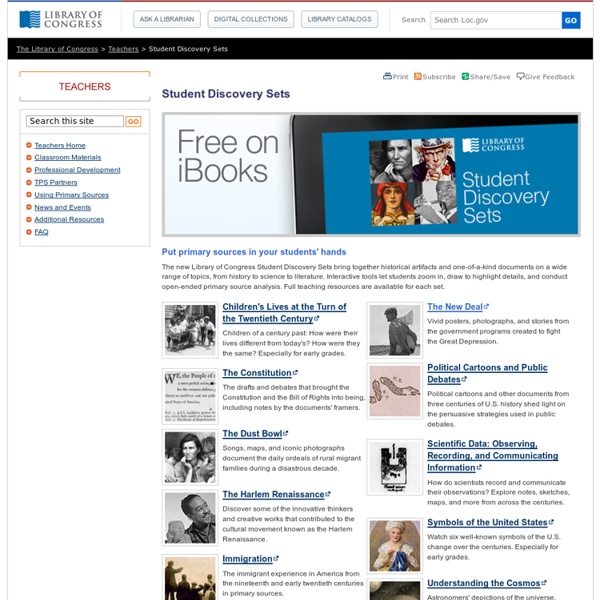
Library of Congress Sets Teachers Abraham Lincoln: Rise to National Prominence Speeches, correspondence, campaign materials and a map documenting the free and slave states in 1856 chronicle Lincoln’s rise to national prominence Alexander Hamilton Manuscripts, images, and historic newspapers document the life and accomplishments of Alexander Hamilton American Authors in the Nineteenth Century: Whitman, Dickinson, Longfellow, Stowe, and Poe A selection of Library of Congress primary sources exploring the topic of American authors in the nineteenth century, including Walt Whitman, Emily Dickinson, Henry Wadsworth Longfellow, Harriet Beecher Stowe, and Edgar Allan Poe. Top
The Best YouTube Channels for Social Studies Classrooms Contemporary social studies teachers need to acknowledge their students’ lack of interest in their lectures. Teachers need to facilitate their students’ learning, and curation has become an essential skill for teachers. However, educator and podcaster Chris Nesi argues teachers should stop curating and start creating. He is half right—teachers should curate and create. Creating videos allows students to learn at their own pace, rather than keep up with the teacher and the fastest students in class. Here are ten must-use YouTube channels for social studies teachers.
6 Secrets to Successful Research with Kids Research, the very word, can draw shudders from teachers and audible sighs from students. If you are one of those shuddering educators dreading that next research project, then you are truly going about research all wrong. Take it from this elementary school librarian!! I have been an elementary educator for twenty years, and a certified library media specialist for the last seven years. I am so pleased that Rachel has let me be your virtual librarian today on Minds in Bloom. How about a few insider secrets to turns those sighs into high fives?? 1) Your librarian should be your best resource. 2) You can easily teach inquiry-based research skills in short bursts of time. 3) I believe that it is our job to set our students up for success. Scaffold the project. Provide strong resources. Simplify the citation process. 4) Successful research inquiries begin with strong keywords! Some people, even a few librarians, think that simple fact-finding questions lack depth and complexity.
Authors Who Skype with Classes & Book Clubs (for free!) Welcome to the Authors Who Skype with Classes & Book Clubs List! I’m Kate Messner, the children’s author and educator who maintains this site. I started it because I’ve found that virtual author visits are a great way to connect authors and readers, and I realize that many schools facing budget troubles don’t have the option of paid author visits. If you’re interested in booking a “virtual visit” with me, please visit my author-Skype page for current availability and directions for requesting a visit! How does a Skype virtual visit work? Authors Who Skype With Classes & Book Clubs (for free!) The following authors offer free 15-20-minute Skype chats with book clubs and classes that have read one of their books! For Picture Book & Young Chapter Book Readers For Middle Grade Readers (Ages 8-12) For Teen Readers(Also check out the list of adult authors below; many also work with teens.) This entry was posted in Uncategorized and tagged book clubs, skype.