

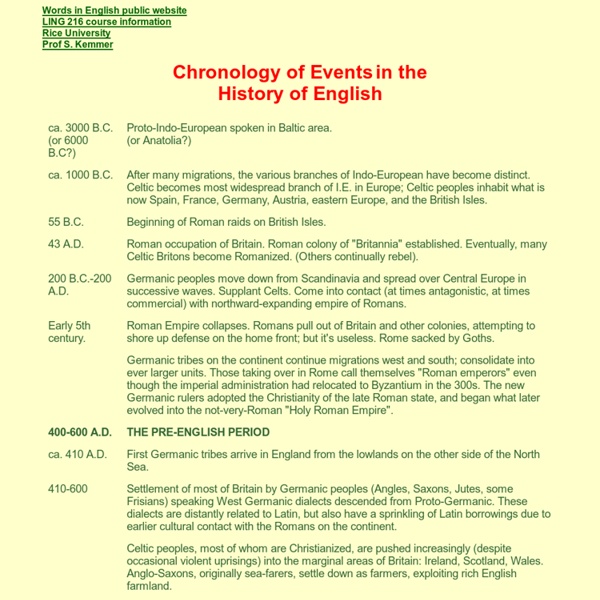
http://www.ruf.rice.edu/~kemmer/Words/chron.html
Related: AMD : English LanguageLanguage Timeline The English language is a vast flea market of words, handed down, borrowed or created over more than 2000 years. And it is still expanding, changing and trading. Our language is not purely English at all - it is a ragbag of diverse words that have come to our island from all around the world. Words enter the language in all sorts of ways: with invaders, migrants, tradesmen; in stories, artworks, technologies and scientific concepts; with those who hold power, and those who try to overthrow the powerful. View the chart below to get an overview of some of the many chapters in the history of the English language. Celts 500BC-43BC
Etymology: Languages that have contributed to English vocabulary over time. In Borrowed Words: A History of Loanwords in English, I examine how words borrowed from different languages have influenced English throughout its history. The above feature summarizes some of the main data from the book, focusing on the 14 sources that have given the most words to English, as reflected by the new and revised entries in the Oxford English Dictionary. Using the date buttons at the top of the graphic, you can compare the impact that different languages have made on English over time.
Do you speak Uglish? How English has evolved in Uganda Please don’t dirten my shirt with your muddy hands. Stop cowardising and go and see that girl. Don’t just beep her again, bench her. Typos? No, we’re speaking Uglish (pronounced you-glish), a Ugandan form of English influenced by Luganda and other local dialects, which has produced hundreds of words with their own unique meanings. Some will be immediately obvious to English speakers: dirten, meaning to make dirty; cowardising, to behave like a coward. History of English The figure below shows the timeline of the history of the English language. The earliest known residents of the British Isles were the Celts, who spoke Celtic languages—a separate branch of the Indo-European language family tree. Over the centuries the British Isles were invaded and conquered by various peoples, who brought their languages and customs with them as they settled in their new lives. There is now very little Celtic influence left in English.
25 maps that explain the English language English is the language of Shakespeare and the language of Chaucer. It’s spoken in dozens of countries around the world, from the United States to a tiny island named Tristan da Cunha. It reflects the influences of centuries of international exchange, including conquest and colonization, from the Vikings through the 21st century. Here are 25 maps and charts that explain how English got started and evolved into the differently accented languages spoken today.
The Evolution of English The Evolution of English George Boeree The English language begins with the Anglo-Saxons. The Romans, who had controlled England for centuries, had withdrawn their troops and most of their colonists by the early 400s. English language 'originated in Turkey' Modern Indo-European languages - which include English - originated in Turkey about 9,000 years ago, researchers say. Their findings differ from conventional theory that these languages originated 5,000 years ago in south-west Russia. The New Zealand researchers used methods developed to study virus epidemics to create family trees of ancient and modern Indo-European tongues to pinpoint where and when the language family first arose. Their study is reported in Science.
The History of English - How New Words Are Created The drift of word meanings over time often arises, often but not always due to catachresis (the misuse, either deliberate or accidental, of words). By some estimates, over half of all words adopted into English from Latin have changed their meaning in some way over time, often drastically. For example, smart originally meant sharp, cutting or painful; handsome merely meant easily-handled (and was generally derogatory); bully originally meant darling or sweetheart; sad meant full, satiated or satisfied; and insult meant to boast, brag or triumph in an insolent way.