

English Grammar Online - free exercises, explanations, vocabulary, dictionary and teaching materials 7 Great Grammar Sites for Teachers and Students June , 2014 Today I am sharing with you a list of some useful websites you can use with your students to help them better improve their grammar knowledge and polish their writing skill. From grammar lessons and teaching materials to free downloadable worksheets and presentations, this collection of websites will provide you with the content you need for teaching grammar. 1- Grammar Bytes Grammar Bytes is a great website that is packed full of teaching materials teachers can use to teach grammar.Grammar Bytes provides a glossary of common terms, fun interactive activities and exercises for students to test their grammar knowledge,instructional presentations and tons of tips on teaching grammar. 2- Road to Grammar Road to Grammar is a free website that provides a wide vareity of resources for teaching grammar. 3- Grammar Gold Grammar Gold provides grammar practice for grades 1 to 5.You can click on any of the grades to access the grammar lessons it features. 4- Grammar Snack
Teaching Prepositions using the Uno Game Playing the game Shuffle the cards and deal out seven per player. It is best to have groups of four or five students per set of cards. Place one card (not a penalty card) face up and put the remainder of the cards (the pack) face down beside it. The aim of the game is to get rid of all your cards. You can discard a card onto the face up pile if it is the same animal or the same preposition as the current card showing. The penalty cards are: "Skip" - the next player skips one turn; "Reverse" - the order of play reverses - the previous student throws next; "Draw Two" - the next player takes two from the pack unless they can put any "Draw Two" card down. The "Wild" card can be played at any time and the thrower has to call out the new animal. When a player throws down their penultimate card, they must shout "Uno" before the next player takes their turn. Children should read the text as they throw down each card.
Idioms Idioms are expressions that would have different meanings if you took the words apart. The individual words in the idiom don’t usually help you make sense of it; you just have to know what it means. It would be helpful to do some online practice to gain a better understanding of idioms. Here are a couple examples, along with their meanings. In the dark- The actual meaning for this would be that there is no light were you are, but the meaning of the idiom is that you don’t know what’s really going on. Inside joke- These words don’t make much sense together, but the meaning of this idiom is that it is a joke that only certain people will understand; maybe those inside the circle of friends. Idioms are fun to read, but they’re even more fun to use in your writing. Here are a few more you can use: catch you later, say the word, hit the roof, a piece of cake.
Differences in American and British English grammar - article By Kerry Maxwell and Lindsay Clandfield An article by Kerry Maxwell and Lindsay Clandfield on recognizing grammatical differences between American and British English. Introduction Speakers of American English generally use the present perfect tense (have/has + past participle) far less than speakers of British English. 1. American English (AmE) / British English (BrE) Jenny feels ill. 2. American English / British English A: Are they going to the show tonight? Verb agreement with collective nouns In British English, collective nouns, (i.e. nouns referring to particular groups of people or things), (e.g. staff, government, class, team) can be followed by a singular or plural verb depending on whether the group is thought of as one idea, or as many individuals, e.g. My team is winning. The other team are all sitting down. In American English, collective nouns are always followed by a singular verb, so an American would usually say: Which team is losing? Which team is/are losing? Use of prepositions
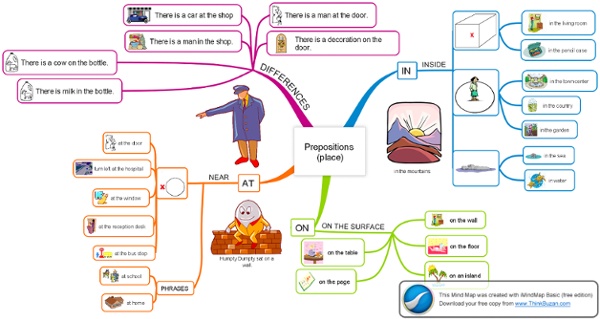
Prepositioner - engelska Prepositioner Här är några vanliga prepositioner och uttryck som de ingår i. Lär er dem uttantill: IN – används bla i tidsuttryck vid delar av dagen (afternoon) och framför årtal och årstider In the morning på morgonen In 1999 1999 In the summer på sommaren Interested in intresserad av In school i skolbyggnaden In Gothenburg i Göteborg AT – används bla vid klockslag och framför högtider At six o'clock klockan sex At Christmas på julen At school i skolan Good at something bra på något Look at me se på mig Late at night sent på natten Throw something at kasta något på At the grocer's hos/ i livsmedelsaffären. ON – används bla vid namn på dagar och datum On Thursday på torsdag On the first of June den första juni On the table på bordet Keen on förtjust iOn the radio på radio Proud of stolt över The prince of Wales Prinsen av Wales In front of framför Afraid of rädd för Get off the train gå av tåget A day off en ledig dag Too It's too much det är för mycket I want it too det vill jag också
F...l....u....e.....n.....c.....y As I was finishing up my report cards a few weeks ago. I noticed that MANY of my students were FAILING not meeting the standards in fluency. I always talk about fluency, but I've never really stressed it. My teammates also had the same problem. They suggested that we all start doing Fry Phrases. I've also started using Jodi's Fluency packs. Then, as one of my Daily 5 mini-lessons, I did a fluency lesson. I made these posters to help them remember. With each poster there is also an action:Rate- Not too fast and not too slow {they pretend to run slow and run fast- with their arms}Expression- Don't sound like a robot {they do the robot dance- channel your inner 80's dance moves}Accuracy-Read the words right {they do a check mark in the air with their pointer finger}Punctuation- Read the punctuation marks {they make an exclamation point in the air} Then, once a week, after I do a running record on a student, I quickly have them fill out this self-assessment.
Grammar A-Z Some grammatical terms may be familiar to you, but others can be confusing or hard to remember. Clicking on any term below will give you a quick and clear definition. Below the categorized section you’ll find all the terms listed from A–Z, so you can browse that way if you prefer. abstract noun A noun which refers to an idea, quality, or state (e.g. warmth, liberty, happiness), rather than a physical thing that can be seen or touched. active An active verb has a subject which is performing the action of the verb, for example: John ate the apple. The opposite of passive. adjective A word, such as heavy, red, or sweet, that is used to describe (or modify) a noun. adjunct A type of optional adverbial that adds extra information to a sentence, for instance: I can’t sleep at night. Read more about adverbials and adjuncts. adverb A word, such as very, really or slowly, that is used to give more information about an adjective, verb, or other adverb. adverbial I put my bag on the floor. affirmative agent
Thanks for trying the Visual Thesaurus The Visual Thesaurus is an interactive dictionary and thesaurus that allows you to discover the connections between words in a visually captivating display. With a subscription you will also get access to the Spelling Bee, VocabGrabber, and Online Magazine. 14 day risk-free trial! Visual Thesaurus Unlike a paper-bound book, the Visual Thesaurus is fluid and dynamic, like the way you think. Subscribe Now Spelling Bee The Visual Thesaurus Spelling Bee will sharpen your spelling skills and expand your vocabulary. VocabGrabber Take any text and Vocabgrabber will instantly pull out the most useful vocabulary words and show you how those words are used in context. Online Magazine The Visual Thesaurus magazine is a feast for language lovers, with informative features written by experts in fields ranging from word origins to copywriting. With a subscription to the Visual Thesaurus, you can: Find the right word and explore The Visual Thesaurus has over 150,000 words and 120,000 meanings. - New York Times
English grammar: A complete guide Do you have a question about the correct usage of the semi-colon or how to place relative adverbs in a sentence? If so, you've come to the right place! The edufind.com English grammar guide is a complete reference on the rules of English usage. Every grammatical rule is explained in clear, simple language with several examples and, when necessary, counter-examples. Comparisons Conditional Future Gerund and Present Participle Infinitive Passive Voice Past Present Functions and classes of determiners Articles Quantifiers Distributives
Simple Present Exercises Simple Present Exercises Here's a list of all my present simple exercises: Present Simple Form (with the verb 'be'): Present Simple Form (with all verbs except 'be'): Mixed exercises with all verbs (be and other verbs): Mixed exercise 1 with be and other verbs (fairly easy) (download in PDF) Here's an exercise about spelling changes in this tense: Spelling changes (easy) (download in PDF) Practice exercises about how we use the present simple: Welcome toPerfect English Grammar! Welcome! 50-common-English-phrasal-verbs