

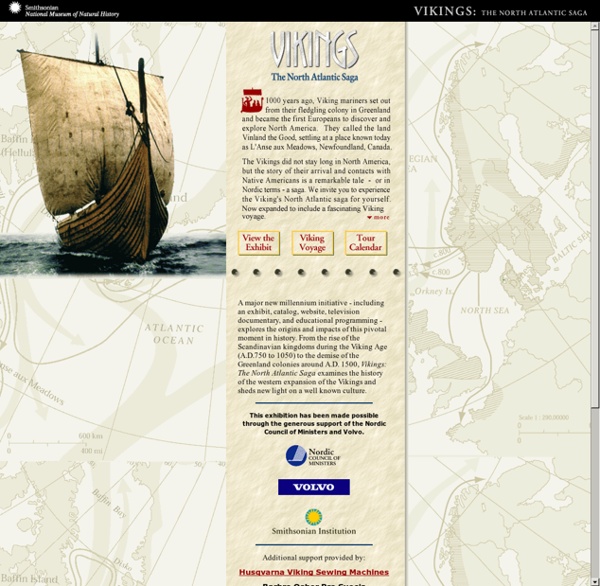
Les vikings : des explorateurs conquérants En plus d'avoir été de terrifiants conquérants, les vikings étaient de fabuleux aventuriers et explorateurs : leurs découvertes en témoignent. (En savoir plus sur les vikings). Islande Les vikings découvrent l’Islande en 860 et s’y établissent par la suite. Groenland : Le chef viking Erik le Rouge, banni d'Islande durant 3 ans suite à un meurtre, s'installe avec sa famille au Groenland en 982 : l'existence de l'île lui avait été indiquée par un marin qui s'était égaré à l'ouest en voulant rejoindre l'Islande. Vestiges de l'église de Brattahild, proche de la ferme d'Erik-le-rouge Deux implantations sont ainsi créées, représentant un total d'environ 4000 personnes : Brattahlid au sud qui comptera 12 églises, une cathédrale, un monastère et un couvent, Un site plus modeste à l'ouest à quelques centaines de kilomètres du cercle polaire comportant seulement une église. Un commerce de fourrure, d'ivoire de morse, d'huile et de laine se développe avec les pays scandinaves. Amérique : Terre-Neuve
What Your Poop and Pee Are Telling You About Your Body *Alert* The Glowing Lean System Registration is OPEN… CLICK HERE to learn more Have you ever wondered if your poop looked “normal,” but were too embarrassed to ask anyone else what their poop looks like? Or has your pee ever smelled a bit putrid but you were too mortified to utter a word to your best friend, let alone your boy friend? Poop is an important part of health and affects your beauty, as everything in your body works as an interrelated system. Well don’t worry, because here is a guide to anything and everything you may have wondered about your pee, and yes, your poop. Click on the infographic below to view a larger image: You’re One Click Away From Reading This Article… Get access to this post, and premium content, simply enter your email. Enter your email belowThen click the button No, thanks
Mysterious Pyramid Baffles Chinese Scientists No one seems to know the origin or the meaning behind a mysterious pyramid that sits atop Mount Baigong in western China that local legends claim is an alien UFO launch tower. Nine scientists form the team that will travel to the western province of Qinghai and the mouth of this 165-198 foot tall structure known as the “ET Relics.” “The pyramid has three caves with openings shaped like triangles on its façade and is filled with red-hued pipes leading into the mountain and a nearby salt water lake,” says China’s state-run Xinhua agency. To add to the mystery, iron debris and unusually shaped stones are scattered about the desolate area. “The theory that the pyramid was created by extra terrestrials is “understandable and worth looking into…but scientific means must be employed to prove whether or not it is true,” says Yang Ji, a researcher at the Chinese Academy of Social Sciences. On the beach at nearby Toson Lake, many strangely-shaped iron pipes lay amid the sands and rocks. (Link)
Monks and Monasteries Saga Sagas are stories about ancient Scandinavian and Germanic history, about early Viking voyages, the battles that took place during the voyages, about migration to Iceland and of feuds between Icelandic families. They were written in the Old Norse language, mainly in Iceland. "Saga" is a word originating from Old Norse or Icelandic language ("Saga" is also the modern Icelandic word for "story"). Saga is a cognate of the English word say: its various meanings in Icelandic are approximately equivalent to "something said" or "a narrative in prose", somewhat along the lines of a "story", a "tale", or a "history".[1] The texts are tales in prose which share some similarities with the epic, often with stanzas or whole poems in alliterative verse embedded in the text, of heroic deeds of days long gone, "tales of worthy men," who were often Vikings, sometimes pagan, sometimes Christian. Background[edit] There are plenty of tales of kings (e.g. Classification[edit] Queen Ragnhild's dream Other[edit]
Nazi Gold: The Merkers Mine Treasure Prologue: Quarterly of the National Archives and Records AdministrationPrologue Page Spring 1999, vol. 31, no. 1 By Greg Bradsher Late on the evening of March 22, 1945, elements of Lt. Gen. George Patton's Third Army crossed the Rhine, and soon thereafter his whole army crossed the river and drove into the heart of Germany. Advancing northeast from Frankfurt, elements of the Third Army cut into the future Soviet Zone and advanced on Gotha. During April 4 and 5, displaced persons in the vicinity interrogated by the Counter Intelligence Corps (CIC) personnel of the Ninetieth Infantry Division mentioned a recent movement of German Reichsbank gold from Berlin to the Wintershal AG's Kaiseroda potassium mine at Merkers. Early the next morning, two military policemen guarding the road entering Keiselbach from Merkers saw two women approaching and promptly challenged and stopped them. By noon on April 6 the women's story had reached Lt. At 10 a.m. Top of Page
Archaeologists discover earliest evidence of seafaring in Crete ATHENS, Jan. 5 (Xinhua)-- Greek and foreign archaeologists have traced the earliest evidence of seafaring in tools dating back to 130,000 years ago during excavations on Crete island, the Greek Culture Ministry said in a statement Wednesday. In over a century of systematic archaeological research on the southern Greek island, scientists had not found evidence that Crete was inhabited before the Neolithic period (7,000-3,000 B.C.). Recent findings of an excavation at Plakias- Preveli near the city of Rethymnon, which started in 2008 by a research team led by Thomas Strasser of the American School of Classical Studies in Athens and Eleni Panagopoulou of the Greek Ministry of Culture and Tourism, show that Crete was inhabited as early as the Palaeolithic period. Noting that even 130,000 years ago Crete was an island, archaeologists present the tools found as evidence that the ancestors of modern man sailed earlier than we thought so far.
Pathways, Civilizations Through Time Page Viking Ragnar There are thousands of web pages devoted to the Vikings and related topics. Many of them have beguiling graphics, an entertaining style, and vast amounts of data. I'm not going to repeat, or compete with, all of that fine work. What I will do is make some comments and suggestions, and provide some links. Use your browser and follow your interests. If you are a lover of fine books, and have a bit of cash on hand, you might want to look at The Complete Sagas of the Icelanders, edited by Viðar Hreinsson. The Havamal contains advice the "High One", Odin himself, on how to get along in life. The mention of runes evokes ideas of symbols of power and mystery from Tolkin's stories, and similar tales. The runes were a writing system used in Northern Europe. The runes differed from our current alphabet in that each character had three levels of meanings. These associations were almost certainly used for magical purposes, including fortune telling (rune casting). Vikings were all pagans, right?
Quadrupling the World GDP by 2010 The solution for the political-economic problems of Africa, Argentina, Afghanistan, and other nations Editor's note: This is the second in a series of articles by financial futurists Karun Philip [KP] and Richard S. Kirby [RK]. Together in a series of books, essays and stories they are laying the foundations for a rapid redefinition of financial civilization. Their purpose is the end of poverty -- their method is making a New World of money. Introduction Karun Philip and I (RK) continue to write collaborative articles on better worlds of money -- new worlds of money made available to the financial world immediately. We are economic realists, and yet we are economic idealists at the same time! The world needs more money because it needs more liquid love. The theory of capital But the theory of capital is itself in constant change. What causes these changes in the theory of capital? The highest economic good Money supply, money creation, credit creation What in the world is 'money supply'?
Websites - Central Library - Catalogue - WebPath Express - (search) Middle ages or Dark Ages