

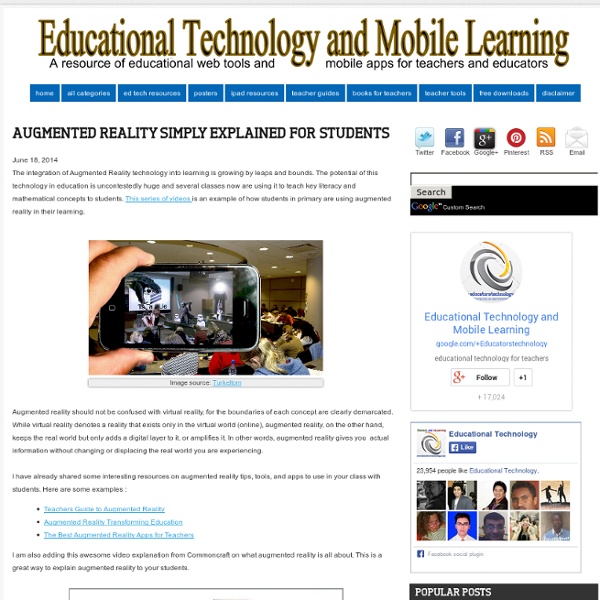
Augmented reality NASA X38 display showing video map overlays including runways and obstacles during flight test in 2000. Augmented reality (AR) is a live direct or indirect view of a physical, real-world environment whose elements are augmented (or supplemented) by computer-generated sensory input such as sound, video, graphics or GPS data. It is related to a more general concept called mediated reality, in which a view of reality is modified (possibly even diminished rather than augmented) by a computer. As a result, the technology functions by enhancing one’s current perception of reality.[1] By contrast, virtual reality replaces the real world with a simulated one.[2][3] Augmentation is conventionally in real-time and in semantic context with environmental elements, such as sports scores on TV during a match. Technology[edit] Hardware[edit] Hardware components for augmented reality are: processor, display, sensors and input devices. Display[edit] Head-mounted[edit] Eyeglasses[edit] HUD[edit] EyeTap[edit]
Google/Magic Leap’s 3D “Cinematic Reality” to replace VR, AR? [From Re/code, where the story includes two videos] Google Set to Lead Huge Investment in Magic Leap and Its “Cinematic Reality” October 13, 2014 By Liz Gannes and Peter Kafka Google and other investors are planning a huge investment in Magic Leap, a secretive but boastful company building hardware and software it says will deliver “cinematic reality.” Sources say Google is leading what could be a $500 million funding round for the Florida-based company; Andreessen Horowitz may be one of the other investors in the consortium. Google, Andreessen Horowitz and Magic Leap reps declined to comment. Aside from a few cryptic interviews and press releases, Magic Leap has kept a low profile until recently, but it has drawn increasing interest from Hollywood and Silicon Valley. On Oculus Rift and pretty much every other virtual and augmented reality experience, what the viewer sees is flat and floating in space at a set distance. “Those are old terms — virtual reality, augmented reality.
Augmented Reality news, reviews, photos and video <img src=" alt="Disney's Wreck It Ralph turns London's Brick Lane into Augmented Reality playground"> <img src=" alt="BAE Systems fighter pilot helmet HMD pictures and hands-on"> OnlineBAE Systems fighter pilot helmet HMD pictures and hands-onWhile augmented reality is still struggling to develop a ubiquity of relevance in the consumer realm, it's going great guns in the professional world and nowhere is it more crucial and more astounding than for fighter pilots. BAE Systems, long provider... <img src=" alt="APP OF THE DAY: Cliff Diving review (PS Vita)"> GamingAPP OF THE DAY: Cliff Diving review (PS Vita)So it's nearly here.
Augmented Reality Brings New Dimensions to Learning Editor's Note: Drew Minock, who co-wrote this piece, is an elementary teacher, co-founder of the popular education blog Two Guys and Some IPads, and is one of the voices on "The Two Guys Show" podcast. Imagine living in the magical world of Harry Potter, where the school hallways are lined with paintings that are alive and interactive. Now imagine creating an atmosphere like that for your students. Augmented Reality (AR) allows educators and students to do just that: unlock or create layers of digital information on top of the physical world that can be viewed through an Android or iOS device. Most people who interact with AR for the first time have a mind-blowing experience but fail to consider classroom applications. In our elementary school classrooms, we use AR to create active learning experiences hitherto inconceivable, and in the process redefine the learning space! Classroom Applications Not Just Another Fad There are endless ideas and possibilities for using AR.
ARToolKit ARToolKit is a computer tracking library for creation of strong augmented reality applications that overlay virtual imagery on the real world. To do this, it uses video tracking capabilities that calculate the real camera position and orientation relative to square physical markers in real time. Once the real camera position is known a virtual camera can be positioned at the same point and 3D computer graphics models drawn exactly overlaid on the real marker. So ARToolKit solves two of the key problems in Augmented Reality; viewpoint tracking and virtual object interaction. ARToolKit was originally developed by Hirokazu Kato of Nara Institute of Science and Technology in 1999[1] and was released by the University of Washington HIT Lab. Features[edit] Single camera position/orientation tracking.Tracking code that uses simple black squares.The ability to use any square marker patterns.Easy camera calibration code.Fast enough for real time AR applications.Free and open source. See also[edit]
AR Flashcards 2.0 IS Here And It's FREE! | AR Flashcards Welcome to a new world of Flashcards. AR Flashcards make learning fun with the technology of Augmented Reality! “It’s definitely unique and a very clever way to get children involved in learning the alphabet and animal names.” – TheiPhoneMom.com “Through the use of augmented reality (AR) and flashcards – this app allows your children to learn in a new and exciting way! “My daughter was repeating the letters and animal names and I could tell that she was learning a lot from this app, which of course is what is most important to me as a parent.” – MidwesternMoms.com “Children will love playing around with the cards and animals while learning the letters of the alphabet.” – Appysmarts.com “I absolutely love this unique twist on flashcards. AR Flashcards are a new way to interact and make Flashcards more entertaining for toddlers and preschoolers. Features: - 26 beautifully rendered Animals to help your toddler or preschooler learn the alphabet! - 6 beautifully rendered Dinosaurs!
GravitySketch Tablet Is a Portable 3D Augmented Reality Sketchpad For Designers There’s an imposing wall dividing real world creation and digital design. To transfer a paper design to a computer, you need training and experience in technically demanding computer assisted design (CAD) programs. Instead, imagine if we could mold digital designs in three dimensions as easily as we mold clay. We may be entering a new era of computer interfaces where standard two-dimensional screen, keyboard, and mouse are enhanced by more instinctive 3D modes of interaction—modes that more closely mimic real world design methods. In sci-fi, 3D interfaces tend to be holographic. Increasingly, instead of holograms, 3D interfaces are powered by a suite of devices working in tandem to produce the illusion of depth in augmented reality. Take the recently developed GravitySketch tablet. They surveyed a group of creators and found that, for many, the creative process begins with a simple pad of paper and pencil. How does Gravity Sketch work? Image Credit: Gravity
Moodle The Periodic Table of Instructional Design Infographic Instructional Design Infographics The Periodic Table of Instructional Design Infographic The Periodic Table of Instructional Design Infographic Students and scholars of chemistry make frequent use of the periodic table of the elements in order to contextualize and organize their understanding of the many substances they work with, as well as help to memorize each of their different properties. Customer-Facing The first group of elements that instructional designers should be familiar with are those dealing with customers and clients. Instructional designers have a uniquely intimate relationship with their customers, especially when it comes to custom courses, because the customer might have very specific requirements for their learners. Learner-Facing On the other hand, what is eLearning without learners? Behind the Scenes A lot of what happens in multimedia projects occurs behind the scenes. Operational Best Practices Course Cripplers Via: elearningbrothers.com
50 best augmented reality games: massive overview of AR games market - Thinkmobiles AR technology is getting deeply implemented in the gaming industry. Nowadays, this is not just the fantastical concept. Augmented reality games can allow you to fight aliens, capture fantastical creatures, defend kingdoms in the real world. And this all is possible without super expensive headsets – just an AR-enabled smartphone or console is required. We’ve done a huge job to collect all the AR games that are worth your attention. Using the Apptopia app, we also prepared monthly downloads and total revenue overviews for the most popular of them. Prepare your phones – you’ll definitely want to download some of these fantastical augmented reality games immediately! Geolocation Games Geolocation games are the most exciting genre in the world of augmented reality games. Using the GPS enabled smartphone the player moves around the neighborhood and completes different tasks. 1. Cost: FREE This is the legendary project by Niantic which brought augmented reality games into the crowds. 2. 3. 4. 5.