

About Svpply is a community of people discovering the products they love. Every one of the 1.1 Million products in our Shop section has been selected by hand by one of our members, and brought to our site using our bookmarklet. We bring in a little over 3,000 new products a day from all across the web. We unofficially represent over 70,000 stores and brands. We are actively working towards giving them access to their inventory and their audience. The Svpply Team & Founders: Contact 625 Avenue of the Americas - 3rd FloorNew York, NY, 10011hello@svpply.com
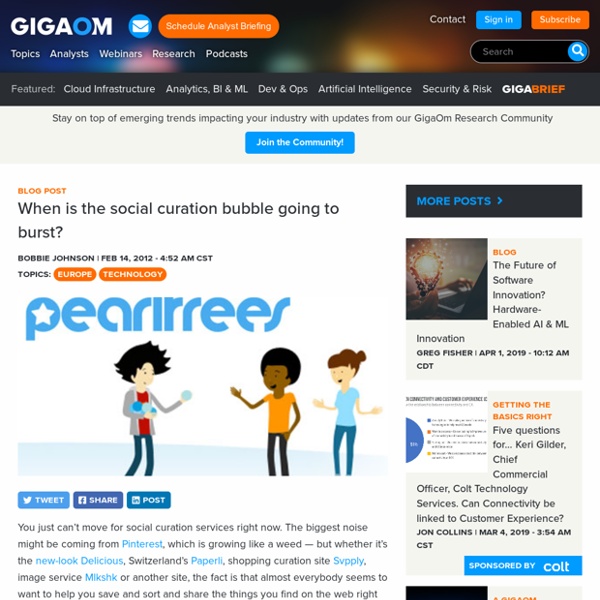
Pearltrees Social Media: Pearltrees Ha Rediseñado Radicalmente su Servicio de Curaduría en Línea para Llegar a un Público más Amplio Pearltrees, el servicio de curación en línea con sede en París que puso en marcha a finales de 2009, siempre fue conocido por su interfaz basada en Flash, bastante peculiar que le ha permitido organizar favoritos de Internet, fotos, fragmentos de texto y documentos en una estructura en forma similar a un mapa mental. Para los usuarios que recibieron esa metáfora, que era un servicio muy potente, pero su interfaz también presentaba una barrera de entrada para los nuevos usuarios. Hoy en día, la compañía está poniendo en marcha un rediseño radical que elimina la mayor parte del equipaje de Pearltrees 1.0. Esto es lo que en Pearltrees 1.0 aparecía: Y aquí está la nueva versión: Pearltrees tienes todavía la misión para permitirle organizar todo lo que quiera sobre el servicio (en ese sentido, casi compite con Evernote). La nueva "rejilla" definitivamente elimina muchos de los problemas de la versión anterior. En términos de funcionalidad, nada ha cambiado realmente en esta versión.
givealink /FAQ What is GiveALink? GiveALink is a social annotation, organization, recommendation, and navigation system for the Web. It is also a research project by the Networks and Agents Network in the Center for Complex Networks and Systems Research of the Indiana University School of Informatics. The project is funded by National Science Foundation (award IIS-0811994: Social Integration of Semantic Annotation Networks for Web Applications). However any opinions, findings, and conclusions or recommendations expressed on this site do not necessarily reflect the views of the NSF. How is GiveALink different from Delicious? There are several great social tagging and social bookmarking systems and Web sites that provide many useful services such as sharing, tagging, syncing, searching, and recommendation. Why share bookmarks? OK, what can GiveALink do? Some functionality is already available on the GiveALink site. What are you working on next? Great, how can I help? Thank you for asking! Yes! Yes!
Droit aux buttes Jardins en buttes à l'écocentre du périgord On les voit fleurir un peu partout, elles représentent une vraie révolution dans notre relation au sol et notre façon de cultiver. Symboles par excellence de l’agroécologie mais surtout de la permaculture (avec la poule), elles n’en sont pourtant qu’un élément parmi d’autres. C’est Emilia Hazelipp qui semble avoir importé la culture sur butte en France. Mais quels sont les avantages de cette culture étrange qui demande pourtant un gros travail de mise en place? tout d’abord, elle évite de se baisser. - limiter l’enherbement, - limiter l’évaporation de l’eau et donc de presque supprimer l’arrosage (hors plantation bien sûr), - fournir régulièrement tout au long de l’année la fertilité à la butte par humification (décomposition par la faune du sol) de la couche de mulch, - protéger cette fameuse microfaune et son cortège de bactéries, champignons et autres arthropodes du gel, du soleil, du dessèchement et de l’érosion. Le non travail du sol.
Online Landscape Evolves With S-Commerce - Direct Internet Catalogue - Retail Early adopters of Facebook commerce, or F-commerce, are dropping it like flies — but so what? Department stores such as Nordstrom and J.C. Penney recently shuttered F-commerce storefronts and ceased selling on the digital platform, but it doesn’t matter, experts contend, because the landscape has already shifted to social commerce, or s-commerce. “Facebook fan page stores are only 10 percent of the total shopping activity on Facebook,” said Wade Gerten, co-founder and chief executive officer of technology solution 8thBridge. “Social commerce is so much more than a brand or retailer’s fan page store.” Experts are priming social commerce to be the next big thing in digital and, going forward, retailers must focus less on F-commerce specifically and more on s-commerce. “There’s been so much overhyping about it that’s its not surprising that there’s going to be a bit of backlash. In fact, it’s just the beginning of it. Brands should rapidly embrace the platform’s new functionalities.
What problem does Pearltrees solve? Saviez-vous qu’il existe des perles de S.I.Lex ? (Pearltrees et le droit) Serait-ce une perle de silex ? (en fait, du silex rubané poli). Krzemień pasiasty kula. Dans la jungle foisonnante des services 2.0 et des médias sociaux, il en est vers lesquels on se tourne d’abord pour leur esthétique et leur élégance, plus que pour leurs fonctionnalités. Il faut dire que Pealtrees est un outil assez atypique, situé quelque part entre les bookmarks sociaux et la cartographie heuristique, qui propose de fournir aux internautes les moyens d’ « éditer » par eux-mêmes le web en construisant sous la forme d’arbres de perles des parcours de page en page. Pearltrees est une start-up française et je vous conseille d’aller faire un tour sur le blog Cratyle.net de Patrice Lamothe, son CEO, où il développe la vision qui est à l’origine du projet et notamment la critique d’une certaine conception du web 2.0 : La démocratisation de la création n’a cependant pas entrainé la démocratisation de l’accès aux contenus. I Cartographier le droit en arbre de perles J'aime :
NodeXL: Network Overview, Discovery and Exploration for Excel - Home 10 Brilliant Social Psychology Studies Ten of the most influential social psychology experiments explain why we sometimes do dumb or irrational things. “I have been primarily interested in how and why ordinary people do unusual things, things that seem alien to their natures.Why do good people sometimes act evil?Why do smart people sometimes do dumb or irrational things?” –Philip Zimbardo Like famous social psychologist Professor Philip Zimbardo (author of The Lucifer Effect: Understanding How Good People Turn Evil), I’m also obsessed with why we do dumb or irrational things. The answer quite often is because of other people — something social psychologists have comprehensively shown. Each of the 10 brilliant social psychology experiments below tells a unique, insightful story relevant to all our lives, every day. Click the link in each social psychology experiment to get the full description and explanation of each phenomenon. 1. The halo effect is a finding from a famous social psychology experiment. 2. 3. 4. 5. 6. 7. 8. 9. 10.
Get inside their heads: 12 factors that impact whether customers click "buy" As I started to take notes, I was a bit startled to hear Amy’s opening question: “If you and I were alone in this room, how would you kill me?” A self-described usability specialist, Eight by Eight’s Amy Africa knows how to get one’s attention – but more importantly, what gets people to buy (and not). In the Shop.org First Look “Neuromarketing and the Influence on Buying Behavior” session at Retail’s BIG Show this week, Amy delved into what makes us tick – as human beings and as shoppers – which in turn are keys for retailers to entice customers to buy. Amy Africa, CEO of Eight by Eight talks about the human brain and shopping. So back to that unusual opening question. Amy used that – and a series of follow up “what if” scenarios – to get the audience to think about how we make decisions. And this has what to do with retailing? We are self-centered.
au secours pas de mode cartographie des proches Comment détruire votre communauté en 10 leçons Si vous avez le malheur de développer un projet « open source » au sein de votre entreprise alors vous courrez le risque de voir arriver une « communauté » qui peut à tout moment s’agréger autour du code source de votre logiciel et en menacer sa bonne gouvernance. Heureusement le développeur Josh Berkus est là pour vous expliquer point par point comment faire pour être certain de ruiner et dissoudre toute velléité communautaire (au cours d’une intervention donnée il y a un mois à la Linux.Conf.au et relatée ici par Jonathan Corbet)[1] Un article évidemment ironique (qui détourne les howto), mais qui donne à réfléchir sur les relations subtiles et complexes qui peuvent exister entre les communautés et les entreprises qui œuvrent sur un même projet. Pas toujours facile de se comprendre en effet quand les uns disent plutôt « logiciel libre » et les autres plutôt « open source » (voire même parfois carrément « fauxopen source »). Comment détruire votre communauté : mode d’emploi 1. 2. 3. 4. 5.
i agree with you s243a. my motivation to join pearltrees was not to import my bookmarks, but to have a useful and fun learning application. especially the web design developement content. of course, once hooked on pearltrees my motivations changed. i am an information junkie and a great place version 1 is for that addiction. haha. so yes, for me, the quality content of version 1's power curators definitely solidified my upgrade to premium membership. was that not a money hit for the power of quality curation and strickly in the version 1 format. and since then i have upgraded to a premium membership plan that allows me to offer premium membership to my husband, family, and friends if they choose. in my world that's called income generated via membership of quality curators . make sense? by ebbead Jun 2
@s243a
Sur le "make money"; eh oui, les utilisateurs vont commencer à réfléchir sur ce qu'est un cloud. by reel Jun 1
> J'ai écrit ça moi ? ? ? On est le 26 avril 2023 sniff sniff je vais pleurer, sniff.
Presque ten years after, je me souviens du séisme de 1974 sur les squares.
Faudra demander de passer aux triangles dans un an; 10 ans après ! ! ;-))))
*****************
Cet article de presse, de 2012, cursif, était obnubilé par le côté interconnectivité "objets" de Pearltrees et n'avait pas anticipé le côté interconnectivité "sujets" (en train d'être créé en 2014).
La mise en contraste avec Pinterest (confondant personnalités et profils stats) est savoureuse... by reel Jun 1
This article gives some insight on what they mean by “democratize”. Essentially it suggests that they think that there may be more money in potential users than in their existing user base. The article claims that only 1% of people invest much time in curation. However. Isn’t there something to be said for quality content? Couldn’t quality content be a big driver of traffic for the site? by s243a Jun 1