technology - electronic aerosol technology : TTP
Destined to replace traditional aerosol and trigger-spray technologies in consumer, drug delivery and pharmaceutical applications, TTP’s patented TouchSpray™ technology uses a low-cost microdevice to generate precisely controlled droplets from bulk liquids without the use of propellants. Innovative aerosol products will be packaged in compact new shapes and sizes thanks to the highly adaptable TouchSpray™ technology, which enables efficient delivery of concentrated liquids and suspensions from an un-pressurised reservoir. Electronic control provides precise and consistent droplet size and creates a spray plume with a flexible format, making the technology suitable for a wide variety of applications. It has already been proven in the medical sector for nebulisers.
Control a PC with body motions
LAS VEGAS – Don't trash your keyboard and mouse just yet. But three companies at the International Consumer Electronics Show demonstrated depth-sensing cameras that let you to control your computer by moving your hands or body. Microsoft's Kinect add-on for the Xbox 360 console has already popularized these cameras for gaming. Now, the technology is being set loose for use on other devices. The companies showed off their cameras to give software developers and gadget makers a chance to work with the technology and incorporate it in their products. WHY IT'S HOT: The cameras represent another challenge to the keyboard-and-mouse regime, which is already being eroded by touch screens. BEHIND THE LENS: The cameras can tell how far away things are in their field of vision. THE DOWNSIDE: If you buy one of these now, there isn't much you can do with it, unless you're a software developer.
Touchscreens UX: Godsend or disaster?
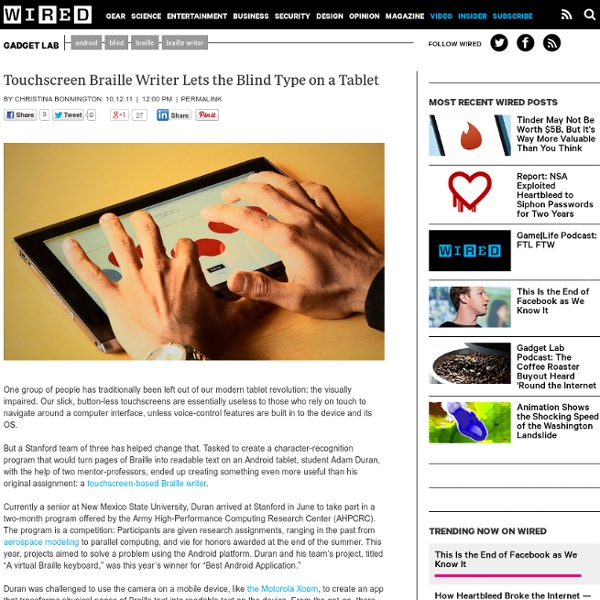
Note: A guest post by Jesse Kunze – More details about Jesse after the post. Touchscreens have taken off – they have went from a rarity, to pressure based touchscreens such as on the Palm Centro, to mostly capacitive, multi-point touchscreens such as iOS products, or most Android devices. As a plus, they are fairly intuitive to use, so you may be wondering why I would ever even think to consider them a disaster in the UX area of design. In fact, you may think that touchscreens will soon take over the whole arena, and you will never get to use a button again. But, I would like to interject right there and say that there are some flaws in touchscreens. Remember the embarrassing Smartphone autocorrect fails? Most are so evident that you would wonder why anyone would ever buy one. 1. Humans are pretty gross. 2. Have you ever had a little drop of water on your touchscreen device? 3. But it’s not all bad. 4. So I have the Palm Pre for Sprint, in this day and age an archaic, old phone. 5. 6.
ABOUT « The Campaign For Disability Employment
About the Campaign for Disability Employment The Campaign for Disability Employment is a collaborative effort between several disability and business organizations that seek to promote positive employment outcomes for people with disabilities by encouraging employers and others to recognize the value and talent they bring to the workplace as well as the dividend to be realized by fully including people with disabilities at work. People with disabilities can and do make important contributions to America’s businesses every day. By implementing good workplace practices, like maintaining a flexible and inclusive work environment, businesses can capitalize on the talents of qualified people with disabilities, benefitting everyone. The Campaign is a collaborative effort between several organizations that are working to raise awareness and change attitudes about disability and employment, including: The Campaign is funded by the U.S. The What Can You Do?
ZoomText
Microactuator
A microactuator is a microscopic servomechanism that supplies and transmits a measured amount of energy for the operation of another mechanism or system. As a general actuator, following standards have to be met. Large travelHigh precisionFast switchingLow power consumptionPower free force sustainability For microactuator, there are two in addition Principle of microactuators[edit] The basic principle can be described as the expression for mechanical work since an actuator is to manipulate positions and therefore force is needed. Classes of microactuators[edit] See also[edit]
Smartphone Booklet by Ilshat Garipov
Not a Pamphlet, It’s a Smartphone Clutch your pearls because I’m about to say something amazing – nanoparticles! Yes these tiny, near invisible objects can revolutionize the bio medical, optical and electronic fields so designer Ilshat Garipov put pen to paper and came up with the Smartphone Booklet – a disposable phone as thin as a cardboard made possible by switching from traditional silicon to nanoparticles. The Booklet unfolds like a pamphlet with each side representing a commonly used application or function. How close is this to reality? Designer: Ilshat Garipov
Touch Gesture Reference Guide
The Touch Gesture Reference Guide is a unique set of resources for software designers and developers working on touch-based user interfaces. The guide contains: 1) an overview of the core gestures used for most touch commands 2) how to utilize these gestures to support major user actions 3) visual representations of each gesture to use in design documentation and deliverables 4) an outline of how popular software platforms support core touch gestures (below). Download Touch Gesture Reference GuideTouch Gesture Cards For wireframes and mock-ups:Visuals only (PDF)Visuals only (EPS)Visuals only (OmniGraffle Stencil)Visuals only (Visio Stencils)How to Guide (Visio) Touch Resources Touch Target Sizes: outlines recommended touch target sizes from Apple, Microsoft, Nokia, and academic research. Touch Gesture Diagrams: listing of touch gesture diagrams that illustrate how users can interact with multitouch interfaces. Platform Support How popular software platforms support core touch gestures.
Triple amputee on a trike » Cyclelicious
Travis Prebble “puts people to pedals” by adaptings bikes and trikes for people with physical limitations. He writes about a Catrike recumbent that was modified for a 12 year old missing both legs and a his right hand. Using prosthetics, the rider will be able to strap into clipped pedals. This will be a step up from the method used with his last bike: duct taping himself to the pedals. He specifically requested that calf supports not be used as they gave away his disability from a distance. Travis writes about equipping the trike so this pre-teen with a single hand can have mobility on the trike. More at BikeAble: Trike for Triple Amputee. Photo by Travis Prebble under CC BY NC ND license. P.S.