

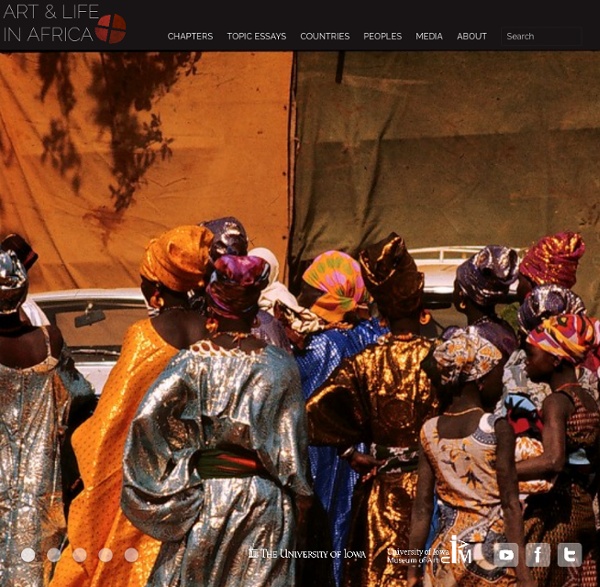
Chinua Achebe's Things Fall Apart: Teaching Through the Novel Activity 1. Mapping the Changing Face of Africa through History: Pre-Colonial, European Colonization, and Independent Nations In his essay "Issues in African History", located on the EDSITEment-reviewed resource Art and Life in Africa Online, Professor James Giblin of the University of Iowa Department of History writes about the European "Scramble for Africa" (1880-1910) and the Berlin Act of 1885, which created a set of European-controlled nation-states that arbitrarily combined into one country diverse African ethnic groups, on one hand, and divided linguistic and ethnic communities, on the other: "Africa's integration into a European-dominated economy has shaped its history since the 1880s. You might point out to the class that the cultural, religious, linguistic, and other historical divisions among ethnic groups have continued to challenge and blur the colonial borders of many African Nation-States, during colonization and especially after Independence. Activity 2. Activity 3.
Government of India The Government of India (GoI), officially known as the Union Government, and also known as the Central Government, was established by the Constitution of India, and is the governing authority of the union of 29 states and seven union territories, collectively called the Republic of India. It is based in New Delhi, the capital of India. The government has recently taken a new initiative by launching a public grievance website, wherein citizens can expect their grievances to be addressed.[1] Alternatively, one can also visit the President of India's official website[2] and register his/her grievance via the President's Secretariat.[3] Legislature[edit] Legislative power in India is exercised by the Parliament, a bicameral legislature consisting of the president of India, the Rajya Sabha, and the Lok Sabha. Executive branch[edit] The executive branch of government is the one that has sole authority and responsibility for the daily administration of the state bureaucracy. President[edit]
Igbo Webpage (collated by Uzoma Onyemaechi, University of Michigan, Ann Arbor) Title Men Obi/Eze Functions The political arrangements for the purpose of administration varied. Obi is the name of the head of the family in the Igbo areas. The functions of Ndichie in the community generally, irrespective of grade, are: first, to act as the Obi's representatives and play the role of public relations officers in the interest of the ruling Obi; second, to maintain law and order; third, to uphold the property of religious and customary practices; fourth, to dispense justice according to equity and the law of the land; fifth, to promote social welfare; and, lastly, to defend the land against aggression. Female administrative titles have not been popular among the Igbo since the late 19th century when the European colonialists entered into the heart of Igbo land not merely to trade but as cultural modifiers. In the kingdom of Obi there was a place for the female-counterpart ruler, the Omu. Position of Elders
How the Judicial System Works" The United States is renowned for having one of the most sophisticated judicial systems in the world. Every day thousands of people, including law enforcement officers, lawyers, judges, government officials and even accused criminals, take part in this system, hoping to settle disputes and work for justice. What makes this system even more remarkable is that it is able to operate successfully in a country as large and diverse as the United States. One of the keys to this success is a balanced and carefully ordered hierarchy: Several different federal courts control issues relating to federal law and each state has its own set of courts that can adapt to the needs of its people. Of course, it’s all a bit more complicated than that and no system works perfectly, but learning how the judicial system works can be useful in case you ever need to file a law suit, defend yourself in court, claim damages from the government or even pay a traffic ticket. Judicial System Basics
Book Summary Things Fall Apart is about the tragic fall of the protagonist, Okonkwo, and the Igbo culture. Okonkwo is a respected and influential leader within the Igbo community of Umuofia in eastern Nigeria. He first earns personal fame and distinction, and brings honor to his village, when he defeats Amalinze the Cat in a wrestling contest. Okonkwo's father, Unoka, was a lazy and wasteful man. Okonkwo despises and resents his father's gentle and idle ways. Because Okonkwo is a leader of his community, he is asked to care for a young boy named Ikemefuna, who is given to the village as a peace offering by neighboring Mbaino to avoid war with Umuofia. Over the years, Okonkwo becomes an extremely volatile man; he is apt to explode at the slightest provocation. After the coming of the locusts, Ogbuefi Ezeuder, the oldest man in the village, relays to Okonkwo a message from the Oracle. A public trial is held on the village commons. Six missionaries, including one white man, arrive in Mbanta.
Nigeria profile 27 November 2013Last updated at 05:29 ET After lurching from one military coup to another, Nigeria now has an elected leadership. But the government faces the growing challenge of preventing Africa's most populous country from breaking apart along ethnic and religious lines. Political liberalisation ushered in by the return to civilian rule in 1999 has allowed militants from religious and ethnic groups to pursue their demands through violence. Thousands of people have died over the past few years in communal attacks led by the al-Qaeda ally Boko Haram. Continue reading the main story Politics: People's Democratic Party (PDP) has dominated since the return to civilian rule in 1999. Country profiles compiled by BBC Monitoring The imposition of Islamic law in several northern states has embedded divisions and caused thousands of Christians to flee. The former British colony is one of the world's largest oil producers, but the industry has produced unwanted side effects.
"Talking About Tribe" Africa: "Tribe" Background Paper, 1 Date distributed (ymd): 971221 APIC Document APIC Background Paper 010 (November 1997) Talking about "Tribe": Moving from Stereotypes to Analysis November, 1997 For most people in Western countries, Africa immediately calls up the word "tribe." Yet today most scholars who study African states and societies--both African and non-African--agree that the idea of tribe promotes misleading stereotypes. In this paper we argue that anyone concerned with truth and accuracy should avoid the term "tribe" in characterizing African ethnic groups or cultures. Most scholars already prefer other terms to "tribe." What's Wrong With "Tribe?" Tribe has no coherent meaning. What is a tribe? Tribe is used for groups who trace their heritage to great kingdoms. Tribe promotes a myth of primitive African timelessness, obscuring history and change. The general sense of tribe as most people understand it is associated with primitiveness. But Why Not Use "Tribe?" This is true.