

American Corporate Software Can No Longer Be Trusted For Anything The discussions around SOPA have shown a very unfortunate side of United States policymaking — that its policymakers are not the slightest afraid of legislatively ordering American-run corporations to sabotage their customers in order to further United States foreign policy. Today, software from two American companies – Microsoft and Apple – run most of the world’s infrastructure, in terms of governments, authorities, social security, et cetera. It has come to be taken for so granted, you can barely buy a piece of hardware for the current ecosystem without code from at least one of these two American corporations. (UPDATE: I’ve seen quite a few network admins complain about this assertion. Note that I’m not pointing to network infrastructure such as switches, raw iron or web servers, but society’s infrastructure: social security, medical records, police databases. There is a problem with proprietary, closed software, which makes me a bit uneasy. What to shift to, I hear you ask?
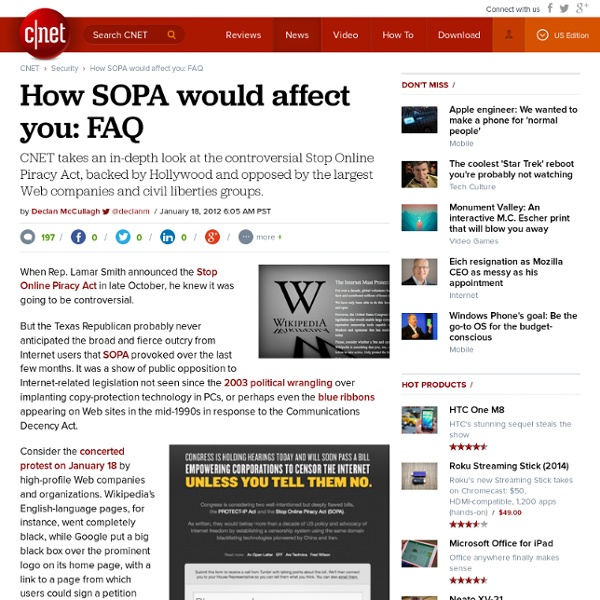
MythBuster Adam Savage: SOPA Could Destroy the Internet as We Know It Right now Congress is considering two bills—the Protect IP Act, and the Stop Online Piracy Act (SOPA)—that would be laughable if they weren't in fact real. Honestly, if a friend wrote these into a piece of fiction about government oversight gone amok, I'd have to tell them that they were too one-dimensional, too obviously anticonstitutional. Make no mistake: These bills aren't simply unconstitutional, they are anticonstitutional. They would allow for the wholesale elimination of entire websites, domain names, and chunks of the DNS (the underlying structure of the whole Internet), based on nothing more than the "good faith" assertion by a single party that the website is infringing on a copyright of the complainant. I'm not kidding. The Digital Millennium Copyright Act (DMCA), passed in 1998, is a lousy piece of legislation and a very useful lens through which to regard these two new pieces of legislation. This is exactly what will happen with Protect IP and SOPA. Educate yourself.
While Drafting SOPA, the U.S. House Harbors BitTorrent Pirates In recent weeks we discovered BitTorrent pirates at the RIAA, Sony, Fox, Universal and even law-abiding organizations such as the Department of Homeland Security. By now it should be clear that people are using BitTorrent pretty much everywhere, and not only for lawful downloads. Today we can add the U.S. YouHaveDownloaded is a treasure trove full of incriminating data on alleged BitTorrent pirates in organizations all across the world. Unauthorized downloads occur even in the most unexpected of places, from the palace of the French President, via the Church of God, to the RIAA. Although we don’t plan to go on forever trawling the archives, we felt that there was at least one place that warranted further investigation – the U.S. The answer is yet again unambiguous – they pirate a lot. In total we found more than 800 IP-addresses assigned to the U.S. Something that immediately caught our eye are the self-help books that are downloaded in the House.
What You Need to Know About SOPA in 2012 The Internet is in an uproar over the Stop Online Piracy Act. The battles lines are drawn. Big Media (the record labels, movie studios and TV networks) support the bill while Big Tech (search engines, open source platforms, social networks) oppose it. The bill, introduced to Congress by Representative Lamar Smith, is ostensibly supposed to give the Attorney General the ability to eliminate Internet piracy and to "protect U.S. customers and prevent U.S. support of infringing sites." There is a lot that may be wrong with SOPA, but putting the power to censor the Internet into the hands of the government is chief among citizens' concerns. How SOPA Would Work SOPA (bill text) sets up a variety of ways for the U.S. government to block sites that are seen to be infringing on intellectual property. Along with the Protect IP Act of 2011, here are the ways the U.S. government can enforce the proposed laws. 1. Who would be affected by these mandates from the Attorney General? Who Supports SOPA?
Now The U.S. Is Trying To Force Dumb Internet Laws On Other Countries Too Stop SOPA! A Plea from the Inventors of the Internet What happens when you combine an overzealous drive to fight Internet piracy, with elected representatives who don’t know the difference between DNS, IM, and MP3? You get SOPA--draconian legislation that far exceeds its intended scope, and threatens the Constitutional rights of law abiding citizens. And it may just pass. An open letter to Congress written by luminaries of the Internet, such as Vint Cerf--co-designer of TCP/IP, and Robert W. The letter goes on to ominously caution Congress. Paul Tassi, a sometimes writer for Forbes, makes his primary living from a website he co-founded. Tassi pleads, “The internet is my life now. You only really need to know one thing about SOPA to realize that it’s bad legislation that must be stopped: it is supported (and probably written) by the RIAA and MPAA. It is almost 2012.
Why SOPA Could Kill the Open Education Resource Movement - Education Thanks to the Open Education Resource movement, remixing and redistributing educational content has become standard. Efforts like the 10-year-old OpenCourseWare project at MIT, OER libraries stocked with free or low cost electronic books for college classes in Washington and California, and the rise of online learning have all contributed to the democratization of education. But all that global knowledge sharing could come to a grinding halt if the Stop Online Piracy Act goes forward. In a "Concerned Educators Letter to Congress" a grassroots collective of OER and educational technology leaders write that SOPA would "chill the creation of educational content." A prime example of SOPA's potential impact on the OER movement comes from the application of the Family Educational Rights and Privacy Act. Pioneering OER platforms could face a similar fate. Photo via (cc) Flickr user Scott Woods-Fehr
How SOPA could actually break the internet We’ve discussed the Stop Online Piracy Act (SOPA) at some length, but haven’t said much about the serious technical problems with the bill as its written. Depending on how its implemented, SOPA could demolish the cohesive structure of the internet by damaging the core functionality of the Domain Name Service (DNS) system. As written, SOPA tasks ISPs with preventing US internet users from accessing a site that’s been deemed to contain infringing content by preventing their browsers “from resolving to that domain name’s Internet Protocol address.” The question is, how might that sort of blocking actually be accomplished? Existing legal structures already allow the government to petition Verisign to remove the DNS records that resolve to any given website (we’ll use pirates.com as an example). All of these methods are already allowed under existing US law and have been used in the past. So far, so good. Next page: Will SOPA break the internet?
Paul Graham: SOPA Supporting Companies No Longer Allowed At YC Demo Day At this point quite a few internet companies have protested H.R. 3261, the Stop Online Piracy Act (SOPA) in creative ways. Held by many to be the worst thing to ever happen to the Internet if it passes, SOPA would makes it really easy for copyright holders to force sites offline that they think are offending, among other things. While the judiciary vote has been delayed until next year, the list revealing the companies who support the act was released yesterday, and many startups, such as Reddit, have begun to drill down into boycotts of individual companies like domain provider GoDaddy. The company boycotts have sparked a thread on Hacker News, where user Solipsist posted a link to the list with the comment, “While I understand your sentiments towards SOPA, are you really going to distance yourself from all of these companies?” To which YCombinator founder and investor Paul Graham replied, “Actually that’s exactly what I thought when I saw the list yesterday. The rationale?
Over 40 Internet Companies Come Out Publicly Against SOPA (Including Us) Since the list of 120 or so SOPA supporting companies hit the Internet yesterday, the lines have been drawn; People are publicly promising to pull thousands of domains from domain registrar Godaddy after it appeared on the list as a supporter. Other people are calling those people “bullies.” Whether you’re for or against it SOPA has become somewhat of a pain point amongst techies, with the overwhelming majority, including myself and almost every other writer on the TechCrunch team, leaning heavily towards “against.” SOPA (the Stop Online Piracy Act) essentially allows ISPs to block entire domains because a piece of hosted content infringes copyright. Here’s a list of all the publicly anti-SOPA tech/Internet companies I could find. Sources: (TechCrunch, Quora, CDT.org, Techmeme).
Cheezburger CEO Threatens to Move GoDaddy Domains 22 December '11, 11:05pm Follow Things are getting heated when it comes to the “Stop Online Piracy Act”, aka SOPA. GoDaddy’s stance has been in support of the act, which leaves many online entrepreneurs wondering if there will even be a free web to innovate for in 2012. One such entrepreneur decided to show GoDaddy just how serious he is about his distaste for act. Huh’s company is best known for its site ICanHasCheezburger, and with over 1,000 domains in its kitty, it would be a huge loss for GoDaddy. GoDaddy is just one company listed as asupporter of the act, and here’s an excerpt of its statement to the House of Representatives last month: GoDaddy is committed to doing everything it can to ensure that the Internet is a safe and trustworthy way to communicate and conduct business. We’ll see about that, GoDaddy.