

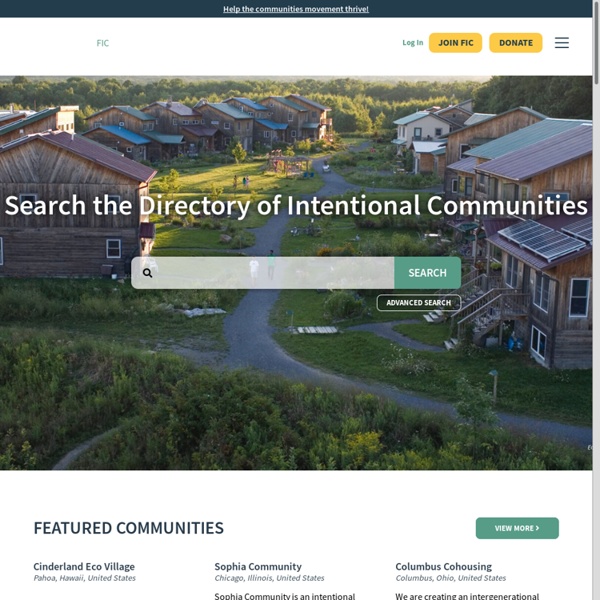
Dr. Martin Luther King, Jr. Online Consumo Colaborativo Intentional community Characteristics[edit] Purpose[edit] The purposes of intentional communities vary in different communities. They may include sharing resources, creating family-oriented neighborhoods and living ecologically sustainable lifestyles (ecovillages). Types of communities[edit] Some communities are secular; others have a spiritual basis. Some communities provide services to disadvantaged populations, for example, war refugees, the homeless, or people with developmental disabilities. Types of memberships[edit] Many communities have different types or levels of membership. Christian intentional communities are usually composed of those wanting to emulate the practices of the earliest believers. A survey in the 1995 edition of the Communities Directory, published by Fellowship for Intentional Community (FIC), reported that 54% of the communities choosing to list themselves were rural, 28% were urban, 10% had both rural and urban sites, and 8% did not specify.[1] Type of governance[edit] See also[edit]
D.C.'s ‘intentional communities’ put strangers in a house joined by core values Called “intentional communities,” these group homes are occupied by strangers who live together based on core values, such as intergenerational child-rearing, environmental sustainability or the attempt to live out Catholic social teaching. They have manifestos on the fridge, nightly house dinners, monthly “feelings and needs” meetings, and commitments to shared decision-making. Is a clothes dryer wasteful? Should non-married couples be allowed as residents? What’s a “Jewish” way to ease poverty? There are at least two dozen of these homes just in and around the Northwest neighborhood of Petworth, a large enough constellation to gather for a regular potluck and an “Olympics” with such events as a compost-toss. With their mostly progressive, war-opposing, meat-eschewing bent, the homes can feel reminiscent of 1960s communes made up of people who sought to escape mainstream life. Maitri House Founded: 2007
Work Exchange | Dancing Rabbit Ecovillage If you’d like to see what life is like at Dancing Rabbit and build your skills in sustainable living at the same time, you may be interested in a work exchange or internship position. In exchange for your help on a project, your project host typically provides for your living accommodations, food, and other living expenses while at Dancing Rabbit. Opportunities to gain hands-on experience is, of course, also part of the exchange. Technology Engineering / Sustainable Living Intern Culinary Assistant & Baker Gardening, Livestock Systems, Green Building, Ecovillage Lifestyle Internships Work exchangers and interns are hosted by individual Dancing Rabbit members. While a major focus of an work exchange/internship is on the work project, these opportunities offer much more. As an eco-village literally “under construction,” we often have many building projects happening at once. The work will depend on the time of the year and the gardening style of the host.
Hatewatch | Exposing hate groups and other extremists throughout the United States since 1981. Managed by the staff of the Intelligence Project at the Southern Poverty Law Center. SPLC and Bill O’Reilly: More Dishonesty From the Fox Anchor Editor’s Note: In light of the building controversy over the truthfulness of Fox News’ Bill O’Reilly, who has been accused of lying about reporting from a “war zone” and about hearing a friend of Lee Harvey Oswald commit suicide, Hatewatch has decided to republish a Feb. 27, 2014, post about the host of “The O’Reilly Factor.” The post describes two encounters between O’Reilly and Southern Poverty Law Center Senior Fellow Mark Potok, along with the details of a completely fictitious story aired by O’Reilly in 2007 that claimed the nation was being terrorized by gangs of pink pistol-toting lesbians. Oh, Really, Bill? Once Again, O’Reilly Can’t Admit a Mistake A week ago today, I went on CNN’s “Erin Burnett OutFront” show, where I was asked if anti-black racism was on the rise. “I think the best data shows that in fact anti-black racism has risen over the last four or five years,” I told Burnett, according to her website.
Shareable: Mais Oui, We Share Photo courtesy of Stefano Borghi “During the most impressive panel of the conference (that I saw), four whipsmart women talked about the intersection of the collaborative economy with government: Molly Turner, Director of Public Policy for Airbnb, April Rinne of Collaborative Lab, Helen Goulden from Nesta, and Anne-Laure Brun Buisson from Sharelex. They recommended a collaborative, non-oppositional relationship with policymakers and regulators, and pointed out that most governments are in crisis, already unable to provide basic services and facing more cuts. In other words, government has never been more open to ideas like a skillsharing platform that supports employment; transportation-sharing programs that enable mobility; a time-dollar system that provides care to fragile elderly, etc. Read more of Ariane’s highlights on Shareable .
Peerconomy.org How To Be An Ethical Carnivore What do you mean You People? Kidding, I agree with you. You people don't understand they difference between personification and reality. Right. What is your PETA position on animals that cant survive without human assistance. Wow. Way to focus on the first few paragraphs of the article and blow it completely out of proportion. Your second paragraph is ridiculous, you are aware the the modern cow as we know it today, has been selectively bred to be these oversized, innefective, freaks of nature? I'm always happy to give scientific, factual answers to the myths surrounding eating meat. Eating vege is not "unbalanced and unhealthy" when done correctly, how many omnivores do you know that you would consider to be eating an unhealthy/unbalanced diet? Man.
Nothing found for Intern The Lost Valley Permaculture Design Series and Certificate Course. Twelve Classes, Three Months. Choose your favorite topics or add them all together to become a certified Permaculture Designer. Continuing education in Permaculture for the working person. This series of courses are available to anyone interested in the principles of Permaculture and the art of Sustainable Living. This PDC course follows the established international standard of 72 hours of contact time with qualified instructors, including a final group design project that brings together everything the students have learned. If you’re already coming for our Permaculture Immersion Internship, you can enhance the depth of your understanding with this classroom-based learning component. For others, these courses are a flexible, accessible way to gain Permaculture knowledge without having to devote two straight weeks to it (like most courses). The Permaculture Design Series: Spring: March 7 – May 23 Summer: June 6 – August 22
Global Exchange | Building People-to-People Ties