

A Treasure Trove of Digital Citizenship Resources for Teachers Via Educational Technology and Mobile Learning There is a special section here in Educational Technology and Mobile Learning where I have aggregated a plethora of resources that teachers can use with their students to teach them about digital citizenship. And today I come across these wonderful resources compiled by Taryn Degnan from Common Sense Media. I thought about tweeting the link without having to share it here but I know thousands of email and RSS Feed subscribers would miss it. Below is a round-up of all the links Taryn featured in her post. Enjoy! You can also check this great page from Tech Learning that features of 20 essential resources on digital citizenship. This article originally appeared on Educational Technology and Mobile Learning, a website operated by a group of dedicated Canadian teachers.
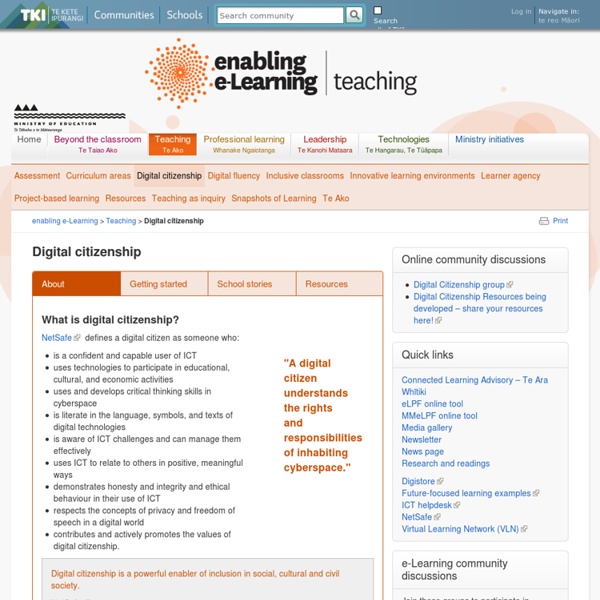
Digital Citizenship in Schools - Netsafe: Supporting New Zealand internet users There has never been a greater need for schools to take a proactive approach towards a whole school community promotion of digital citizenship, including online safety and wellbeing, than there is now. This is why Netsafe has created its revised position on digital citizenship in education in its new white paper From literacy to fluency to citizenship: Digital Citizenship in Education. Summary Digital citizenship is a powerful enabler of inclusion in social, cultural and civil society. It is time to seek a definitive statement for digital citizenship and its relationship to ‘digital literacy’ and ‘digital fluency’. This paper is Netsafe’s initial contribution to achieving this aim. Netsafe asserts that digital citizenship combines the confident, fluent use and combination of three key elements: and then critically: Six underpinning principles for digital citizenship Netsafe advocates for the following six principles to underpin approaches to the development of digital citizenship:
21st Century Fluencies The Essential Fluencies The Essential Fluencies of innovative learning are structured processes for developing the skills that your students need to succeed, today and in the future. Get Started Now “The Essential Fluencies have nothing to do with hardware—they are about headware, and heartware!” Solution Fluency Develop problem-solving superpowers Learn More Information Fluency Learn Sherlock-style data skills Learn More Creativity Fluency Unleash your inner Picasso Learn More Media Fluency Be the next Spielberg Learn More Collaboration Fluency Bring together unstoppable teams Learn More Global Digital Citizenship Be global, and be great Learn More Discover Wabisabi, a whole new way to love the school day. Get Started for Free Pin It on Pinterest 236 Shares Share This
Scope & Sequence: Common Sense K-12 Digital Citizenship Curriculum Get Trained Use our professional development resources to learn best practices for teaching digital citizenship to your students. Onboard Students: Digital Passport Introduce students in grades 3-5 to Digital Passport, our award-winning suite of games that help onboard students to the foundational skills of digital citizenship and Internet safety. Teach Lessons: Unit 1 Teach Lessons: Unit 2 5 - Picture Perfect How can photos be changed on the computer, and how can that affect your feelings about the way you look? Teach Lessons: Unit 3 Extend Learning: Digital Bytes Challenge teens to take a real-world look at digital citizenship through student-directed, media-rich activities in Digital Bytes. Give Assessment Assess your students’ learning of lesson objectives and gauge their understanding and attitudes through interactive unit-level assessments. Engage Families Invite parents into the conversation with our Connecting Families program and resources.
How do you deal with cyber-bullying in schools? – EDTECH 4 BEGINNERS Recently, I have noticed that cases of cyber-bullying are being reported more and more often in the news. As social media and technology is already a central part of children’s lives, online safety is an incredibly important issue to tackle. What is cyberbullying? Cyberbullying is defined as, “the act of harassing someone online by sending or posting mean messages, usually anonymously.” How does it affect schools? Studies have found that the problem of cyberbullying in schools is on the increase (DFE, 2015). I have made a graphic to help you spot the main forms of online bullying in schools: How can schools tackle the problem? Watch my video for 10 tips to prevent or deal with cyber-bullying: Educate pupils: ensure e-safety and cyber-bullying is part of the school curriculum in every age group.Introduce an e-safety and cyber-bullying policy. Have you had incidences of cyber-bullying in your school? Like this: Like Loading...
L’educazione alla cittadinanza in Europa – Eurydice Italia Nel 2013, Anno europeo dei cittadini, non poteva mancare una pubblicazione dedicata alla cittadinanza; la rete Eurydice ha infatti predisposto già nel 2012 un rapporto dedicato a tale tematica. L’Unità italiana di Eurydice ha ‘ospitato’ la traduzione italiana di tale rapporto nell’ultimo numero della serie I Quaderni di Eurydice per contribuire alla diffusione delle politiche e delle pratiche educative europee nell’area dell’educazione alla cittadinanza. In particolare, i cinque capitoli della pubblicazione sono dedicati ad aspetti quali, ad esempio, la presenza dell’educazione alla cittadinanza nei curricoli europei, la partecipazione alla governance della scuola da parte di studenti e genitori, il coinvolgimento degli studenti nella vita civica, la valutazione dell’offerta di educazione alla cittadinanza e dei risultati degli studenti, la preparazione e il supporto offerto a insegnanti e capi di istituto in tale disciplina.
Common Sense Digital Citizenship: Certified Educator "I'm inspired to teach digital citizenship and become a Common Sense Digital Citizenship Certified Educator because I see the excitement, engagement, and passion from my students when using technology in a way that is safe and enhances their individual learning experiences." Nicole Swick, Common Sense Certified Educator, CICS West Belden Charter School, Ill. Being a Common Sense Certified Educator is an official stamp of recognition from Common Sense. If you give permission, Common Sense Education also will list your name and school on our website. Last, but not least, you'll have the satisfaction of knowing that you've helped your students develop essential skills to learn and thrive in the 21st century.
Digital Citizenship Poster for Elementary Classrooms Turn wired students into great digital citizens Get all the tools you need with Common Sense Education's FREE Digital Literacy and Citizenship Curriculum and Connecting Families Program. The relevant, ready-to-use instruction helps you guide students to make safe, smart, and ethical decisions in the digital world where they live, study, and play. Download a printable PDF of this poster (en español)Order a larger print through CafePress Curriculum See our full Scope & Sequence. Poster for upper grades also available!
SIMONE ALIPRANDI BLOG: Il Diritto d'autore sui contenuti didattici: incontro divulgativo a Brindisi Dopo l'evento sugli open data di sabato 4 marzo, venerdì 10 marzo sarò nuovamente a Francavilla Fontana (BR) per un incontro divulgativo intitolato "Il Diritto d'autore sui contenuti didattici" e aperto alla cittadinanza. L'appuntamento è per le ore 14.30 presso l'Aula Magna del Liceo Classico "V. Lilla" in Viale Lilla 21 a Francavilla Fontana. [EDIT] Condivido qui le slides utilizzate per il seminario 8 digital life skills all children need – and a plan for teaching them A generation ago, IT and digital media were niche skills. Today, they are a core competency necessary to succeed in most careers. That’s why digital skills are an essential part of a comprehensive education framework. Without a national digital education programme, command of and access to technology will be distributed unevenly, exacerbating inequality and hindering socio-economic mobility. What’s your DQ? The challenge for educators is to move beyond thinking of IT as a tool, or “IT-enabled education platforms”. Like IQ or EQ – which we use to measure someone’s general and emotional intelligence – an individual’s facility and command of digital media is a competence that can be measured. DQ can broadly be broken down into three levels: Level 1: Digital citizenship The ability to use digital technology and media in safe, responsible and effective ways Level 2: Digital creativity Level 3: Digital entrepreneurship Why are we neglecting digital citizenship? There is no need to wait. Share
The Power of Educational Innovation: A Design Thinking approach to Digital Citizenship Design Thinking is a problem solving methodology used by people all over the world to come up with new ideas. Recently there has been a lot of discussion about how to integrate this approach into education. This summer I took two Online courses to learn more about the process. I am very interested in ways to use this approach in my own teaching. This fall I decided to apply this approach to my 7th grade Digital Citizenship unit which focuses on cyberbullying. Here is my lesson plan. Cyberbullying Design Thinking Activity (for 7th graders) Empathize Present the idea “How might we end Cyberbullying?” Define: Students share with the class what they learned about cyberbullying from their research. Ideate: Each group on chart paper brainstorms 100 ideas for solutions in 15 minutes.Post chart paper and all students look at all solutions.Each student has 5 post it notes and votes on the top 5 ideas they see (different color for each group).Groups pick one idea to work on. Prototype: Test:
Safer Internet Centre - Italia - Generazioni Connesse Come educare cittadini digitali: necessario un framework nazionale Che l’implementazione del digitale nei contesti educativi viaggi ad una diversa velocità rispetto alle capacità e agli strumenti che la scuola ha a disposizione per farsi istituzionalmente carico di una seria e sistematica educazione alle competenze digitali, è questione non di poco conto. La scuola sa bene che, al di là delle categorie in cui sono stati variamente ascritti i propri utenti – nativi digitali, net generation, generazione app, ecc. – bambini e adolescenti si muovono con sufficiente destrezza tecnica tra i numerosi dispositivi, ma non certo con competenza. Ne sono testimonianza i molti episodi con cui la scuola si scontra sempre più spesso, atti di piccola o grande pirateria informatica, uso scorretto dei canali di comunicazione, flaming e cyberbulling nei social. Sappiamo che il tema delle competenze di cittadinanza digitale è previsto tra le azioni imminenti del PNSD e si prova in questa sede a formulare alcune proposte operative: